Wounded Warriors of WWII

On Memorial Day we honor those who sacrificed for their country. I have always been proud that my father worked to rehabilitate the wounded warriors during WWII as part of a new program, introduced in 1943. This program utilized athletes and coaches from across the country.scan0011

My father played baseball and basketball in high school, helped coach the local teams and played semi-pro baseball before the war started. Wiseman VioletsHe considered himself fortunate to be selected as part of this rehab program. His letters to my mother reflect his sense of honor at being among the many talented athletes.Ream General Hospital Baseball Team

While going through some old papers that my mother carefully packed away in a small wooden chest, I came across a newspaper article dated October 13, 1943, she clipped from the Rockford, Illinois, newspaper. This article, by Pvt. Howard Martin, explains the rehabilitation program better than I could, so I have transcribed it here. I hope you find it as interesting as I have.

TRAIN PICKED GROUP TO REHABILITATE WOUNDED

by PVT. HOWARD MARTIN

One hundred nineteen picked men, combed from the nine service commands, are hard at work at Camp Grant under a new physical education rehabilitation program designed by the surgeon general to recondition convalescents in hospitals in the United States and in combat zones. The school, now functioning under the direction of Capt. Everett C. Hogan at Company D of the 32nd battalion, is the first established by the army.

All soldiers selected for the eight-week course were former athletes, college and high school coaches and experts in teaching physical education in civilian life. The men, prominent in baseball, football and basketball, have plunged into their new duties and with a zest that is the marvel of Lt. Karl Gertenhouse, appointed by Capt. Hogan to be in charge of the detachment for classes and duties. His assistant is Lt. John Fitzgerald.

Upon reporting to Camp Grant the prospective phys-eds received a 10-day refresher course reviewing group exercises and physical education conditioning subjects as prescribed by the surgeon general. Maj. C. H. Barton, of the surgeon general’s office, conducted this class and the men then moved to Company D to begin learning their  new duties under the physical education rehabilitation program.

Four Point Program

As outlined by Lt. Gertenhouse, the rehabilitation program is divided into four groups:

1 – Getting convalescent soldiers back to duty with mass drills and competitive sports designed to restore the will to win.

2 – Ambulatory cases who have been on their feet for some time will be given body building and breathing exercises and such games as softball, medicine ball, volley ball and tumbling.

3 – Ambulatory cases still requiring treatment will be led in moderate arm and shoulder exercises and participate in light games.

4 – Bedridden patients will receive special exercises designed to strengthen uninjured parts of the body.

Under the rehabilitation program the instructors must be able to lead classes, give correct demonstrations and determine which type of reconditioning fits the convalescent soldier.

Puts In A Strenuous Day

The phys-ed trainees – many are non-commissioned officers – have a busy day that begins with calisthenics at 7:30 a.m. From 8 to 9 there is close order drill with each man learning to give commands. This is followed by a period of college anatomy and physiology. Special service duties and hospital management are studied for the next hour and at 11 there is more drill and tests in ensuing commands.

Afternoons are devoted to hikes of 7 to 12 miles twice a week, four hours on the obstacle course once a week and two to four hours in the commando gymnasium learning judo, tumbling and physical exercises. And when there is time, the group engages in competitive games.

The physical part of the program is directed by Master Sgt. Melvin L’Dell, who teaches jiu jitsu and commando  fighting, and Staff Sgt. J. P. Leverett, commando group exercise instructor, who makes things look easy in his demonstrations, which, when put into practice by his willing pupils, cause involuntary groans and creaking of bones and muscles.

Among the better known athletes receiving instruction under the phys-ed rehabilitation program are Euel Moore, who pitched for the New York Giants in 1935; Heinie Mueller, late of the Philadelphia Phils; Carvel Rowell, star of the Boston Braves and Milt Trost, the former Marquette University and Chicago Bear football tackle.

Others in Class

Other coaches and athletes attending the rehabilitation school are: Nick Jackimchuck, who played baseball with Indianapolis in 1942; Burt Van Buren, who coached Dunellen high school to the New Jersey state high school basketball title last winter; Allen Burns, former Kansas State basketball star and later coach at Fredonia, Kas., high school, which won state prep basketball title; Jack White, Haskell Institute athlete, basketball and football player at Redlands college and coach at Bacone junior college in Muskogee, Okla.; Jimmy Dunn, professional squash racquets and court tennis player from Philadelphia; Quinten Laabs, football half back from New Mexico A. and M.; William H. Lutz, track coach at Centralia, Ill., where Dwight Eddleman learned the form that enabled him to jump 6 feet 7 1/4 inches as a high school boy; Howard Wright, basketball captain at Purdue University in 1927; Tom Hamill, who pitched for Montreal of the International league last year; Clair Bates, first Baseman with Oklahoma City and Shreveport of the Texas league; Russell St. Pierre, baseball property of the St. Louis Cardinals; Louis Romano, basketball start at Glenville college (W. Va.) and with Aberdeen Proving Grounds quint; and Frank McElyea, outfielder and first baseman with the Boston Braves last year.

I listed all the names in case someone is searching for information about their family member’s service during WWII. Many of the support groups get little recognition. I have found very little information in my internet searches for more information about the phys-ed rehabilitation program, so I am sharing what information I have.

Behind the Barbed Wire – American Airmen POW’s

When many of us think of American airmen held as prisoners by the Germans during World War II, we see images from the movie “The Great Escape” or the TV comedy series “Hogan’s Heroes.” Unfortunately, the truth about their imprisonment was no adventure and certainly no comedy. The real stories, as told by the men who lived through the experience, are fascinating. Their survival nothing short of miraculous.

American bomber crews and fighter pilots flew thousands of missions over German occupied Europe from 1942 to 1945. Many were shot down and most of the survivors became prisoners of war.

Just imagine – Airmen in a bomber raid flew at 20,000 feet or higher, endured sub-zero conditions in un-pressurized planes, survived terrifying fighter attacks and the helplessness of flying through flack to get to their targets. Youth, optimism and sheer determination kept them going. When their plane sustained damage, the decision to bail out came as a shock to many. Everyone knew it was possible, something they’d been briefed on before every flight, yet these brave, young men didn’t believe it would ever happen to them.

Some of them jumped into a sky filled with airplanes, bullets flying, debris from exploding planes, and artillery shells(flack)  exploding around them. Others chose between a crash landing or a parachute ride. When they floated to the ground in hostile territory, they landed in fields, in trees, in water, or in the very towns they had been bombing. Sometimes angry civilians greeted them, ready to kill them on the spot if the German military did not intervene.

The crews became separated once they bailed out and many did not see fellow crew members or know what happened to them until the war was over. If a downed airman landed in an occupied country, such as France, Holland, Belgium, Poland, or even Italy, local partisans or resistance fighters sometimes hid them and helped them evade capture. But with or without help, the Germans captured most of the downed airmen.

Until a prisoner was reported to the International Red Cross, he remained vulnerable to the whims of his captors. Once in the hands of the German military, downed airmen were transported to a Stalag Duft or interrogation center. Intelligence officers attempted to glean information from prisoners by keeping them in solitary cells and questioning them for hours at a time.

In German-held territory the different branches of the military ran POW camps. So, the Luftwaffe (German Air Force), the German Navy, and the Wehrmacht (German Army), operated separate camps. They generally complied with the requirements of the Geneva Convention for treatment of prisoners of war. The food was the main complaint. If it hadn’t been for the Red Cross packages shipped in through Switzerland, many prisoners would have starved.

Probably the most famous German POW camp was Stalag Luft III. At this camp near what is now Sagan, Poland, British and American airmen staged the most daring escape attempt of the war. Known as “The Great Escape,” the popular 1963 movie and many books recount the story. Today there are several websites dedicated to Stalag Luft III and the Great Escape. Some websites have posted interviews with former POW’s or personal accounts written by former POW’s. These websites are a tribute to the prisoners, those who survived and those who didn’t.

An often forgotten portion of the story of Stalag Luft III is the evacuation of the camp in January 1945 to prevent the Russians from taking it. As a blizzard approached, orders came to assemble and be ready to march. The men took what they could carry and wore whatever clothes they had. Over ten thousand prisoners and their German guards trudged in the freezing cold along snow-covered roads through the night and for days to come with no idea where they were going. Sub-zero temperatures, inadequate winter clothing and boots, and lack of food took their toll. Along the way the prisoners were allowed to rest in various shelters – churches, barns, a jail building and a tile factory. Finally reaching a marshalling yard, the Germans packed the prisoners into boxcars and transported them to overcrowded POW camps in Nuremberg and Moosburg, Germany. Many prisoners did not survive the horrific journey.

The Germans moved prisoners from Stalag Luft III and other POW camps to consolidate them in the face of Allied advances and in hopes of using them as bargaining chips in surrender negotiations. But negotiations never took place and Allied forces continued their advance. In late April, 1945, the camps were finally liberated by American troops.

Read more about the POW camps and the experiences of the prisoners on these websites:

http://www.b24.net/pow/stalag3.htm

http://www.merkki.com/

http://www.pbs.org/wnet/berga/beyond/system.html

http://www.303rdbga.com/pow-camps.html#dulagluft

http://www.loc.gov/vets/stories/pow-germany.html

Old Deeds and Genealogy

Was my great-grandmother a real estate mogul? Not likely. But she did buy and sell real estate at a time when women were supposed to stay home, keep house and raise children. We’ve found her name on several deeds, from 1892 to 1914, some in prime locations in the downtown district of the thriving community. She passed on her real estate savvy to her son, my grandfather, who invested in several land parcels. Disposing of his real estate sent me on a search where I found more than deeds.

Great-grandmother Boone & Aunt Lura

Old deeds can provide another tool for genealogical research. Although they are not likely to be available on the internet, if you are willing to search through courthouse records, they can provide a valuable resource in learning about your ancestors. Which is what I have done, not for the sole purpose of genealogy, but for the purpose of settling an old estate.

It might seem incredible to some but my grandfather’s estate, at least the real estate portion of it, has never been settled. Not so bad you say, except he died in 1921. Yes, that’s ninety-one years ago. He left a widow and nine children, including my four-year-old mother. All the children are gone now, so it is up to the grandchildren to settle his estate. With so many heirs, the property must be sold and the proceeds divided up. After the lawyers take their share, no one will get much, but my hope is to get it settled before the hundred-year mark.

Before selling real estate you must have the deed. The task of locating these documents has proved to be difficult. Although my family paid the real estate taxes all these many years, when the lawyers searched for the deeds they couldn’t find them all. Or rather, they couldn’t match the deeds they found with the property. So my dear brother and his wife went to the courthouse and scanned every deed they could find that might be related to our family. Scanning them was an enormous task. Reading them and making sense of them proved to be something entirely different.

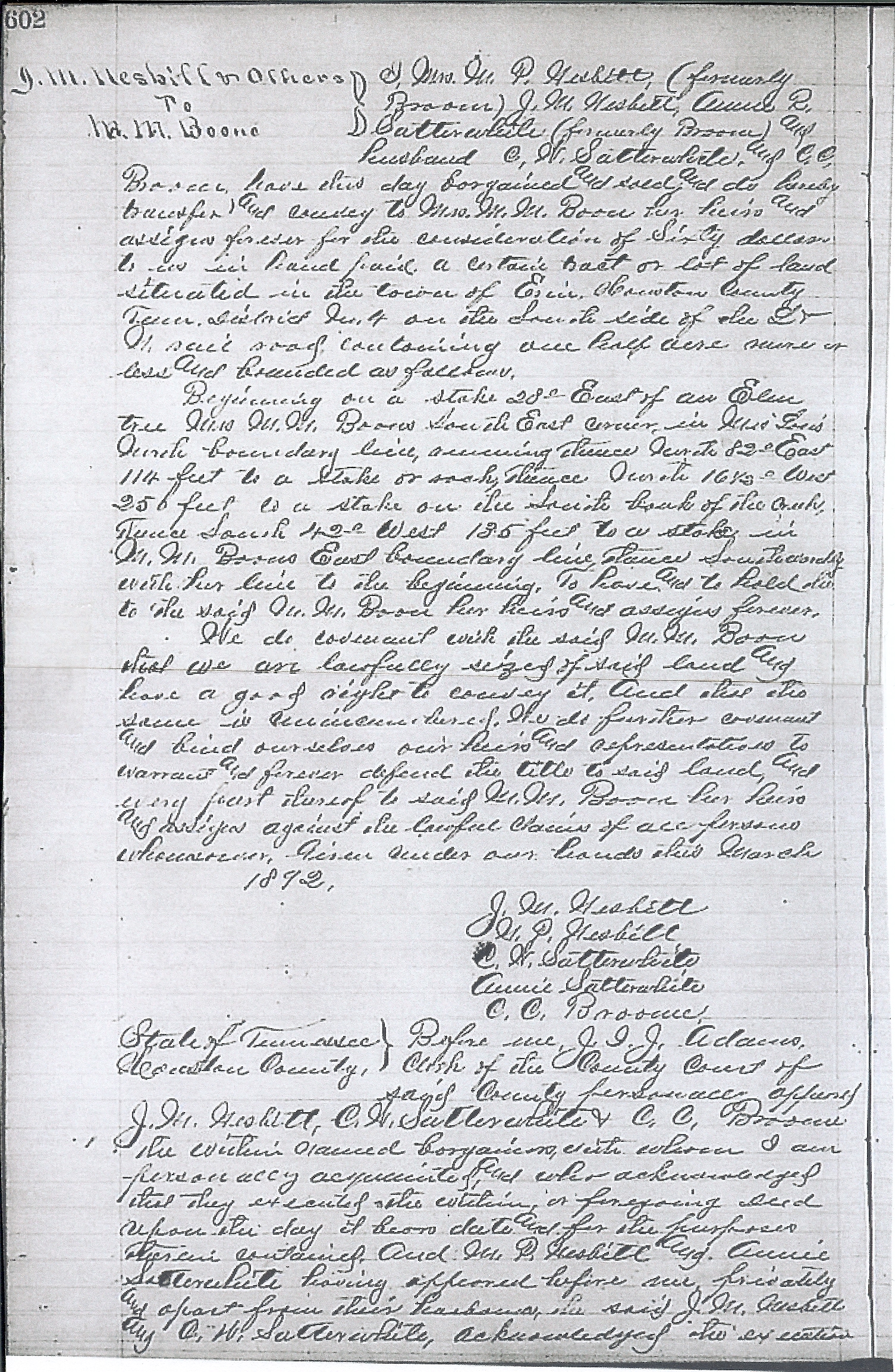
Have you ever read a hand written deed from before 1900? If not, it is an experience you should try at least once – if you have the patience. Needless to say, I volunteered for the job.  I had deciphered some old deeds from the 1800’s passed down in my husband’s family so I didn’t go into it entirely blind. I’ve also spent time on Ancestry.com reading census records and other handwritten documents. So I used those experiences as a guide. I knew the people involved, at least I knew their names from our genealogical records. Finally, I knew the location of the property. I grew up in the small town and my mother made a point of showing us the property when we were younger.

The deeds I looked at were dated as early as 1871 and as late as the 1950’s. The ones prior to the 1920’s were hand-written. The old descriptions might refer to an “oak tree” or a “tree stump” that is long gone and usually list adjoining property owners who years ago sold their land. The people involved are no longer living. Roads have been moved or widened or re-named or no longer exist. So it has been quite a challenge.

The silver-lining to all this work has been the insight I gained about my Great-grandmother Boone. My mother and grandmother rarely spoke of the woman although she lived near them and was obviously a part of their lives. I got the impression from my grandmother that Great-grandmother Boone was the stereo-typical mother-in-law, always critical. Perhaps that came from her own difficult life.

At age 23 she was left a widow with two small children. Both her husband and father-in-law died during a cholera epidemic in 1873. I don’t know how she survived in the ensuing years. I do know that over time she became a business woman. She managed to send her son to Edgewood Academy,  a prominent boarding school in the area. And she invested in real estate.

By 1900, census records tell us she owned her home, free of mortgage, and she took in boarders. Both the 1910 and 1920 censuses show that she ran a hotel, which she rented, and she had employees. According to family lore, she and her daughter ran the hotel for the railroad. It sat facing the railroad tracks across the street from the train station. She purchased a lot on Market Street (the main drag) in 1914 which became the location of the Central Hotel when the building was moved in 1921.

In the early 20th century, Erin was a thriving railroad town where twenty or more trains came through each day because it was the shortest route from Nashville to Memphis. The high ridge west of town meant each west-bound locomotive needed the help of a hill engine to get it to the top of the hill. The train would stop in Erin so that the additional engine could be hooked up. A turn-around track enabled the hill engine to reverse directions both in town and atop the ridge.  Over time the railroad decided that a longer route was more economical than utilizing the hill engine so traffic declined. But during the railroad’s heyday, my great-grandmother’s hotel would have been a thriving business.

When her daughter-in-law died in 1911 leaving six small children, my great-grandmother refused to raise her son’s children. She was 61 and running her own business. My other, and younger, great-grandmother and great-grandfather moved in with my grandfather and took over the day-to-day responsibilities of running the household and caring for the children. Comments in later years from one of my aunts conveyed my grandfather’s disappointment in his mother. Family resentment carried down through the generations.

As a career woman and grandmother myself, I have some understanding of my great-grandmother’s viewpoint. She had raised her children to adulthood alone. She had moved on to become a business woman active in her church and community. At her age taking on the responsibility of caring for a baby, a toddler, pre-schoolers and school children must have seemed an insurmountable task and a drastic change to her lifestyle. So I can sympathize with her decision. She didn’t abandon the family. She was nearby to provide support and guidance. As the children grew older she let them work at the hotel, she set a high standard for her grandchildren’s behavior, and, I’m sure, she contributed financially to their support.

Yes, my great-grandmother Boone was a strong, independent woman well ahead of her time. And I’m pleased to have learned more about her and her many real estate transactions.

The First Women in the Military

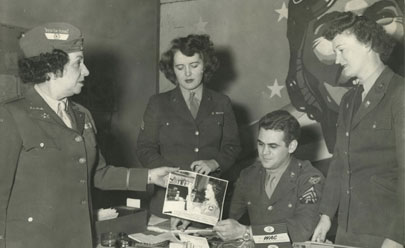
Today most of us know women who have served in the military and many who served overseas in combat. But how many of us know about the first women in the military? And how many know what our mothers and grandmothers did during WWII? Did they serve in the military? Red Cross? Defense industry? During World War II women’s lives changed. The vital role they played, both as civilians and in the military, impacted the outcome of the war and changed how American women viewed themselves.

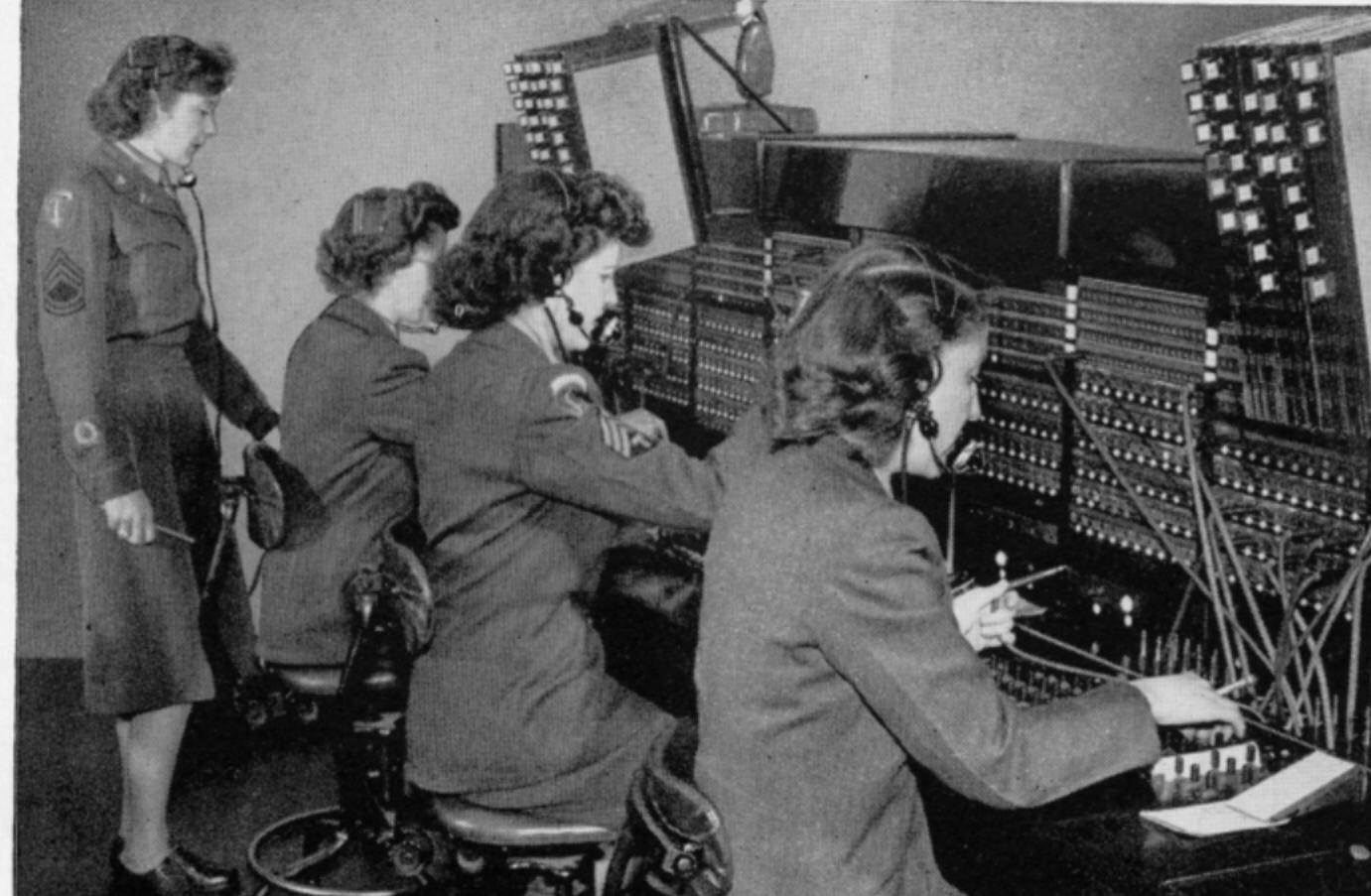
Women filled the void left by men who either joined or were drafted into the military after Pearl Harbor. Factories converted to wartime production needed workers so, out of necessity, they hired women. Jobs formerly reserved for men opened up for women. Females worked in factories, hospitals, offices, and farms. And some of them joined the military. Of course, it took an act of Congress to allow women into the armed services, but with strong enemies across the Atlantic and Pacific the U. S. needed to utilize all its resources.

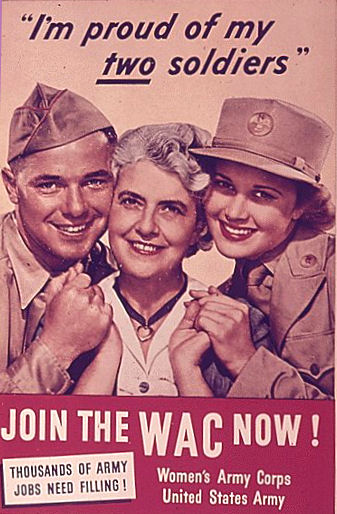
Before 1942 women who supported the military worked as civilians, except for Army Nurses. With Congressional authorization the Navy established the WAVES (Women Accepted for Voluntary Emergency Services) and the Coast Guard SPARS (Semper Paratus – Always Ready) as part of the Department of the Navy. The Army chose to create two “auxiliary” units, the Womens Auxiliary Army Corps (WAAC) and the Womens Airforce Service Pilots (WASP).  These women’s auxiliaries had separate command structures, they were paid less than men, and they had no military benefits like life insurance or veterans medical benefits.  With WAAC’s being sent overseas, the Army recognized the problems and in 1943 the Women’s Army Corps was authorized as an official part of the Regular Army. But the WASP never gained the same status and it was disbanded in December, 1944. Authorization for women in the WAC, WAVES, and SPARS only lasted for the “duration plus six months.” At that time these women’s’ military organizations ceased to exist.

After much political discussion the WAC was reinstated in 1947. Many today may not realize that women remained segregated from the regular Army until 1978. Yes, it was post Vietnam when the separate Women’s Army Corps was abolished and women were integrated into the regular Army.

In the 1940’s many across America opposed women serving in the military. Back then most believed that a woman’s place was in the home. Culturally it was difficult for both men and women to accept. Many female enlistees were accused of being immoral or gay. Some men refused to let their wives, girl friends, daughters or sisters join up. But other families supported and encouraged their young women to do their patriotic duty.

First Lady Eleanor Roosevelt threw her support behind the women who volunteered to serve. The media used advertising to promote images of  women in uniform and Hollywood made movies depicting beautiful starlets serving in the various branches of the armed forces. Thousands of women answered the call.

What was it like for those first female soldiers? Seeing women in uniform was a new experience for everyone. Young ladies donned newly designed, skirted uniforms, little green sear-sucker fatigue dresses for their rigorous physical training and twill jumpsuits or coveralls for heavier work. Girls left home for the first time and found themselves  living in open barracks with no privacy, not even in the shower. They learned to march in step, keeping the seams of their heavy cotton stockings straight. Long hikes carrying heavy packs toughened the most feminine. Failing inspections drew the dreaded gigs and led to extra hours of KP (Kitchen Police) duty. In basic training male instructors taught them military regulations and procedures until enough women were trained and available to take over. Many specialized training courses took place on college campuses where the military  commandeered both space and teachers. Others trained alongside the men. Unlike modern female soldiers, the WAC’s of WWII were considered non-combatants so they were not trained to shoot or handle weapons.

In researching my latest work-in-progress I read some memoirs that give  fascinating, first- hand accounts of WAC’s wartime experiences. “Call of Duty, A Montana Girl in World War II” by Grace Porter Miller, “Mollie’s War” by Mollie Weinstein Schaffer, and “One Woman’s War, Letters Home from the Women’s Army Corp 1944-1946” by Anne Bosanko Green give three diverse accounts of Army life during the war.

And to answer my other question, my mother did clerical work as a civilian at several military bases as she followed my father from one post to another. My dad and two of his three brothers served in the Army, while the third worked in a defense plant. My mother’s sisters also worked in defense plants. So no WAC’s or WAVES in my immediate family. But my sister’s mother-in-law served in the WAC’s. The woman was quite a character and I wish I had had the opportunity to talk to her about her military service and her experiences during World War II before she died.  The “Greatest Generation,” both men and women, are quickly dying off and they take with them the stories of their service to their country so many years ago.

Today’s female soldiers, as well as all American women who work outside the home, benefit from what these brave women did during World War II. They stepped up and proved that they were capable of doing almost any job. I believe that the women’s movement had its origins in the mothers who, after the war, told their daughters they could do any thing they wanted to do. The women of the Greatest Generation believed it because of what they did in helping to win the war.

B-17 or B-24?

During WWII, the two bombers that carried the load in European air war for the Americans were the B-17 Flying Fortress and the B-24 Liberator. In my latest work-in-progress I am trying to decide which airplane my hero/navigator would have flown.  My first thought was to use the B-17 since it seemed more glamorous, but with more research about both planes, I found that the Liberator was quite a plane, too. After all, Jimmy Stewart flew the B-24. How’s that for glamor?

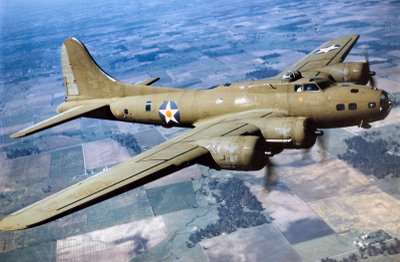
Boeing B-17 Flying Fortress
Almost everyone has heard of the iconic B-17. When we think of bombers of that era, images come to mind of planes shot full  of holes, with sections blown off and engines not functioning, yet landing safely on air fields in England. Those images are usually of B-17’s. Its crews loved the Flying Fortress because it took lots of damage and still brought them home.

Memphis Belle

Anyone remember the Memphis Belle? It was the first bomber that finished the required 25 missions in 1943. (Mission requirements were increased to 30 and then to 35 in 1944)  Major William Wyler, the famous director and movie maker, as part of the First Motion Picture Unit of the US Army Air Forces, directed a film depicting the final flight of the Memphis Belle. The footage became the documentary “The Memphis Belle: A Story of a Flying Fortress.”  As a morale booster for the Army and the folks back home, the crew, the plane and the movie toured the US selling war bonds and recruiting flyers for the Army Air Force. In 1990, Hollywood made a movie about that last flight, “The Memphis Belle.” Both films depict the lives of bomber crews in WWII and are well worth seeing.

Consolidated B-24 Liberator
But what about the B-24 Liberator? In researching accounts of WWII  bomber crew members, I discovered that Jimmy Stewart (Yes! the movie star) flew combat missions over Europe in B-24’s. Starr Smith wrote in “Jimmy Stewart Bomber Pilot”about Jimmy enlisting before the war even started. He earned his wings and became an instructor flying B-17’s. Apparently the military feared Stewart would be  harmed if sent overseas, which frustrated Stewart. Finally in 1943 his wish for combat duty came true with his assignment to the 445th Bomber Group, part of the Eighth Air Force.  He quickly learned to fly the B-24 and within months received orders for England. Captain Stewart commanded the 703rd Squadron of the 445th Bomber Group and regularly flew combat missions. Promoted to Major and transferred to the 453rd Bomber Group as Operations Officer, Stewart continued to fly combat missions, including flying on D-Day (June 6, 1944). In July 1944, Lt. Colonel Stewart’s transfer to Second Combat Wing Headquarters severely limited his combat flying.  In his twenty-three months overseas, Stewart flew 20 combat missions over Europe, all in B-24 Liberators.

Jimmy Stewart
Data for a head to head comparison of the B-17 and the B-24 can be found on several websites for anyone who likes statistics.  One interesting difference I found was that the B-17 was slower than the B-24.  The difference in speed meant that the two bombers could not fly in the same formations, although they were often sent on the same missions.  But the B-17 could fly at higher altitudes. There is no doubt that the Flying Fortress crews and the Liberator crews each believed their plane the best and maintained an ongoing, good-natured rivalry.

Some believe that the B-17 got better press during the war and many thought it a better looking plane. It is definitely the one most people associate with WWII.

So, which plane will I use in my book? I haven’t decided. But I’m leaning toward the B-24 because it’s less known and because I have found some good books to use as reference material. Among them are:  “A Reason To Live” by John Harold Robinson who flew as a gunner and engineer on a B-24; “Lucky Penny’s Tail” by Gregory J. Matenkoski recounting the story of Edmund Survilla, a tail gunner on a B-24; and “Jimmy Stewart Bomber Pilot” by Starr Smith.

For additional research, I plan to travel to Savannah, Georgia, to visit the Mighty Eighth Air Force Museum sometime in the near future. This museum should give me additional details and insight into the WWII air war.  Wouldn’t I love to take a ride on one of those old planes? I’m watching for an opportunity.

It’s Not A Tank – M7 Priest

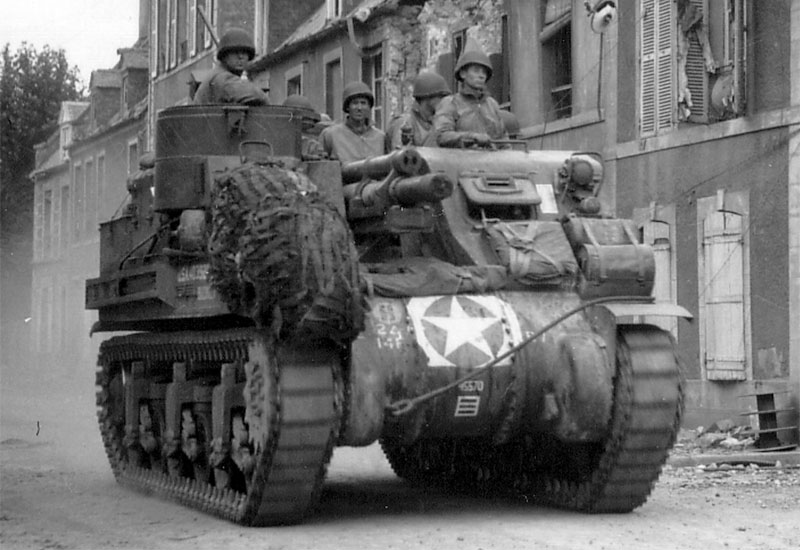
To the average person, this vehicle looks like a tank, but it’s not. It’s an artillery piece. One key difference is the main gun, a 105 mm Howitzer. Compare this to a 75 mm gun on a Sherman tank. Also on the M7 the crew is riding on top of the vehicle in the open unlike a tank crew tucked away safely inside the tank. So the men on the M7 had no armor plating protecting them in combat. But the track gave this gun the mobility to advance alongside tanks and infantry into the thick of battle.

My father-in-law served on an M7 in the 276th Armored Field Artillery Battalion. When his son asked him what he did in WWII, the veteran told him he was on a tank, rather than trying to explain to him about the track-mounted artillery piece.  So as a boy my husband proudly proclaimed to his friends that his father served on a tank with Patton. As he grew older my husband learned more about the war and he continued to ask his father questions. Although reluctant to talk about his WWII experiences, the ex-GI explained that the vehicle he manned was actually an M7 105 mm Self Propelled Gun, also called an M7 Priest. (The British dubbed it “Priest” due to the .50 caliber machine gun mounted in a drum-like ring on the front that resembled a priest’s pulpit.)

The former soldier rarely relayed stories about the war. When he did, he told of experiences during the Battle of the Bulge, Remagen Bridge and the invasion of Germany as part of Patton’s Third Army. GI’s on the front didn’t know the big picture. He said that as long as they were moving, they figured things were going good.

Reading the history of the 276th AFA BN put their role in the war in perspective. I learned that these artillery pieces were assigned to whatever front or division needed their support. So, like other artillery units, the 276th was not included in the combat records of any particular division, which makes research for specific details much more difficult. Fortunately we have a copy of the official account printed immediately after the war and given to each soldier in the unit.

M7 Priest in Michigan

Last summer while visiting relatives in Michigan, my brother-in-law took us to a VFW outside Flint where an M7 Priest is on display. For the first time my husband saw, in person, a gun like his father’s. Having served in an armored unit himself, my husband has been around many tanks, but seeing and touching this vehicle thrilled him. He even climbed up on top in the rain to gain perspective on his Dad’s experience riding atop the powerful gun. That day we both made a connection to his Dad and his experiences during the war, experiences that changed a 19-year-old forever.

Dad’s Gun

If you are interested in the history of action aboard the M7 during the second world war, read “Longneck, A History of the 274th AFA BN” by Jack K. Morrison or “Payoff Artillery – WWII” by Frank H. Armstrong. Both these veterans give fascinating accounts of their service in these unique units.

Research Using USGenNet Sites

Whether researching your family history or a specific area for a novel setting, the USGenNet group of webpages is a great resource.  Quoting from their site at http://www.usgennet.org/ “USGenNet is the first and only nonprofit historical-genealogical web hosting service on the Internet.” Many states, county and local genealogical and/or historical groups have websites using this hosting service. When you go to one of these websites, such as the one for Dickson County, Tennessee, you will find a wealth of information about the area. There are family histories, obituaries, maps, cemetary information, newspapers, pictures, etc. Links to other sites of interest, like state archives, are often provided.

Keep in mind that these are websites maintained by individuals so the exact information posted and how often the information is updated depends on the individuals maintaining the site. Some allow contributors to submit items to be posted on the site. Most rely on volunteers to keep the sites going.

I have spent hours exploring the TNGenWeb site – since Tennessee is my home state. The County Pages offers easy access to every county that has an individual site and offers additional information about each county.  It  includes a clickable map of the counties which is very helpful if you need to research a region but you aren’t sure which counties to search. And if you are looking at a county, like my home county (Houston), which was formed from sections of several different counties, you can dig deeper by going to those original counties. Another map evolves over time with the creation of the counties starting before statehood when Tennessee was a part of North Carolina. It even includes the State of Franklin, the first attempt at adding a new state to the original thirteen states. The State of Franklin is another whole topic for a later day – but a very interesting episode in the history of our country. My adopted home state of Florida‘s site includes lots of information that I have only just begun to explore.

Although I started using these pages for genealogy research, I found some truly fascinating stories. For a historical novelist, the details provide not only story ideas but authentic background, events, dates, and locations.