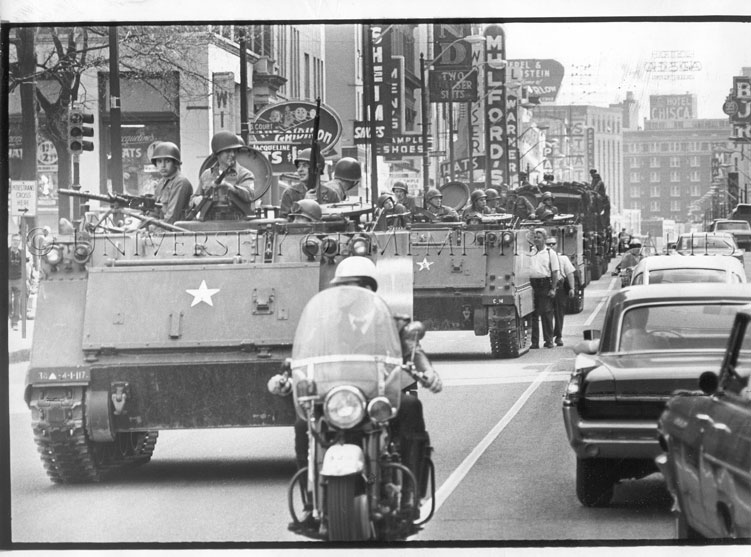
With the news coverage of the National Guard being sent into our cities to assist the police, I remember when my husband served in the Tennessee Army National Guard. In 1968, he was sent to Memphis, twice; once for the sanitation workers strike and a few days later when Rev. Martin Luther King, Jr., was killed. Despite the rioting, looting and fires, none of the demonstrators or rioters were killed. The Tennessee Army National Guard was commended for the way they handled the situation in Memphis.
https://digitalcommons.memphis.edu/speccoll-mss-commercialappeal2/4
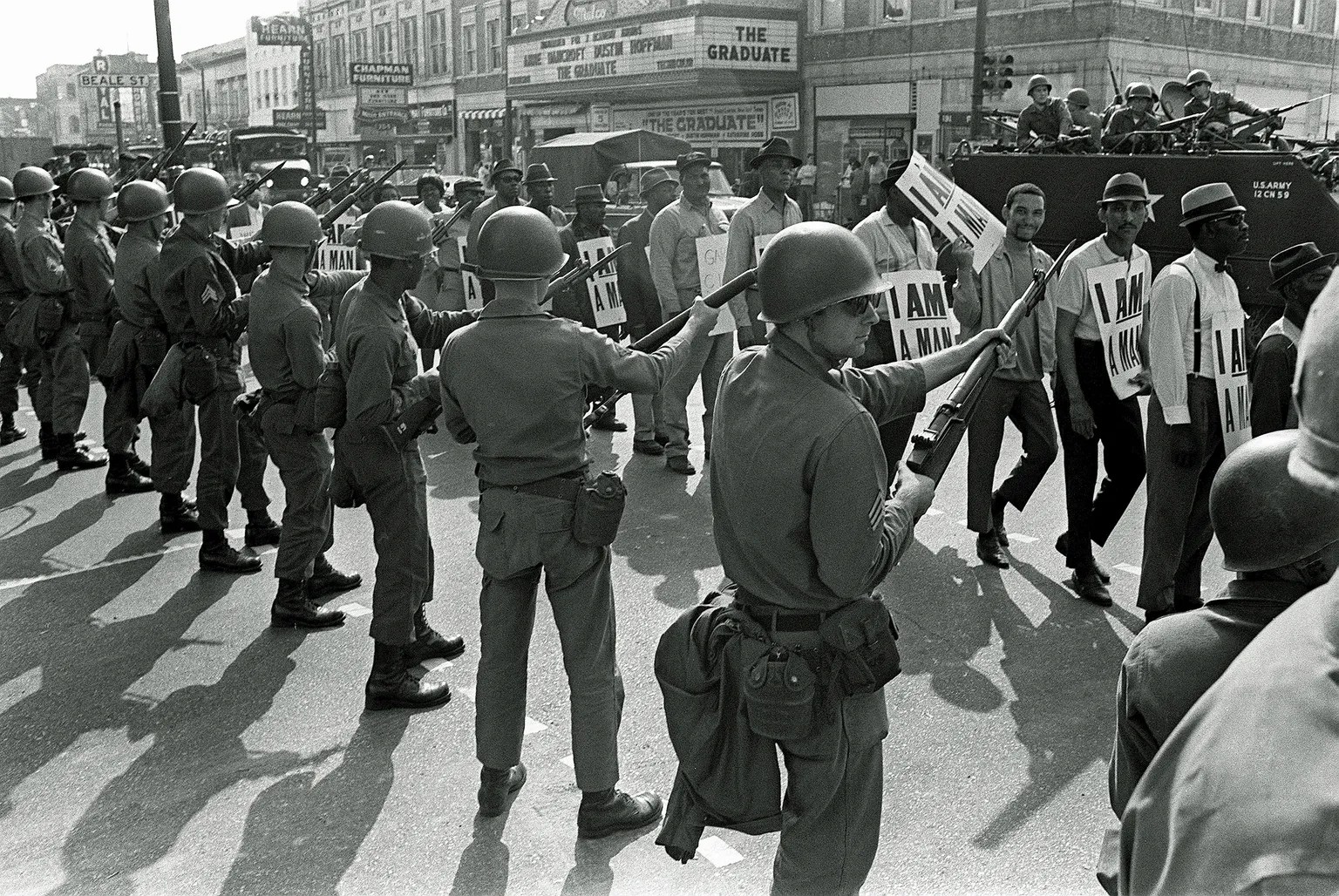
My husband and his brother were included in the National Guard troops sent to Memphis due to a riot that broke out during a march in support of the striking sanitation workers. Rev. Martin Luther King Jr., marched with the striking workers. The Civil Rights Movement was in full swing at that time with lots of marches and demonstrations. Most did not become violent, but this one did. A riot broke out and the local police could not contain it.
Charlie Kelly/AP
Tennessee’s governor ordered the National Guard to Memphis to assist the Memphis police in maintaining law and order. After a few days, the city settled down and the Guard withdrew. My husband came home and went back to work.
On April 4, 1968, Rev. Martin Luther King Jr. was shot and killed in Memphis as he stood on the balcony of the Lorraine Motel.
While ironing my husband’s starched uniforms (they didn’t have the nice, wrinkle-free uniforms back then), I was in front of the TV when the announcement came on that Rev. King had been killed. I knew the Guard would call my husband at work and he would hit the door running as they had only a short time to report. I hurriedly finished the ironing, got our things together for him, our four-month-old baby, and myself. My husband dropped us off at my parents house, which was on the way to the National Guard Armory where he was to report.
Fear and anxiety filled my parents house as we waited for word from my husband and my sister. We watched reports on television of the rioting, the looting and the buildings set on fire, not just in Memphis, but in every city across the country.
At the time, my sister was attending school in Memphis. Her campus and dormitory were close to Beale Street, the center of the rioting. My mother tried to call her, but the phone lines were so jammed that no one could get through. (No cell phones or internet back then.) Not only did I worry about my husband and brother-in-law, I worried about my sister who might be caught up in the violence. It was a number of days before my sister finally got a call through. She was safe at her boy-friend’s (later husband’s) parent’s house in the suburbs. No calls from my husband.
When it was over and my husband returned home, he told us what it was like. I was right to be frightened.
https://digitalcommons.memphis.edu/speccoll-swstrike/127
In some other states where the National Guard was deployed for rioting, they carried rifles but no ammunition. Because the rioters knew they could not fire without being issued ammunition, they were less effective in keeping the peace. In Memphis, the Guard issued live ammunition to every soldier with orders not to load their guns unless specifically ordered to. After being mocked by locals, the men decided to display their ammo on their helmets, so everyone could see it. Although not condoned by their officers, the move made an impression on belligerent locals who threatened to attack them.
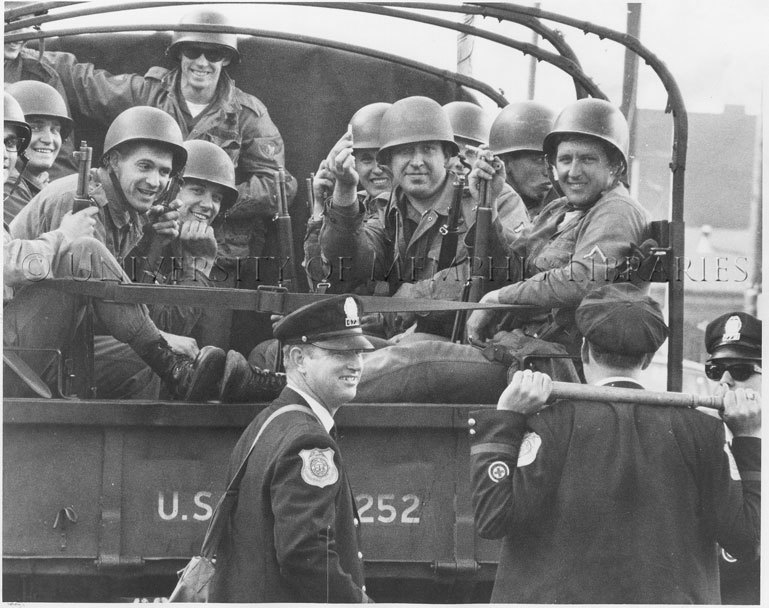
At times my husband’s unit was assigned to accompany Memphis police officers on their calls. This show of force enabled the police to safely do their duty. The guard also patrolled the streets in trucks and jeeps. In the worst areas, they lined the streets to prevent violence.
They also protected fire fighters. One time when a rioter set a building on fire, my husband’s squad accompanied the fire department to the scene. The perpetrators shot at the firemen and the Guardsmen from a nearby building. The National Guard accompanied the police into the apartment building they suspected the shooter was using. They went door to door, kicked in the door and entered the apartment. As police officers know, someone could be standing on the other side of the door with a gun, ready to shoot when the door is kicked open. It’s dangerous work. Yet to the credit of the police officers and the National Guardsmen, no one was killed. The shooter was not found. He probably left the building when the other tenants were evacuated.
As I said, the Guardsmen were called to duty on very short notice. Many didn’t have time to grab personal items like razors, toothbrushes, shampoo, etc. When off duty, they slept in an empty airplane hanger – on concrete floors with only a single, thin, Army blanket. No warm beds, no sleeping bags, no hot showers, nothing. Other times they slept underneath two-and-a-half-ton trucks, which wasn’t much better. Needless to say, after a few days they looked and felt pretty raunchy.
Local merchants were happy to have the National Guard on patrol. My husband said that a doughnut shop gave them the keys and let them have as many free doughnuts as they wanted. Many of the men didn’t have much cash on them. Some had paychecks they needed to cash. A local bank let the armed Guardsmen come inside in small groups and cash their checks. My husband said it felt strange to go in a bank armed with a rifle, but he needed to cash a check. (No ATM’s)
My heart goes out to the two National Guardsmen who were shot in Washington D.C. on Nov. 26, 2025. Sarah Beckstrom died and Andrew Wolfe was critically wounded. I pray for Andrew’s recovery and I pray for their families and loved ones. Just like our military stationed all over the world, the National Guardsmen deserve our support and our prayers for their safety.

 Barbara Whitaker