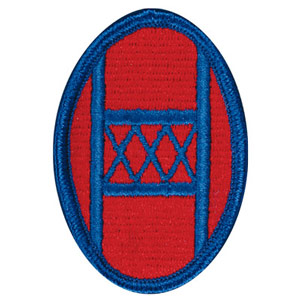
Morris Irving Grayson, 276th Armored Field Artillery

I always love to hear the stories passed down in families about how their parents or grandparents met, fell in love and started a life together during World War II. These stories reflect the realities of the time. The country was at war. Men, from age 18 to 45, either volunteered to serve in the military or they were drafted. Young men and many young women left home either to go into the military or to go to work at a defense plant or to go into some type training, such as nursing. All across the country single men and women met and dated. Couples were separated and those already married struggled to maintain a marriage through separation. Often the wife followed her husband to wherever he was stationed. It was a time of great turmoil in our country. And I find it fascinating.

A member of the extended family of the 276th Armored Field Artillery Battalion shared one of those stories with me. Morris Irving Grayson served in Battery B of the 276th while my father-in-law served in Battery A. Irving’s daughter, Teresa Williams, agreed to let me share her parents’ story on my website as a way to keep the memories of the war alive and to let younger people know what soldiers and their families went through.

In 1941, Irving Grayson and Doris Smiley graduated from Childress High School in Childress, Texas. Although they went to the same school in the same town, they didn’t get to know each other until the next year when Doris noticed Irving at the local open air skating rink. Irving was a skilled skater and loved to show off. The two started dating.
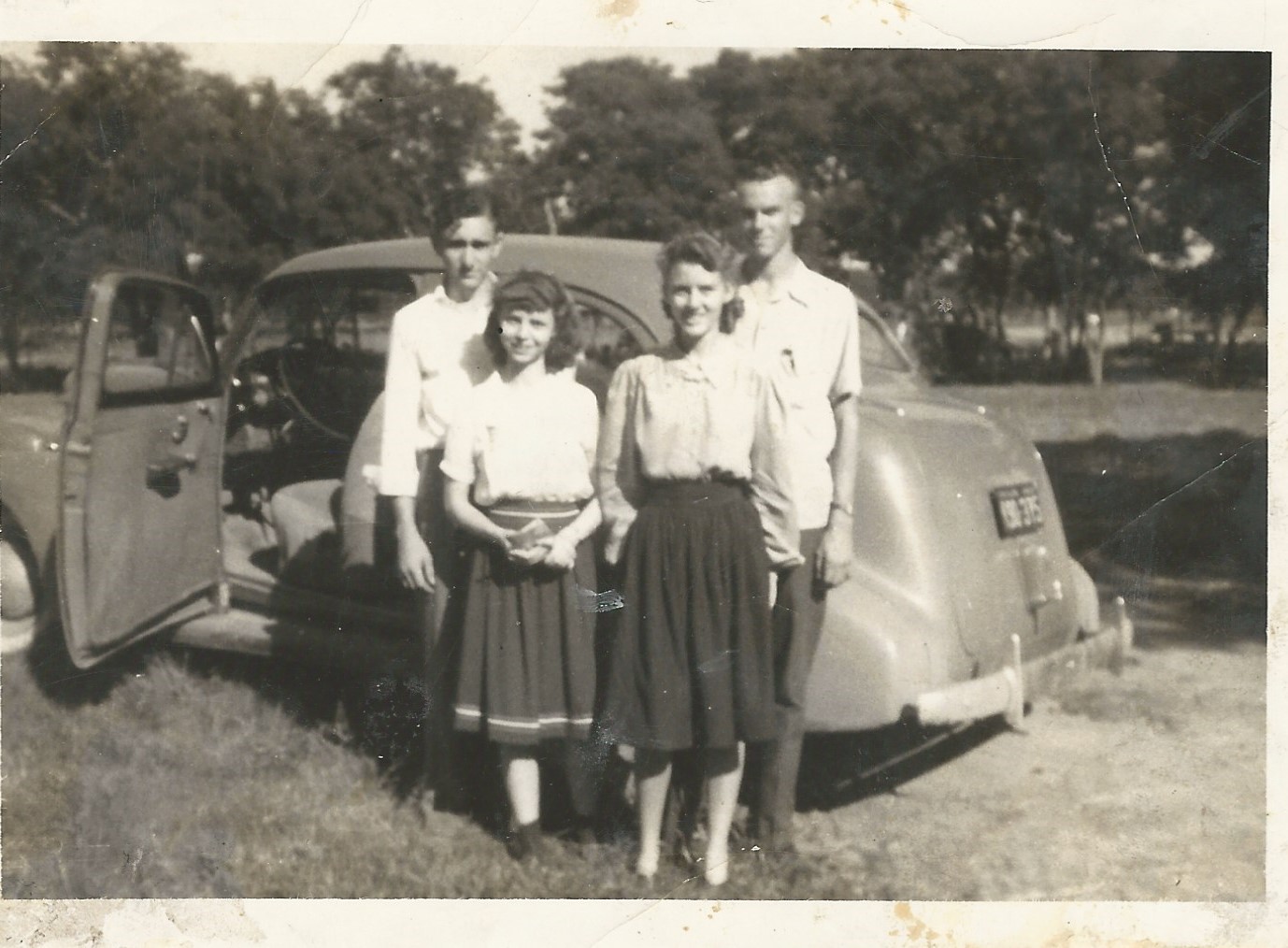
Irving and Doris (on left) on double date

Irving planned to enter the military in 1942 but he had appendicitis. His illness delayed his enlistment until April 27, 1943, when he signed up in Lubbock, Texas.  He went to Fort Sill, Oklahoma, for basic training. Before completion of the course he volunteered to become a paratrooper and was transferred to Camp Tocca, Georgia. At that time it was more prestigious to be a paratrooper and they were paid more than regular soldiers.

While in paratrooper training in Georgia, Irving complained of the extreme heat, the humidity and the miles of daily marches carrying full packs. One night his sergeant came into the barracks and said, “If you don’t want to be here, we don’t want you here, there will be a bus out front tonight. Be on it.”  Irving made sure he was on that bus even though he had no idea where the bus would take him.

The bus took Irving to a train station and the train took him to Camp Phillips, Kansas, where he was assigned to the 276th Armored Field Artillery. The 276th was originally a typical field artillery battalion with tow-behind artillery pieces. Irving began training for the field artillery.

002-2-irving-and-doris-grayson-when-marriedWhile at Camp Phillips, Doris joined Irving bringing along their new baby. Irving and Doris were married in Salina, Kansas, December 2, 1943. Housing was scarce around these new Army training camps. Irving and Doris rented a tiny apartment in what must have been an older apartment building or converted house. Doris later told her family that she found a rat in the baby’s crib one night and after that the baby slept in the bed with her.

At Camp Phillips Irving served as assistant to the supply sergeant. The sergeant left unexpectedly, probably reassigned, so Irving took over his duties. Although doing the sergeant’s job, Irving was not promoted as he thought he should have been. In early 1944 the 276th moved east to Tennessee for extensive maneuvers intended to simulate combat conditions. During these maneuvers, the Army decided to convert the 276th from a field artillery battalion to an “armored” field artillery battalion. They were pulled out of the maneuvers and sent to Camp Campbell, Kentucky, where they trained on the M-7 self-propelled, track-mounted 105 mm howitzer cannon.  These track-mounted guns had proved to be more maneuverable in North Africa and the Army believed they would be able to keep up with the tanks after the Allies invaded Europe.

When Irving went to Tennessee, Doris and the baby went back to Childress. The couple began corresponding by letter. Doris sent him pictures of their son with notes about his progress. Irving came home on leave before he went overseas. Later Doris wrote to tell him she was expecting another child. Their second son was born while Irving was in Europe fighting the Germans. I can only imagine how difficult it was for Doris, with one baby and another on the way and her husband overseas in danger of being killed. She probably wrote cheerful letters with pictures of the babies to keep his spirits up.doris-grayson-with-son-during-war

Adding to the difficulty for this young mother was an especially disturbing letter she received from Irving. It had been intended for an English girl he met during his brief stay in England but the letter got switched with his letter to Doris. When Doris received the wrong letter, she of course assumed the worst, that he was cheating on her, and she did not write him for some time. Irving insisted the he and the English girl were just friends and eventually the trouble was resolved.

While in England, Irving became a jeep driver responsible for carrying messages between the battalion and headquarters. He also scouted for locations to set up the battery headquarters and drove damaged half-tracks and M7’s to the maintenance platoon for repairs. The 276th fought their way across France, Belgium, Luxembourg, and Germany from September, 1944, until the German surrender on May 8, 1945.

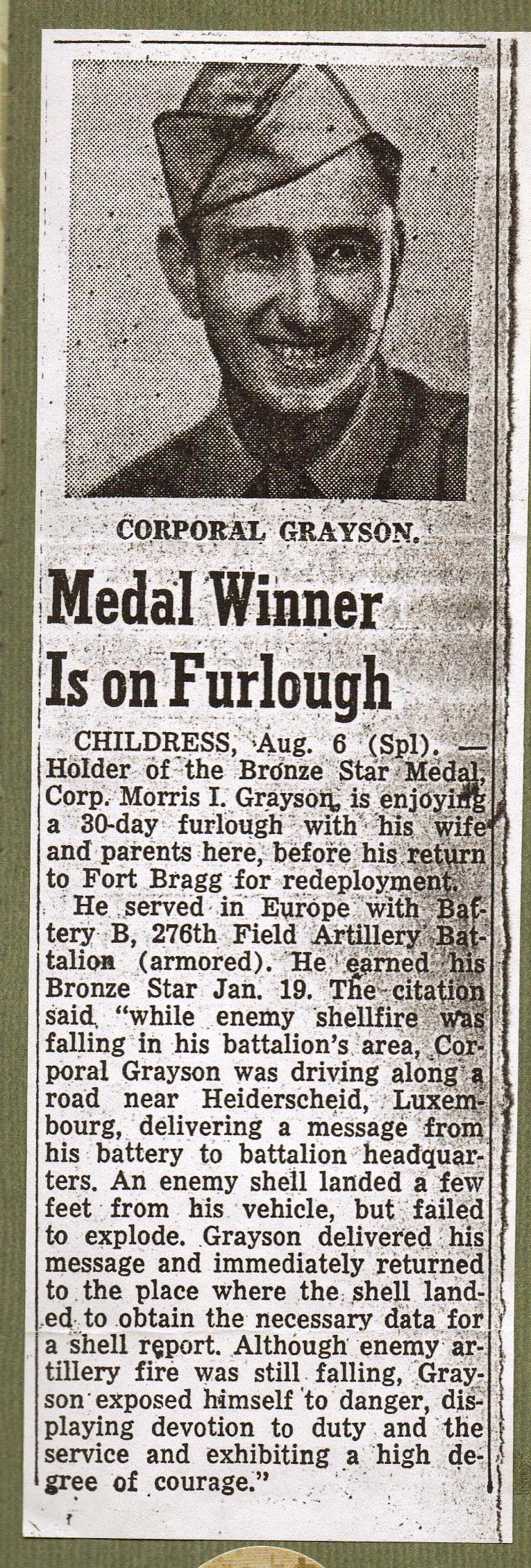
On June 10, 1945, Corporal Irving Grayson was presented the bronze star for heroism by Brig. General John C. Lenz. In one of the ironies of war, Irving thought he received the medal for one action when in fact he received it for something different. He told his family this story —

As he lay in the street of a small German town, a heavy artillery shell went went over his head hitting a building in front of him and skidded along the side of the building but did not explode. Then another shell went over his head hitting the same building and again skidded along the without exploding.  Irving realized you could tell where the gun firing on them might be located by the angle the shells were hitting and skidding. He crawled on his stomach a couple of blocks back to Battery B headquarters and told his commander what he had observed. The commander told a sergeant of the heavy artillery to follow Irving back to where he had seen the shells hitting the building. They crawled back and located the German gun.  They crawled back to the heavy artillery and the sergeant directed his men where to fire.  The German gun was hit and American lives were saved.  All his commanders were congratulating Irving on what he had done, so he thought he received the bronze star for this. See the newspaper article for the account from the Bronze Star citation.grayson-newspaper-article
The 276th AFA returned to the states in July, 1945, as part of the experienced combat troops who were redeployed for the invasion of Japan. The men received leave to visit their families before reporting for additional training for the invasion. During this leave another child was conceived and that child, Teresa, was born in 1946. The war ended in August, 1945, after the atomic bombs were dropped on Japan.

Irving returned to his old job in a packing plant in Childress, Texas, and a fourth child arrived in 1947. He later trained to be a machinist, probably using the GI Bill, and in 1951 the family moved to Dallas. In 1953 the couple’s fifth child made her appearance making three boys and two girls.

Irving and Doris raised their five children and, after twenty-one years of marriage, they divorced. Both remarried and they remained close to their children.

You might say that Irving and Doris didn’t have the “typical” WWII romance. But their experiences were typical for the time. A hasty marriage with the strains of separation, fear and anxiety. Doris didn’t know if Irving would return to her, didn’t know how long he would be gone. And Irving longed for his wife and babies. He missed the birth of his second son and the experience of seeing both sons early life. He could only write censored letters and hope his parents and hers were helping his young wife and children through this difficult time. Their love, loyalty and determination brought them through the war and the years of adjustment afterwards, like so many other couples of that time.

If you want to share a family story about World War II, please send it to me along with any pictures you have. I would love to hear your stories and share them here on my website.

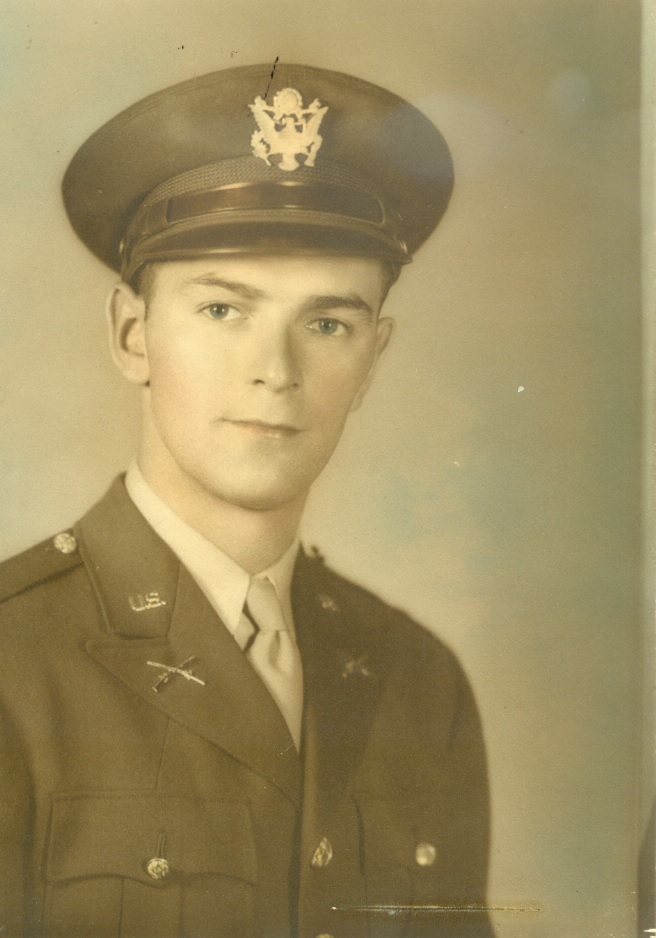
The 30th Division’s Final Push to the End of the War

With this post I will finish my series of posts on the exploits of the 30th Infantry Division during World War II. I have been distracted by other events in my life (like selling my first novel). Nevertheless, I need to bring their story to a conclusion and, in doing so, tell of some interesting occurrences during the last days of the war.

After crossing the Rhine River on March 24, 1945, the 30th pushed into the heart of Germany. By the 28th, the 8th Armored Division passed through their lines and the mission of the 30th was to follow behind and mop up. After Dorsten fell on March 29, XIX Corps took command of the 30th. By April 1, Old Hickory was reassigned to following the 2nd Armored Division on a long road march eastward towards Berlin. Before them lay the Teutoberger Wald, the place where the Germanic tribal chief, Hermann, defeated the Roman legions of Varus in 9 AD. The 2nd Armored Division left the Autobahn, which veered north at this point, and crossed the long ridge of the Teutoberger Wald with the assistance of the 30th. A German Officers Training School aided regular troops to resist the Americans in the rough, steep, heavily forested terrain. They tried to take a stand on Monument Hill, the site of the Hermannsdenkmal (the statue commemorating famous battle), but Old Hickory defeated them.

On April 7th the 117th Regiment cleared Hamelin minus K Company who had been left behind to guard an Allied Prisoner of War camp. During the advance the 30th took over an assortment of installations, including airports, hospitals, training camps and German research facilities. All had to be guarded in addition to the thousands of German prisoners. Feeding the prisoners, freed POWs and slave laborers fell to the military which was unprepared to care for such numbers.

IMG_20151020_140627
Frank Towers talking about his experiences with the 30th Infantry Division

The 30th’s next objective was Brunswick. The German commander, General Veith, called for a truce to negotiate a surrender of the city, but after a meeting with General Hobbs, Commander of the 30th, the Germans refused the terms of “unconditional surrender.” The conference was only a delaying tactic to allow the German Army to escape. Fighting resumed almost immediately with the 117th Regiment attacking and the 120th moving into position to block escape from the city. By April 12 the 3rd Battalion of the 117th remained to mop up Brunswick while the remainder of the 117th along with the 120th pushed eastward toward the Elbe River. (The 119th was attached to the 2nd Armored Division at this time.)

After Brunswick fell, the 743rd Tank Battalion and infantry from the 119th Regiment were proceeding toward Magdeburg when they passed through the town of Farsleben. Lead elements found a long freight train stopped on the track. The Nazi guards attempted to flee from the Americans but were captured. The train had a full head of steam and was awaiting orders when the Americans showed up. It didn’t take long to determine that the old freight cars contained 2,500 Jewish prisoners who were being moved from Bergen-Belsen prison camp to some unknown location in the east. Problem was that the Russians were advancing from the east. The bridge over the Elbe had been destroyed and at one point the Nazis ordered the crew to drive the train into the river which would have killed all aboard. Shocked by their discovery the Americans could scarcely believe the condition of the prisoners. Frank Towers tells the story of the liberation of the train and the following events in a section of the book “The Fighting 30th Division – They Called Them Roosevelt’s SS” by Martin King, David Hilborn and Michael Collins. You can also watch and listen to Frank Tower’s account of the incident in an interview by University of Florida oral history program on YouTube.

Although the 30th Infantry Division had been issued maps through to Berlin, the order came down that they were to take Magdeburg and stop on the banks of the Elbe River. The Russians would proceed from the east and the two allies would meet at the Elbe. Many in the 30th were disappointed at not getting to push on into Berlin.

Magdeburg appeared an easy task. There were hopes of a surrender but when men went in to discuss it with the German commander they found him either unwilling or unable to surrender the city. Before the attack by both the 30th Infantry Division and the 2nd Armored Division, bombers unloaded on the already damaged city. Within twenty-four hours Magdeburg was cleared. It was April 18, 1945.

With orders to hold at the Elbe, Old Hickory’s fighting in Europe came to an end.  While they waited for the Red Army and the German surrender, which finally came on May 8, 1945, the 30th occupied the area and took 7,468 prisoners.  Some crossed the river to escape being captured by the Russians. All along the line the large numbers of surrendering German soldiers became a burden on the Allies to feed and house. In addition, there were thousands of freed slave laborers and liberated prisoner of war camps to deal with. Contact with the Russians came on May 4th.

Old Hickory moved south from Magdeburg to Thuringia and assumed occupation duty after the surrender. Near the end of June, the 30th learned they had been chosen for redeployment to the Pacific Theater. Their orders would carry them home, to the United States, to prepare for the invasion of Japan. Those individuals with enough points to be discharged were transferred primarily to the 76th Infantry Division with lower point individuals from the 76th moving into the 30th to replenish its ranks. These transfers due to points often explain why a veteran’s discharge papers show him in a different division from the one he fought with.

In July, the 30th moved across Europe to Camp Lucky Strike near Le Havre, France. The bulk of the division crossed the channel to England to await shipment to the U.S. That’s where they got the news that Japan had surrendered August 15, 1945. The 119th Regiment had sailed from France on August 12 so they were at sea when word came. All the men of Old Hickory let out a sigh of relief.  Their fight was over. On Aug. 16th the division boarded the Queen Mary and sailed for home where the 30th Infantry Division was deactivated on November 25, 1945. The 30th Infantry Division left a glorious record of bravery, hard fighting and sacrifice in which we can all take pride.

Updated – Frank & Mary Towers Love Story

Frank W. Towers passed away July 4, 2016, at the age of 99. His beloved wife, Mary, survives him. Mr. Towers served in the 120th Regiment of the 30th Infantry Division during World War II. He landed on Omaha Beach on June 13, 1944, was wounded in Normandy and returned to his regiment to fight his way across France, Belgium, The Netherlands and Germany until the end of the war.

Frank Towers was passionate about the 30th Infantry Division and about remembering those who fell during the Second World War. He established the website of the 30th Infantry Division organization which I have referred to often. He was quoted in books, spoke at venues around the world and co-founded the Camp Blanding Museum.

You can read his full obituary in the Gainesville Sun.  See a beautiful picture of Frank and Mary at the Camp Blanding Museum on Memorial Day 2016. Or watch a YouTube video of Frank as he tells about liberating a train load of Jews being transported from one concentration camp to another.

I will never forget how Frank’s face lit up when I asked him about how he met his wife. I could tell, as he launched into it, that it was a story he loved to tell. We’d spent hours talking about the history of the 30th, the men he fought with and their exploits during the war, but when he talked about Mary it was evident that she was the love of his life.

In tribute to Frank and Mary Towers, I am posting their story again (originally posted in October 2015). This story was written almost entirely by Frank himself and I was honored that he let me post it here on my website. The story he sent me, a portion of his unfinished memoirs, is longer than what is included here. I hope to post “the rest of the story” about Frank and Mary during the war at a later time.

Frank & Mary Towers – A WWII Love Story

In October my husband and I drove down to Camp Blanding to talk to Frank Towers, a 98-year-old World War II veteran of the 30th Infantry Division. Of the many stories he told us one of the most interesting was in answer to my question of how he met his wife.Frank Towers at Graduation

In December, 1940, Frank Towers said “Good-bye” to his girl friend and boarded a train  to travel from his home in Vermont to Florida as part of Company K 172nd Infantry Regiment  43rd Infantry Division. The 43rd Infantry Division, consisting of the Vermont, Connecticut, Rhode Island and Maine National Guard, had been federalized and sent to Camp Blanding, Florida, for training.Mary Olive Thomas Towers June 1944

I’ll let Frank continue the story in his own words.  (From Frank’s memoirs which is a work in progress.)

“During the preceding months, the local social organizations and churches, wishing to show the hospitality of these local organizations, extended invitations to every unit on the Post, particularly those of the 43rd Division, with “the boys” so far away from home, they wanted to make life as bearable as possible, and prevent some from getting homesick.

Basically, each Company would receive so many invitations, and they were issued out on some unknown basis. Trucks would be at a designated pick-up point on Saturday evening and take the men to these sites from which the invitations had originated. Once inside of the building, there was no going outside, until the truck came for the return trip to Camp shortly after midnight. If one met a girl, and he wished to date her again, he would have to get her name and address and phone, number and from that point onwards, they were on their own.

Many of the guys resented this ‘Censorship” and declined any further invitations, because they could not take the ladies outside and go to other places on their own and probably drink beer. Unthinkable in a religious town like Jacksonville.

No! We were not to lead these innocent young ladies to any such immoral establishments. However, many long lasting romances resulted from these meetings.

After a few weeks of refusal to attend these functions, it was determined that the invitations would be issued on a “volunteer” basis, and if not enough men volunteered, “you were assigned” this as a duty.

The “boys” were all pretty frisky when it came to Saturday night, and they wanted to go where beer was dispensed, not to a “dry bar” of soda-pop and cookies !!

As it turned out, I was “volunteered” to go to one of these social affairs, and I went rather reluctantly, but “it was my duty !! During the course of the evening, I met one young lady that looked rather appealing, and I asked her for a dance. We danced and chatted about home and family, and had a relatively nice evening. The outcome was, I had to have her name and address, so that we could meet again, probably at her home, and meet her family.

After a week or two and some correspondence, I made the solo trip to Jacksonville, to meet this young lady, Mary-Olive Thomas, and her family, all of which went well. After one or two more such excursions, we began to get to know each other better, and enjoyed being together. On the next proposed visit, I found her not at home, but in the hospital. A few days previous, she had been struck by a speeding car, and severely injured with some broken bones, scrapes and bruises. So with a handful of roses, I trekked to the hospital and soon a “bedside romance” began to bud. So with continued occasional correspondence, we kept up our relationship.

In early February we got our “priority” shipping orders to go to Camp Shelby near Hattiesburg, Miss., to do some advanced training and some marksman training there, then to proceed to Fort Ord, Calif., and await embarkation to the Pacific Theater, to become embroiled in the battles that faced the 43rd Division. This I thought, would end my relationship, with Mary-Olive Thomas, so I forgot about her.

In March, while still at Camp Shelby, Miss., I was called in for an interview by my former C.O., Maj. Tudhope and the Regimental Commander, Col Buzzell, and others, acting as a Review Board, to interview prospective applicants to go to the Officer’s Candidate School at Ft. Benning, GA. Here we were to take further advanced infantry tactics and weapons training, and to become a commissioned officer. I never really got any basic infantry tactical training, and precious little weapons instruction, although I did fire all weapons and qualified with each one, as a Sharpshooter. I was selected and shipped off to Ft. Benning, GA to upgrade my status in life and to become a commissioned officer.

Upon graduation, I became a 2nd Lieutenant, a 90 Day Wonder, and much to my disappointment at the time, I was assigned to Camp Wheeler, GA as a Basic Training Instructor of draftees, just coming into the military for 12 week basic training cycles. Many of my graduating classmates were assigned directly to the 1st Infantry Division, which was preparing to pull off the invasion in North-Africa. That is where I wanted to be at the time! “We’d” win this war and get it over with in a few months. Little did we know of the heartbreak and suffering to come in the next many, many months.”

(During these months of training Frank received a “Dear John” letter from his girlfriend in Vermont breaking up with him.)

“Now from the time that we left Camp Blanding, I wrote very little to Miss Mary – there was nothing serious going on, and I was just too busy with my new academics at Ft. Benning, GA, and I just didn’t have time, and neither one of us felt any obligation to write. I really didn’t have time to do much letter writing, as having become a Platoon Leader in M Company of the 13th Training Battalion at Camp Wheeler, I had to do a lot of homework in preparation for the next days’ session of instruction. But, as time went on, I began to feel lonesome, and perhaps homesick, and started writing to her again. As time went on, I made 2 or 3 trips down to Jacksonville to see her.

While at Camp Wheeler, GA, I received my promotion to 1st Lieutenant, and then I asked Miss Mary-Olive to come up to Camp Wheeler to celebrate New Year’s Eve, 1942-1943. I gave her an engagement ring at midnight that night, and we were married there in a military wedding on 1 March 1943. To this girl that I had met in Jacksonville, FL, (Mary Olive Thomas) while I was at Camp Blanding. Here it is 72+ years later, and we are still hanging around together!!”

In our discussion that day at Camp Blanding, Frank continued his story about he and Mary. He said that Mary’s parents didn’t particularly approve of the “Yankee” dating their southern daughter. It didn’t help that he was Catholic and they were Primitive Baptists. That’s why Mary came to Camp Wheeler for their wedding instead of having it in Jacksonville with her family.

Frank W Towers at Madgeburg Germany
Frank W Towers at Madgeburg Germany at the end of the war

At this time (October 2015) Frank Towers is 98 1/2 years old and his wife Mary is 96. They have been together since 1943. Congratulations to them both for their many years together. It is an honor for me to share their story.

Frank Towers at St Pellerin NormandyFrank Towers at Francorchamps Belgium

As a post script to Frank and Mary’s story, when Frank left Camp Wheeler he was assigned to the 30th Infantry Division and served with them in the European Theater until the end of the war.

Researching a World War II Army Veteran

Several people have contacted me asking how to get information about a family member who served in the military in World War II. I do not profess to be an expert on researching individual veteran’s records but since I have done some research I can provide a little guidance.

I have been immensely fortunate that I have records directly from the veteran for my most immediate family members who served in WWII. I have a copy of my father’s discharge paper and a box of letters he wrote to my mother during the war. We have my father-in-law’s copy of his unit history from the 276th Armored Field Artillery Battalion. These histories were published right after the war and I have learned that they are both rare and valuable. The family also has his discharge paper. These can be very helpful as a starting place in searching for records.

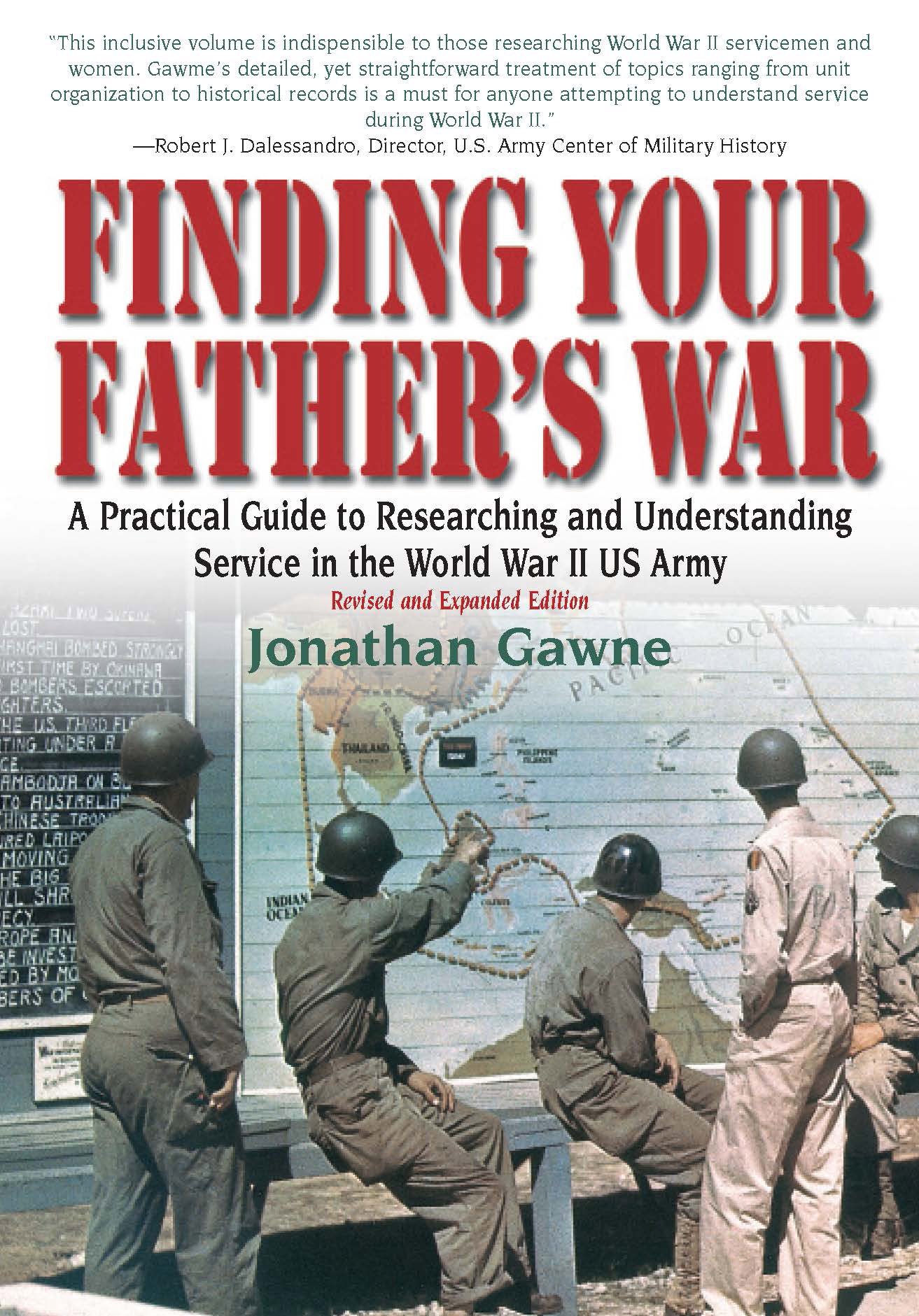
On the other hand, last year when I was searching for information about my father’s cousin, Herman Connell Jr., who was killed in Europe in 1945, I found out just how difficult it was when you had very little specific information about the soldier. All I had was his name and the unit he served in which was on his gravestone. I was able to compile a story about his unit and the action they were in at the date of his death but I couldn’t get any specific information about his individual experiences.Finding Your Fathers War Cover

The inquiries I received prompted me to look for some guide to searching for records. What I found was an excellent book which contains an enormous amount of information. “Finding Your Father’s War” by Jonathan Gawne is a must-have book for anyone looking for information on someone who served in the U.S. Army during World War II. I would even go so far as to say that it is a must-have book for anyone writing about World War II. It deals with the Army only, no Navy or Marines. It does include information about the Army Air Corp since during WWII the fly boys were part of the Army. It wasn’t until after the war that the Air Force became its own branch of the service.

One of the main reasons Gawne focused on the Army was that a fire in 1973 destroyed much of the individual service records as well as the company level records. The Navy, Marine and Coast Guard records were not burned and are available through those branches.

Some things discussed in “Finding Your Father’s War” I had already figured out from various sources. If I’d had this book it would have been so much easier and faster. There are other useful tidbits in Gawne’s book that I did not know. If you are trying to put together the pieces of someone’s military service these little details can yield a wealth of understanding.

I’ll give you some examples just to give you a feel for what I am talking about.

One of the things that I had already figured out from the many memoirs I’ve read was the structure of an Army Infantry Division. Each division had three infantry regiments thus it is referred to as a triangular organization. A division also had division artillery and division headquarters where all the support units were attached. Continuing with the triangular organization each infantry regiment was divided into three battalions plus headquarters. Although each infantry regiment had a unique number (the 30th Infantry Division consisted of the 117th, 119th and 120th Infantry Regiments), the battalions were simply numbered 1st, 2nd and 3rd (so the 117th Infantry Regiment had a 1st Battalion, a 2nd Battalion and a 3rd Battalion plus Headquarters). Each Battalion was made up of three rifle companies and a heavy weapons company. A letter designated each company but the letter designation wasn’t the same in each battalion. Instead it went like this: 1st Battalion consisted of Company A, Company B, Company C and Company D, the last being the heavy weapons company; 2nd Battalion consisted of Company E, Company F, Company G and Company H, again with the fourth one being heavy weapons; 3rd Battalion consisted of Company I, Company K, Company L and Company M, again Company M was heavy weapons and the letter J was skipped. So if you know your Army veteran was in Company H, he would have been in the heavy weapons company of the 2nd Battalion. This can be helpful since many historical accounts of battles refer to the battalion.

Something I learned from “Finding Your Father’s War” is that the soldier’s serial number isn’t just a random number assigned when he entered the service. The number will tell you something about the soldier. Serial numbers with no letter prefix means the soldier was an enlisted man. The prefix “O” indicates he was an officer. Others with letter prefixes included nurses, warrant officers, WAC’s and others. If the first number was a “1” the soldier was an enlistee. If it was a “2,” he was in the National Guard. A “3” meant he was drafted. Late in the war some draftees were given serial numbers starting with a “4.” The second digit in the serial number tells the geographic region of the country the soldier was in when he entered the service. These numbers correspond to the service commands within the United States. A map is included in the book.

In addition to this book there are numerous resources online that can help you. The National Archives, the Center for Military History, division organizations websites and Facebook pages, and even sites like Ancestry.com and Fold3.com. Local historic societies and local newspapers may be a source since many servicemen had articles written about them during the war. Family stories and even old pictures can provide clues especially if you know what to look for.

Good luck in searching for your WWII veteran’s records. It is always fascinating to learn about an individual’s service during the war when millions were in uniform and had such a variety of experiences.

30th Infantry Division – From the Roer to the Rhine

By the end of January 1945 the Allies had fought their way back to the positions they occupied before the Battle of the Bulge. Six weeks of fighting in the worst winter many had ever seen where the weather was as much of an enemy as the Germans. The 30th Division assembled near Liernieux, just west of St. Vith, Belgium, where they had been sent to recover from both the cold and the battle casualties. Rumors abounded about what would come next. Would they tackle the Sigfried Line again? Or was something else in store?

After months of fighting the 30th had become a well-oiled fighting machine. Experienced officers and non-coms knew how to plan an attack and how to carry it out. With replacements coming up they knew how to train and quickly assimilate them in with the more experienced soldiers. So it was no surprise when they were reassigned to the Ninth Army and trucked north to take part in clearing out the section of the Rhine valley facing the industrial center in the Ruhr valley.Arns War Cover

Returning to the Aachen area and the flat lands of the Cologne plain, Old Hickory received a tough assignment – a treacherous stretch of the Roer River between Julich and Duren, due west from Cologne. The Germans flooded the river by blowing up the control sluices on one of the dams upstream so the Roer crossing, originally planned for February 10, was delayed. Knee deep water covered the lowlands on either bank of the Roer. Like the previous fall when Old Hickory sat facing the Sigfreid Line for two weeks, now they faced the Roer waiting for it to subside. They again used the time for training the men, for reconnaissance and planning.  But this time the attack would be across a river rather than against the pillboxes of the Siegfried line.

When they left the Ardennes, the 30th Division along with the entire Ninth Army traveled in secret. They removed shoulder patches and vehicular markings. They assigned code names to roads and telephone exchanges. All to keep the Germans from knowing the Allies exact plans. Although Axis Sally spoke of the 30th returning to the Aachen area, the tactic worked. For once the Germans lost track of Old Hickory.

Roer%20River%209th%20army%20crossingWaiting for the river to subside didn’t mean the division was without casualties. German artillery pounded the western bank and the Luffwaffe flew regular missions including the first sightings by 30th Division men of German jet-propelled aircraft. Edward C. Arn, in his memoir “Arn’s War,” tells of being wounded by artillery fire while reconnoitering one of his platoon’s positions near the Roer.

Before the 30th finally crossed the Roer on February 23, 1945, the biggest artillery barrage in Europe up to that date pounded the Germans on the Eastern shore. The 30th’s assigned 8,000 yards of front received fire from the Division Artillery, plus three 18-piece battalions of 2nd Armored Division’s self-propelled artillery, the 823rd Tank Destroyer’s 36 guns and guns from Corp and Army battalions totaling 246 guns firing. Wow!XVI%20Corp%20photo%20Alligator%20on%20Rhine

While part of the 234th Engineer Combat Battalion ferried men across in Alligators, armored amphibious vehicles, and in assault boats, other engineers struggled to build a footbridge across the Roer, all under the cover of a smoke screen provided by the 82nd Smoke Generator Company.  On the far shore the 30th faced little resistance, thanks to the artillery, and quickly accomplished their assigned tasks.

Meanwhile the intrepid engineers completed a treadway bridge in just twenty-one and a half hours allowing tanks and trucks to cross the river. In the next few days Old Hickory took town after town as they moved ever closer to the greatest obstacle between the Allies and the heart of Germany – the Rhine River.

Rhine1 practice on MaasOn March 6, 1945, the 30th Division returned to Maas, Netherlands, to prepare for their next assignment – spearheading the Ninth Army’s attack across the Rhine. Again preparation made all the difference.

It was March 24, 1944, when all three regiments of the 30th crossed the great river at the same time along a five mile stretch from south of Wesel to Mehrum. Naval assault boats ferried, tanks, tank destroyers and infantry men continuously across the great river. That’s right – the U.S. Navy hauled boats inland for this vital operation. XVI%20Corp%20photo%20landing%20craft for rhine crossing

Engineers constructed a pontoon bridge for the tanks and other vehicles in record time again under cover of a smoke screen.Rhine2 smoke screen

The 117th history says the First Battalion of that regiment went first with the Third Battalion carrying the stormboats to the river’s edge so the assault troops would be fresh. It was 2:00 AM on March 24th. With little resistance by midnight the 117th had reached their assigned positions and moved on toward the next town.

For the first few hours after the crossing Old Hickory encountered only light German resistance. Then the 116th Panzer Division moved into their path. One of only two German mobile divisions available, the 116th focused on holding back the 30th while the 15th Panzer Grenadier Division spread out facing the British and Canadians further north. The enemy’s backhanded compliment to the 30th Division wasn’t appreciated by the men on the line.

The 30th doggedly fought their way eastward against armor and anti-aircraft guns lowered to fire at ground troops. After days of continuous fighting fatigue added to the stubborn enemy resistance to slow down Old Hickory. Plans for the 8th Armored Division to pass through the 30th and take on the fight called for the 30th to advance far enough to allow the armor to take over in open country. Old Hickory’s boys fought on taking Gahlen in street fighting against determined resistance. Finally on the morning of March 28, 1945, the 8th Armored Division came forward and took over the fight. Nearly 100 hours after their assault across the Rhine, Old Hickory finally got some much needed rest.

The 30th Division wasn’t through fighting. It would be over a month before Germany finally surrendered. Even at this late date, more would die before the war was over.

Frank and Mary Towers – A WWII Love Story

In October my husband and I drove down to Camp Blanding to talk to Frank Towers, a 98-year-old World War II veteran of the 30th Infantry Division. Of the many stories he told us one of the most interesting was in answer to my question of how he met his wife.Frank Towers at Graduation

In December, 1940, Frank Towers said “Good-bye” to his girl friend and boarded a train  to travel from his home in Vermont to Florida as part of Company K 172nd Infantry Regiment  43rd Infantry Division. The 43rd Infantry Division, consisting of the Vermont, Connecticut, Rhode Island and Maine National Guard, had been federalized and sent to Camp Blanding, Florida, for training.Mary Olive Thomas Towers June 1944

I’ll let Frank continue the story in his own words.  (From Frank’s memoirs which is a work in progress.)


“During the preceding months, the local social organizations and churches, wishing to show the hospitality of these local organizations, extended invitations to every unit on the Post, particularly those of the 43rd Division, with “the boys” so far away from home, they wanted to make life as bearable as possible, and prevent some from getting homesick.

Basically, each Company would receive so many invitations, and they were issued out on some unknown basis. Trucks would be at a designated pick-up point on Saturday evening and take the men to these sites from which the invitations had originated. Once inside of the building, there was no going outside, until the truck came for the return trip to Camp shortly after midnight. If one met a girl, and he wished to date her again, he would have to get her name and address and phone, number and from that point onwards, they were on their own.

Many of the guys resented this ‘Censorship” and declined any further invitations, because they could not take the ladies outside and go to other places on their own and probably drink beer. Unthinkable in a religious town like Jacksonville.

No! We were not to lead these innocent young ladies to any such immoral establishments. However, many long lasting romances resulted from these meetings.

After a few weeks of refusal to attend these functions, it was determined that the invitations would be issued on a “volunteer” basis, and if not enough men volunteered, “you were assigned” this as a duty.

The “boys” were all pretty frisky when it came to Saturday night, and they wanted to go where beer was dispensed, not to a “dry bar” of soda-pop and cookies !!

As it turned out, I was “volunteered” to go to one of these social affairs, and I went rather reluctantly, but “it was my duty !! During the course of the evening, I met one young lady that looked rather appealing, and I asked her for a dance. We danced and chatted about home and family, and had a relatively nice evening. The outcome was, I had to have her name and address, so that we could meet again, probably at her home, and meet her family.

After a week or two and some correspondence, I made the solo trip to Jacksonville, to meet this young lady, Mary-Olive Thomas, and her family, all of which went well. After one or two more such excursions, we began to get to know each other better, and enjoyed being together. On the next proposed visit, I found her not at home, but in the hospital. A few days previous, she had been struck by a speeding car, and severely injured with some broken bones, scrapes and bruises. So with a handful of roses, I trekked to the hospital and soon a “bedside romance” began to bud. So with continued occasional correspondence, we kept up our relationship.

In early February we got our “priority” shipping orders to go to Camp Shelby near Hattiesburg, Miss., to do some advanced training and some marksman training there, then to proceed to Fort Ord, Calif., and await embarkation to the Pacific Theater, to become embroiled in the battles that faced the 43rd Division. This I thought, would end my relationship, with Mary-Olive Thomas, so I forgot about her.

In March, while still at Camp Shelby, Miss., I was called in for an interview by my former C.O., Maj. Tudhope and the Regimental Commander, Col Buzzell, and others, acting as a Review Board, to interview prospective applicants to go to the Officer’s Candidate School at Ft. Benning, GA. Here we were to take further advanced infantry tactics and weapons training, and to become a commissioned officer. I never really got any basic infantry tactical training, and precious little weapons instruction, although I did fire all weapons and qualified with each one, as a Sharpshooter. I was selected and shipped off to Ft. Benning, GA to upgrade my status in life and to become a commissioned officer.

Upon graduation, I became a 2nd Lieutenant, a 90 Day Wonder, and much to my disappointment at the time, I was assigned to Camp Wheeler, GA as a Basic Training Instructor of draftees, just coming into the military for 12 week basic training cycles. Many of my graduating classmates were assigned directly to the 1st Infantry Division, which was preparing to pull off the invasion in North-Africa. That is where I wanted to be at the time! “We’d” win this war and get it over with in a few months. Little did we know of the heartbreak and suffering to come in the next many, many months.”


(During these months of training Frank received a “Dear John” letter from his girlfriend in Vermont breaking up with him.)


“Now from the time that we left Camp Blanding, I wrote very little to Miss Mary – there was nothing serious going on, and I was just too busy with my new academics at Ft. Benning, GA, and I just didn’t have time, and neither one of us felt any obligation to write. I really didn’t have time to do much letter writing, as having become a Platoon Leader in M Company of the 13th Training Battalion at Camp Wheeler, I had to do a lot of homework in preparation for the next days’ session of instruction. But, as time went on, I began to feel lonesome, and perhaps homesick, and started writing to her again. As time went on, I made 2 or 3 trips down to Jacksonville to see her.

While at Camp Wheeler, GA, I received my promotion to 1st Lieutenant, and then I asked Miss Mary-Olive to come up to Camp Wheeler to celebrate New Year’s Eve, 1942-1943. I gave her an engagement ring at midnight that night, and we were married there in a military wedding on 1 March 1943. To this girl that I had met in Jacksonville, FL, (Mary Olive Thomas) while I was at Camp Blanding. Here it is 72+ years later, and we are still hanging around together!!”


In our discussion that day at Camp Blanding, Frank continued his story about he and Mary. He said that Mary’s parents didn’t particularly approve of the “Yankee” dating their southern daughter. It didn’t help that he was Catholic and they were Primitive Baptists. That’s why Mary came to Camp Wheeler for their wedding instead of having it in Jacksonville with her family.

Frank W Towers at Madgeburg Germany
Frank W Towers at Madgeburg Germany at the end of the war

At this time (October 2015) Frank Towers is 98 1/2 years old and his wife Mary is 96. They have been together since 1943. Congratulations to them both for their many years together. It is an honor for me to share their story.


Frank Towers at St Pellerin NormandyFrank Towers at Francorchamps Belgium

As a post script to Frank and Mary’s story, when Frank left Camp Wheeler he was assigned to the 30th Infantry Division and served with them in the European Theater until the end of the war.

Company Commander by Charles B. MacDonald

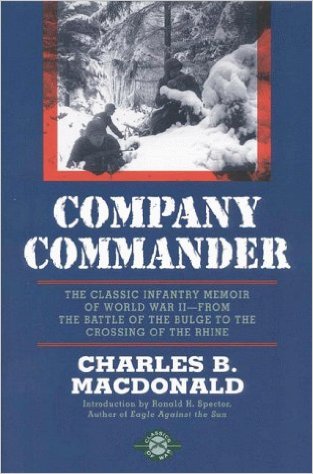
I’m a writer. So when I read a memoir or a historical account I’m always looking for something I can use in my writing. Sometimes it’s a story idea. Sometimes it’s how the person reacts to the situation. Sometimes it’s how two people meet. And sometimes it’s very specific details of the combat experience that can be used to recreate a realistic combat scene in a story.Company Commander book cover

In reading Company Commander by Charles B. MacDonald I discovered incredibly rich detail about his combat experience. In addition to detailed descriptions of terrain, weather and military procedures, MacDonald relayed his feelings during each episode, not just saying “I was frightened,” but saying “My body began to shake uncontrollably. My voice trembled despite my efforts to control it.” These realistic and vivid descriptions are all through the book.

Captain MacDonald joined I Company, 23rd Infantry Regiment, 2nd Infantry Division in September, 1944, as a replacement Company Commander just after they had captured Brest on the French coast. Almost immediately they were loaded in French forty-and-eight freight cars and transported across France to Longuyon. From there they convoyed by truck to Belgium where they relieved elements of the 28th Division along the Siegfried Line near St.Vith.  Along the way MacDonald got to know his more experienced men, both his platoon leaders and the men who would man his Command Post, and worried about gaining their acceptance.

MacDonald describes the procedure of taking over the positions including the guides assigned to walk them to their positions, the discussion with the Company Commander he was relieving, and an account of the defensive positions themselves. My writer’s eye marveled at the detailed description of the interior of the pillbox used as their command post, at the explanations of the deployment of his men, at his impressions of how the combat veterans accepted their new, twenty-two-year-old, inexperienced captain who felt so insecure in his first combat experience. Then later, during German attacks, he describes the process of communicating with the battalion to call in artillery fire to protect the riflemen in forward foxholes and the problems with broken phone lines and dying radio batteries at critical times.

The book follows MacDonald’s journey from the pill boxes on the Siegfried Line on to other defensive positions along the Belgium-German border as the autumn progressed and the weather deteriorated. In early December, the 2nd Division was ordered further north for an offensive against the Roer River dams. They were relieved by the 106th Division, newly arrived from the U.S. MacDonald describes them as “equipped with the maze of equipment that only replacements fresh from the States would have dared to call their own… and horror of horrors, they were wearing neckties!”  The 106th took over positions in the proximity of St. Vith, Belgium, on December 11, just five days before the German offensive known as the Battle of the Bulge would begin.

The 23rd’s new positions were located in “a giant fir forest” where they de-trucked “half-frozen from a five-hour nightmare of cold, snow and hazardous blackout driving.” They were greeted by “a foot of frozen whiteness covering the ground.” They then hiked a mile along an icy highway, crossed a small, icy stream and up-hill on a one-way trail to a point in the snow-covered forest designated as their new home. MacDonald said “I felt like crying.” This was a far cry from the comforts of their last positions. Yet their kitchen truck was able to follow them and provide a hot breakfast.

After word filtered in about a German attack, MacDonald tells of his meeting at battalion headquarters where he received orders to move to an assembly area in support of the 99th Division whose area had been penetrated. “We would take blanket rolls, three meals of K-rations and packs.” These scenes of meetings with commanding officers and discussions of details about deploying his men on short notice along with his anxiety about going on the offensive after only defensive action bring the reader into the moment. And they help me as a writer, and non-military person, visualize the situation.

I Company would go on to frantically try to hold their assigned positions against the German onslaught and ultimately have to scatter and withdraw. In the mêlée MacDonald is wounded and berates himself for not holding while worrying about his men who he can’t account for.  Again the reader is right with them.

In March, after recovering from his wounds and receiving a medal, MacDonald is reassigned to Company G as the Americans push into Germany and cross the Rhine. He recounts the anxiety as they enter each German village never knowing whether they would meet gunfire, surrendering German soldiers or gawking civilians. More than once large anti-aircraft guns fired at them as a few Germans tried to desperately fight on.

MacDonald had an extraordinary memory to be able to recall so many details included in the book, written in 1947, three years after the events. It was not surprising to learn that MacDonald became a military historian after the war. He wrote two of the U.S. Army’s official histories of the European campaign.

I’ll mention what I thought was an interesting tidbit. MacDonald mentions many men by name along with their hometowns. At one point he mentions meeting Captain John M. Calhoun of Athens, Tennessee, who was then commander of F Company 23rd Regiment. Knowing that Athens, Tenn. was the headquarters of B Company, 117th Regiment, 30th Infantry Division when they were federalized in 1940, I went to their history which lists all the members of B Company at the time of federalization. Sure enough, John M. Calhoun was listed as a Private First Class. The B Company history states that in 1942 twenty-two of its enlisted men were sent to Officers Training School. Captain Calhoun was apparently one of those and he ended up in the 2nd Division as a Company Commander.

30th Infantry Division – Battle of the Bulge

During the months of December 1944 and January 1945, an enormous battle raged in Europe – the well-known German offensive called the Battle of the Bulge. On December 16, 1944, with the Allies believing that the Germans were beat and the war would soon be over, Hitler’s massed armies attacked through the thinly defended Ardennes. The attack caught the Americans manning the eighty-mile stretch of border between Belgium and Germany by surprise. The Germans smashed through the American lines and pushed deep into Belgium and Luxemburg creating a “bulge” in the lines, thus the name given to the battle.

When the Battle of the Bulge is mentioned, many people think of the battle for Bastogne where the Germans had the 101st Airborne surrounded. But the battle was much bigger than that. It involved many divisions across a wide front. On the northern portion of the bulge the 30th Infantry Division stopped the German advance blocking a critical path to Liege and Antwerp.

After Aachen, the 30th Division came off the line and moved back to Holland for a much-needed rest. Then the Germans attacked on December 16th. When the Allied command realized that they were facing a major offensive, the 30th was called back into action. Loaded on trucks the 30th’s three combat regiments reached the front in Belgium on December 18th. The 117th Regiment encountered the enemy first near Stoumont in route to their assignment of Stavelot. The 120th proceeded to Malmedy while the 119th took up positions near Spa, where First Army Headquarters was being hastily dismantled and moved to the rear.

Spa, Malmedy and Stavelot form a rough triangle of roads suitable for an armored force to use in a winter offensive. Stoumont lies further west along the road running through Malmedy and Stavelot. Von Rundstedt planned to use these roads for the main German thrust to Liege where the Allies had huge stores of fuel, ammo and essential supplies. Thus the Germans would split the Allied forces and push on to recapture the port of Antwerp.

During their drive to the front lines, the men of Old Hickory first heard Axis Sally call them the “fanatical 30th Division, Roosevelt’s SS troops.” She also told them they would once again face the 1st SS Panzer Division spearheaded by Lt. Colonel Joachim Peiper. This was the same division they had stopped at Mortain months before.

Knowing roads were essential to the German tanks and trucks in the hilly, forested area, the 30th focused on blocking roads and destroying bridges across the many streams. The 291st Engineers blew up several key bridges early in the offensive essentially stopping Peiper’s advance. Two huge fuel dumps, one close to Stavelot and the other between Stoumont and Spa, could have provided the Germans with much-needed gasoline if captured. While the 30th fought to halt the German advance, supply units began moving the gasoline back out of danger. When elements of Peiper’s force neared the fuel dump near Stavelot, portions of the fuel were set ablaze to prevent their capture.

From December 18th through Christmas eve intense fighting ensued throughout the area assigned to the 30th. They fought bravely with Congressional Medals of Honor earned by Sgt. Frances S. Currey and Staff Sgt. Paul L. Bolden, both of the 120th Regiment. A Presidential Citation was awarded to the 119th Regiment and the attached Company C 740th Tank Battalion and 2nd Platoon Company A 823rd Tank Destroyer Battalion for their battle with the 1st SS at Lorce-Chevron and Stoumont, Belgium.

Despite heavy losses on both sides, the Americans stopped the German advance. The strong resistance along the German’s preferred route to Liege and its supply depots forces Von Rundstedt to shift his focus further south toward the area around Bastogne where resistance was less – except for the stubborn 101st. The unmovable “Old Hickory” Division had blocked their path once again.

Reading accounts of the 30th’s action in those early days of the battle brought to mind scenes from the movie “The Battle of the Bulge” starring Henry Fonda. Although much of the movie is fictional and lacks historical accuracy, it is clear that the action portrayed is mainly in  the 30th’s area, including the fuel dumps, the Malmedy massacre, and the intense fighting to block the roadways. The movie might have been better if the makers had included more of the real events. They avoided topics like the Army Air Force bombing our own troops in Malmedy, several times, because the communications was so bad. Another dramatic episode revolved around Americans captured by the Germans, including a major who gathered intelligence before escaping. Some of these prisoners were released when Peiper’s men abandoned their tanks and vehicles. Another dramatic episode would have been the tale of the 740th tank battalion with no tanks who raided a repair depot for anything that would run, taking a hodgepodge of equipment to valiantly fight the enemy.

The end of “The Battle of the Bulge” movie implies that the battle was over when the Germans retreated. This was far from the truth. Veterans of the Battle of the Bulge say that the fighting after Christmas and into January to recapture the ground lost was rougher and the weather worse than those first days stopping the German advance.

I’ve never understood why Hollywood hasn’t made a movie about the 30th. Either the fighting around Mortain or the action in the Malmedy-Stavelot-Stoumont area of Belgium would have made great movies.

Old Hickory played a key role in halting the last great German offensive. Many months of bitter fighting remained before the final surrender in May. The battle hardened troops of the 30th division would go on to take the fight onto German soil once again. Many proudly repeated the nickname given to them by their enemy – “Roosevelt’s SS.” Knowing that the most elite German forces were the SS, it was the highest compliment the enemy could give.

Camp Blanding And Its WWII History

Recently my husband and I drove down to Camp Blanding and toured the Camp Blanding Museum located just off Florida State Road 16 at the entrance to the base. Since it was a typically hot and humid Florida day, we spent most of our time inside the museum building. Before leaving we walked around viewing the monuments for each division that trained at Camp Blanding and looking at some of the WWII vintage equipment on display. We hope to return when it is cooler so that we can venture further and see more of the equipment including some more modern tanks, helicopters and planes.Barbara at Camp Blanding

Our original intent was to learn more about the 30th Infantry Division since we knew that Old Hickory had trained at Camp Blanding before going overseas. What we learned was that nine full divisions trained at Camp Blanding before it became a replacement training center.

Camp Blanding is situated in Clay County, Florida, near Starke. The 73,000 acre military reservation, which includes Kingsley Lake, is the training facility for the Florida National Guard as well as a Joint Training Facility for U.S. military, international forces and various other agencies. In 1939 Florida established the base for training the Florida National Guard. At the beginning of World War II the U.S. Army took it over to train the federalized national guard units as well as portions of the regular army.

Once under the control of the federal government, Camp Blanding rapidly expanded so that it could accommodate at least two divisions for training. Construction boomed, employing thousands. As the troops moved in the area soon grew to be the fourth largest city in Florida.

The first housing for the troops consisted of pyramid tents, to which wooden floors and walls were added. Due to the ankle-deep sand, wooden walk-ways were constructed and drills had to be conducted on the paved roads.31st Div at Camp Blanding

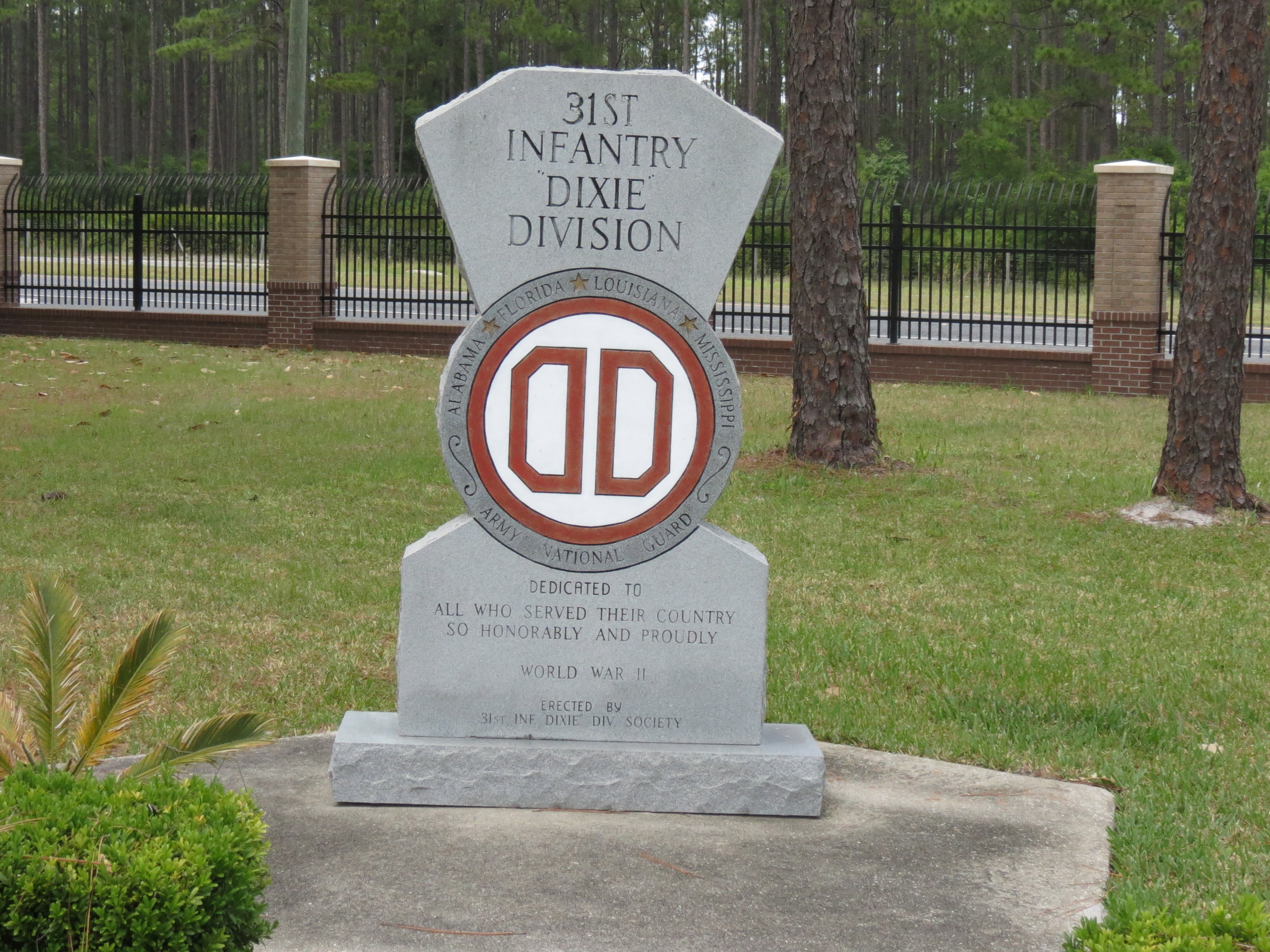
In the beginning, the 31st Infantry Division made Camp Blanding its home. The 31st, known as the Dixie Division, consisted of the Louisiana, Mississippi, Alabama and Florida National Guard. With capacity for two divisions to train, the 43rd Infantry Division moved to Camp Blanding. The 43rd, or Winged Victory Division, was made up of the Maine, Vermont, Connecticut and Rhode Island National Guard. Thus streets were named for the respective states, both north and south, and locations within those states. With units from the deep south and the northeast training at the same base, the old north-south rivalries emerged, but remained relatively good-natured.36th Div at Camp Blanding1st Div at Camp Blanding

When the 31st Division and the 43rd Division left Camp Blanding to eventually serve in the South Pacific, the 36th Infantry Division, made up of the Texas National Guard, moved in. They were soon joined by the First Infantry Division, the only Regular Army division to train at Camp Blanding. These two divisions ended up in North Africa, then Sicily and Normandy for the “Big Red One” and Italy for the Texans.IMG_1412

By August of 1942 the 79th Division, an Army Reserve unit, occupied Camp Blanding. And the 29th Infantry Division, also known as the “Blue and Gray” since it was made up of the Virginia, Maryland, Pennsylvania and District of Columbia National Guard, arrived in the Florida camp.

It wasn’t until October 1942 that the 30th Infantry Division came to Camp Blanding for training. The North Carolina, South Carolina, Georgia and Tennessee National Guard, all components of the 30th, remained in Florida until May of 1943. From Blanding Old Hickory participated in the Tennessee Maneuvers, then moved on to Indiana and Massachusetts where they shipped out for Europe in February 1944. A few days after D-Day the 30th landed in Normandy and fought almost continuously until they met up with the Russians in May 1945.IMG_1415

Two other U.S. Army Reserve Divisions also trained at Camp Blanding. The 66th Infantry Division, called the “Black Panthers,” was activated in April 1943 at Blanding. In June 1943 the 63rd Infantry Division was formed at Camp Blanding. They used the nickname “Blood & Fire.” Both went on to fight in Europe.

In 1943 the Florida base took on a new role as an infantry replacement training center, soon becoming the largest such training facility in the country. With the fighting going on in the Pacific, North Africa and Italy, it became clear that replacements were needed to fill the ranks depleted by casualties, so bases like Camp Blanding became vital to the war effort.  And with the capture of prisoners on the battlefields the need for Prisoner of War camps arose. So a portion of the military reservation was converted to a prison camp and eventually housed some 378,000 German POW’s.

The inauspicious Camp Blanding with its pine trees, sand and picturesque lake played a major role in training U.S. troops during World War II. An estimated 800,000 soldiers trained at the Florida base during the war.  Although now it has reverted back to its original purpose, we should not forget what the base contributed during the desperate years when the world struggled to defeat the Axis powers.Jeep Display at Camp Blanding

The Camp Blanding Museum pays tribute to all the divisions who trained here. Exhibits tell of each divisions training and combat experiences. Uniforms, weapons, medical gear, and much more provide the WWII amateur historian ample food for thought. To read more about Camp Blanding’s history, read the article by Jim Ashton on the 30th Infantry Website.Patches at Camp Blanding

In the book store I purchased a book about the 30th Division and another about Florida’s role in WWII. My husband got another “Old Hickory” hat. He loves wearing the 30th hat with their eye-catching insignia because it spurs so many comments and has started several long conversations on a subject he thoroughly enjoys.Pat at Camp Blanding

117th Regiment 30th Infantry Division – Siegfried Line to Aachen

Many historical accounts or discussions about the Second World War in Europe skim over the events of the fall of 1944. They focus on the D-Day Landings and the battle in Normandy. Next comes the liberation of Paris and the race across France to the German border. From there they jump to the Battle of the Bulge and cover the terrible winter of 1944-45. Yet from the first of October through mid-December, 1944, intense battles raged all along the German border.

Until my husband got me interested in researching the 30th Infantry Division, I knew little about the fight to breach the Siegfried Line. I had heard of Aachen but didn’t really understand what happened there or its significance. So in this post, I will continue my discussion of the 30th Division’s combat experiences beginning where I left them along the infamous Siegfried Line not far from the historic city of Aachen.

30th Infantry Division Patch

At the beginning of October, 1944, the 30th Infantry Division faced the German border from southernmost Holland only a few miles from Belgium. Before them lay a section of what the Germans called the West Wall, a series of pill boxes, trenches, tank traps and dragon’s teeth built in the 1930’s to defend Germany from the French. The West Wall, also known as the Siegfried Line, was intended to provide a defensive position from which the Germans would attack, rather than fortifications to defend like the French Maginot Line.

After the German invasion of France, Belgium and Holland, the Third Reich no longer needed the West Wall defenses, so they stood unused and neglected. But when the Germans rapidly withdrew to their borders in the summer of 1944, the Wehrmacht again occupied the West Wall fortifications. They quickly repaired and reinforced the last line of defense of their homeland. In the area around Aachen the West Wall extended from the north around both the eastern and western sides of the ancient city.

Aachen held great significance as a symbol of German supremacy. The city had been Charlemagne’s capital during the time of the Holy Roman Empire or the “First Reich.” Determined to hold the city, Hitler and his henchmen moved more troops into the area for its defense. On the other side, the Allies were just as determined to make Aachen the first German city captured.

In the last half of September the 1st Infantry Division and the 3rd Armored Division crossed into Germany from Belgium south of Aachen and attacked through a gap in the West Wall fortifications. By the end of September they reached the southern edge of the city, but determined German resistance brought them to a stand-still. To relieve the pressure on the forces of VII Corps the XIX Corps attacked from the north through the heavily fortified Siegfried Line or West Wall. The 30th Infantry Division led the way followed by the 2nd Armored Division while the 29th Infantry Division guarded their flanks.

On October 2, 1944, the 117th and 119th Regiments of the 30th launched the attack. The 117th on the left attacked through Marienberg while the 119th on the right went through Rimburg. The Americans crossed the Wurm River under heavy German fire. After crossing the narrow, steep-banked stream, they climbed up to the railroad track just beyond. Ahead lay the numerous pill boxes of the Siegfried Line. One by one the 30th captured or destroyed the German fortifications which were barely touched by the pre-attack bombing. Old Hickory sharpshooters took out numerous German machine gunners by firing through the narrow pillbox ports. On October 3rd the 117th took Palenberg and controlled much of Ubach. By October 7th the 117th occupied much of the city of Alsdorf opening the way to Aachen.

The 2nd Armored Division followed the 30th’s initial attack and swept north and east to Frelenberg and Beggendorf expanding the bridgehead into Germany. With their objectives met the 30th and 2nd Armored hoped for a break to rest and regroup. It was not to be. XIX Corps and VII Corps wanted to press on and link up thus surrounding Aachen and forcing its surrender. So Old Hickory pressed on southward to Wurselen where the intense German resistance halted their progress. Both sides utilized everything they had from artillery barrages to bombing to tanks and anti-tanks to house-to-house fighting.

Meanwhile the 1st Division fought off repeated counter attacks to hold on to the ground already taken. On Oct. 8th the First Division began an offensive to take the high ground southwest of Aachen including a high point dubbed “Crucifix Hill,” where they were to link up with the 30th Division.

To break up the 30th’s stalemate, on Oct. 16th the 117th and the 120th Regiments undertook a diversionary attack east of the main force which successfully drew the German artillery fire away from the 119th and 116th Regiments. That afternoon Company E 117th Regiment attacked through a wooded area held by the Germans toward a railroad. The intent was to convince the enemy that it was the main attack. Despite heavy casualties the 117th repeatedly attacked the German forces successfully diverting them away from the 119th pushing south toward the 1st Division positions.

Elements of the 30th from XIX Corp and the 1st from VII Corp finally linked up on October 16th. Street fighting continued in Aachen for another week. Finally, on October 21st, the last garrison in Aachen surrendered.

From the kickoff on October 2 to the final surrender of Aachen the 30th Infantry Division suffered approximately 3,000 casualties. Few of the old National guardsmen remained. Not many who landed with the Division on Omaha Beach were still with the division. Some who had been wounded along the way and sent to hospitals to recover would rejoin the 30th in later battles. Despite the turnover in personnel the 30th Infantry Division proved to be a formidable force in Europe. For their “Diversionary attack in the Battle of Aachen Gap” Company E, 117th Infantry Regiment received a Presidential Citation.

The first breach of the Siegfried Line and the battle to capture the first German city, Aachen, in October gave the Allies hope that the war could be won by Christmas. Little did they know what Hitler had planned.

Read more about the battle for Aachen on the following sites:

https://en.wikipedia.org/wiki/Battle_of_Aachen

http://www.history.army.mil/books/wwii/Siegfried/Siegfried%20Line/siegfried-ch13.htm

http://www.oldhickory30th.com/Aachen%20Gap%20Closing.htm