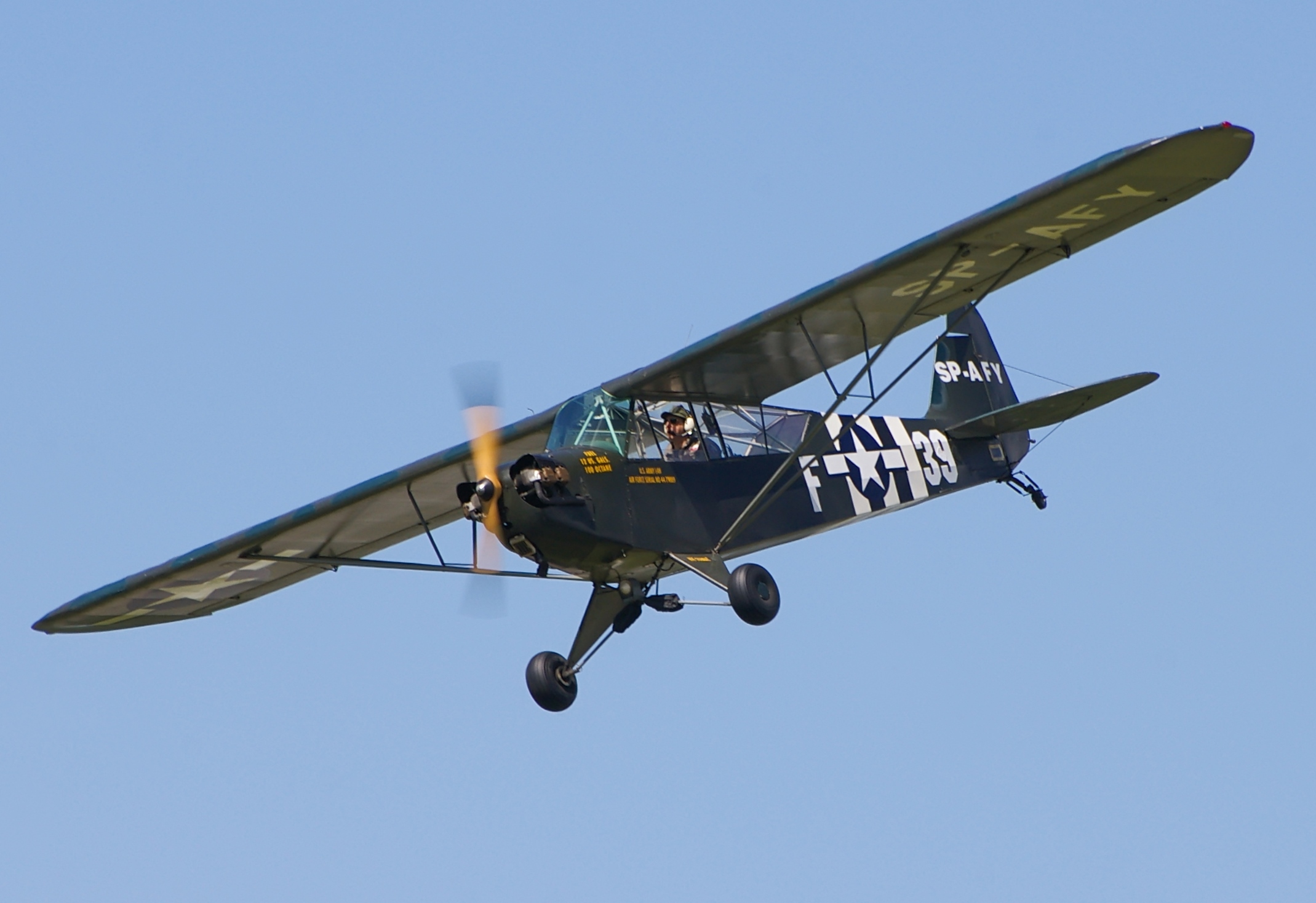
Have you ever flown in a small plane? Not substantial enough for me. I’d rather be in a bigger plane like an airliner or a B-17 bomber. Yet the iconic Piper Cub made history in both military and civilian aviation.
Imagine flying in a tiny Piper Cub over enemy lines scouting for artillery targets. That’s what happened during World War II. The small plane was perfect for the job. It flew fairly slow yet it was highly maneuverable. It could fly as low as the tree-tops and had good visibility for observing enemy positions. An observer could ride behind the pilot calculating coordinates and radioing the artillery with instructions. They would even stick around to make sure the artillery shells hit their target and adjust fire if necessary.
But when the enemy started shooting at the Piper Cub, the little plane had no defense – no fire power, no armor protection, nothing. The pilot might have brought along a Tommy gun or a pistol, but that was it. Not enough to really defend itself. All the pilot could do was maneuver and hope they didn’t get hit. And all it took was a rifle or machine gun round in just the right spot and down it went. Then you had a pilot and observer, if they survived the crash, either taken prisoner or evading capture until they could make their way back to friendly forces.
Before the war, the Piper Cub was primarily used for training. Most of the pilots in the U.S. Military learned to fly in a Piper Cub. Once the military saw how useful it could be, they designated it the L-4 Grasshopper and production ramped up. The military used it for things like carrying messages, ferrying high ranking officers, transporting wounded and training new pilots. By far, its value for reconnaissance, observation and as a spotter for the artillery exceeded the other uses. Additionally, it could land or take off on a short section of road or a small field. The L-4 Grasshopper was used in North Africa, Europe, and in the Pacific Theater where the Navy, as well as the Army, took advantage of its many uses.

In Europe, the Germans learned to fear the Piper Cub more than any other airplane. When they saw this little plane flying over, they knew it would be followed by an artillery barrage. Unlike the Germans or the Japanese, the American artillery could concentrate fire from many different artillery battalions due to their system of communication. And depending on the target, the Americans could bring to bear an enormous amount of fire power. Also, the American artillery shells had “Proximity Fuses.” These could be set for the shell to explode above ground to expand its effect, set to explode on impact or set to delay the explosion, tricking the enemy into believing it was a dud. No wonder the enemy feared the American artillery and the little Piper Cub.
I first learned about the Piper Cub and its use for artillery observation while researching the 276th Armored Field Artillery Battalion. The Battalion had two liaison pilots assigned to them along with two Piper Cubs. The pilots must have rotated because several were listed in the 276th History as receiving Air Medals and many with Oak Leaf Clusters meaning they received the medal multiple times. The pilots were 1st Lieutenant Charles R. Lindgren, 1st Lieutenant Dwight W. Jewett, 1st Lieutenant John B. Blazak, 1st Lieutenant Ward R. Price, Master Sergeant John C. Taylor, Jr. , and 1st Lieutenant Frank W. Zachman who also received the Silver Star. No doubt these men earned their medals for the perilous missions they carried out.
To learn more about the “Little” Piper Cub, watch the videos below.












 Barbara Whitaker