During WWII, the two bombers that carried the load in European air war for the Americans were the B-17 Flying Fortress and the B-24 Liberator. In my latest work-in-progress I am trying to decide which airplane my hero/navigator would have flown. My first thought was to use the B-17 since it seemed more glamorous, but with more research about both planes, I found that the Liberator was quite a plane, too. After all, Jimmy Stewart flew the B-24. How’s that for glamor?
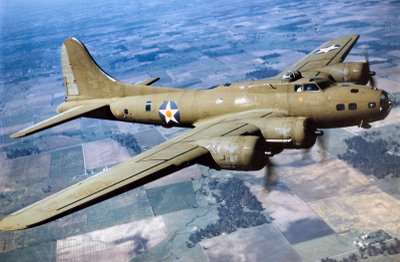

Anyone remember the Memphis Belle? It was the first bomber that finished the required 25 missions in 1943. (Mission requirements were increased to 30 and then to 35 in 1944) Major William Wyler, the famous director and movie maker, as part of the First Motion Picture Unit of the US Army Air Forces, directed a film depicting the final flight of the Memphis Belle. The footage became the documentary “The Memphis Belle: A Story of a Flying Fortress.” As a morale booster for the Army and the folks back home, the crew, the plane and the movie toured the US selling war bonds and recruiting flyers for the Army Air Force. In 1990, Hollywood made a movie about that last flight, “The Memphis Belle.” Both films depict the lives of bomber crews in WWII and are well worth seeing.


Some believe that the B-17 got better press during the war and many thought it a better looking plane. It is definitely the one most people associate with WWII.
So, which plane will I use in my book? I haven’t decided. But I’m leaning toward the B-24 because it’s less known and because I have found some good books to use as reference material. Among them are: “A Reason To Live” by John Harold Robinson who flew as a gunner and engineer on a B-24; “Lucky Penny’s Tail” by Gregory J. Matenkoski recounting the story of Edmund Survilla, a tail gunner on a B-24; and “Jimmy Stewart Bomber Pilot” by Starr Smith.
For additional research, I plan to travel to Savannah, Georgia, to visit the Mighty Eighth Air Force Museum sometime in the near future. This museum should give me additional details and insight into the WWII air war. Wouldn’t I love to take a ride on one of those old planes? I’m watching for an opportunity.
 Barbara Whitaker
Two years too late it seems, but I will give you my perspective anyway:
The B-24 could carry several times the bomb load over a much larger distance than could the B-17 (which is why B-17 usage in the Pacific pretty much ended as quickly as replacement B-24 units could arrive in theater).
On the other hand, the B-17 could take a tremendous amount of damage and return her crews home; the B-24 was much more fragile, particularly around the wing area. A single flak burst anywhere close to wing roots would often tend to cause the wings to break off, with rather unfortunate results for the crew. Also, the B-24 did not survive ditching events very well, as it tended to break up on impact and sink before the crew could escape. Pilots generally considered it little fun to fly, which Stephen Ambrose documented in his book ‘The Wild Blue’. This is at least partially corroborated by the fact that the Army Air Force scrapped the entire B-24 fleet almost immediately after WWII, while retaining a number of ‘special duty’ B-17s well into the late ’50s/early 60’s.
Nevertheless, if you would be looking for a high-tech, cutting-edge but dangerous machine for your hero to fly, the B-24 is your aircraft. BTW, Clark Gable flew the B-17 operationally from England during the war!
My father was a radio operator on B-24s, and flew 26 missions over occupied Europe and Germany – after VE day, his unit was recalled to the States, and was in the process of transitioning to the B-29 when the war finally ended. My favorite uncle was a crew chief on B-24s in the Pacific, so B-24s tended to run in my family…
Byron H. Boyd
Thanks for your comment and the information on both the B-24 and the B-17 bombers. You obviously know about their history and capabilities. These planes are fascinating. Many people today don’t know the hardships the crews endured – not just the flack and fighter attacks, but also the lack of pressurization requiring the use of oxygen, the sub-zero temperatures that caused frostbite and required primative, heated suits, and the lack of instrumentation to aid in navigation and bombing. The heroic stories are endless. I decided that the hero of my novel would fly in a B-17 but I was torn. Both planes did a fantastic job during the war. Thanks again for your comment.