Impacts of Weather During WWII

Most of us have been carefully watching the weather all winter. Whether it was snow and freezing temperatures dipping deep into the south, the series of snow/sleet/ice events across the mid-west and northeast or the winds that fueled wild fires on the west coast, the weather impacts everything we do.

The weather also impacted the fighting during World War II. Forecasting helped with planning, but it didn’t change the weather. All the armed forces had to endure the weather while trying to achieve their goals.

The most famous military operation impacted by the weather was the D-Day invasion of Europe. Originally planned for June 5, 1944, to take advantage of the favorable tides, bad weather made chances of success unlikely. General Eisenhower, Supreme Commander, ordered a one day delay. Why only one day? The weather forecasters told him that there would be a break in the storm which would allow the invasion to take place. The Germans didn’t know about the possible break in the weather due to their limited weather information so they did not expect the invasion at that time. .

Battle of the Bulge, winter 1944-45

Another famous battle impacted by the weather was the Battle of the Bulge. Imagine being a soldier fighting in snow and freezing conditions. In the winter of 1944-45 Hitler’s attack surprised the Allies. Both sides fought in freezing temperatures and feet of snow. Ice and snow made roads near impassible. Armored vehicles slid on the ice, despite their tracks. Thick clouds blanketed the area preventing any air operations.

At the center of the “bulge” sat Bastogne, a cross-roads town the Germans needed. As the Germans surrounded the town and its American defenders, the weather prevented resupply of food and ammunition. Despite the freezing, overcast conditions and lack of air support, the Americans held out. When the sky finally cleared, Allied planes dropped much needed supplies and the siege was over.

Weather, both over England and over Europe, impacted operations of the Eighth Air Force in England. Bad weather over England grounded them and over Europe blocked their view of their planned targets.

Let’s not forget the war in the Pacific. The battle for the Aleutian Islands, part of the American territory of Alaska, lasted from June, 1942, when the Japanese captured Attu and Kiska islands, until August, 1943, when the Americans and Canadians recaptured them. Severe storms halted operations on the sea, in the air and on the ground. Fog and low clouds interfered with air navigation, targeting and reconnaissance. Sudden powerful wind gusts called “Williwaws” disrupted air operations. Rough seas and storms impacted naval operations for both sides, affecting resupply and troop transport. The rough terrain and terrible weather made land operations very difficult. The severe cold caused many casualties from frost bite and pneumonia.

American troops hauling supplies through Jarmin Pass on Attu May, 1943. Public Domain, https://commons.wikimedia.org/w/index.php?curid=88696

During the Allied invasion of the Philippines in December 1944, Typhoon Cobra almost destroyed Admiral Halsey’s task force. Halsey had incorrect information so did not attempt to evade the storm. The typhoon strengthened and headed straight toward the Americans. The 140 mph winds and accompanying waves wrecked havoc on the Navy. Three destroyers sank and nine other ships were badly damaged. Waves swept airplanes from the decks of aircraft carriers. A total of 790 sailors died.

During Typhoon Cobra. By US Navy – USS Cowpens (CVL-25) – The Mighty Moo Copyright Information, Public Domain, https://commons.wikimedia.org/w/index.php?curid=3656661

War causes havoc with untold damage and loss of lives. Fighting the weather makes it worse. Although we have progressed in weather forecasting, the weather will continue to impact our lives.
The Shetland Bus

Version 1.0.0

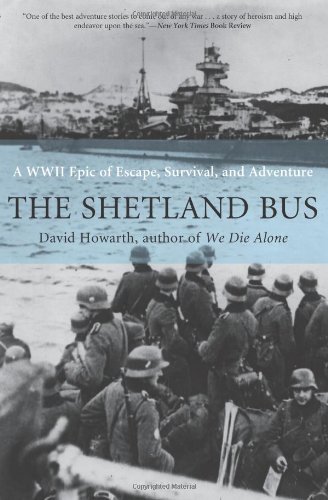
Odds are that most of you have never heard of the Shetland Bus. I knew nothing about it until I watched an episode of Shetland (BBC/BRITBOX), the TV series created based on the series of novels by Ann Cleeves set in Shetland, Scotland. The World War II operation piqued my interest. After researching it online, I found an excellent account of the secret operations during the early years of WWII in the book “The Shetland Bus” by David Howarth.

The Germans invaded Norway in 1940 and quickly gained control of the country. The King of Norway and his family, as well as many Norwegians, escaped to England via Shetland. They came on Norwegian fishing boats across the North Sea, landing in Shetland since it is Britain’s closest point to Norway. Norway and Shetland have always had strong ties. In the past Shetland was governed by Norway before becoming part of Scotland.

In 1940 British intelligence set up an operation using Shetland as a base for sending agents and weapons to Norway utilizing Norwegian fishing boats and their crews. These boats blended in with other fishing boats along the Norwegian coast, could operate in shallow water and narrow passageways, and their crews knew the Norwegian coast like the back of their hand. Darkness also provided cover so they took advantage of the long nights in the wintertime and avoided the long days of summer. Navigating the North Sea in winter meant sailing through the frequent storms, some with hurricane force winds. Experienced sailors and the sturdy Norwegian boats made the trips seem routine, but not without danger.

David Horwarth, author of the book “The Shetland Bus,” arrived in Shetland as a British Naval Officer in the spring of 1941. His superior, Major L. H. Mitchell of the British Army, had begun setting up the unorthodox base. The book is Horwarth’s account of his time in Shetland and his dealings with the Norwegian fishermen, their boats, and his management of personnel, supplies and equipment.

The book includes stories of crossing the North Sea in bad weather with waves crashing over the deck, of attacks by German airplanes and dodging bullets that bore holes into the small crafts , of plans going wrong requiring ingenuity by Norwegian fishermen to escape capture, and of the Norwegian refugees shivering in the cold on their way back to Shetland. Although Howarth never sailed to Norway himself, he reviewed the logs and interviewed the crews after every voyage. His accounts are fascinating and vividly realistic.

Although the British intelligence ran the base in Shetland, it was largely a civilian operation with volunteer Norwegian crews and a relaxed atmosphere encouraged by the few British Officers involved. Despite several boats and crew lost either to the Germans or to the sea, the operation succeeded. New boats were assigned and new crew members from among the refugees volunteered. Eventually, losses drove the higher-ups to seek additional resources. In the summer of 1943, help came from an unlikely source, the Americans. The U.S. Navy had developed a small, fast submarine chaser that fit the bill for what was needed for the trips between Shetland and Norway. Three were sent to Shetland. The Norwegian crews quickly learned to operate and maintain these sleek, new vessels. The submarine chasers started making runs to Norway in the fall of 1943. Their safer, faster crossings helped to achieve the goals of British intelligence without so much loss of life.

If you are curious about World War II in Norway, the Norwegian resistance, and the restrictions placed on the population of Norway by the Germans, I highly recommend this book. Even if you are only interested in the Norwegian fishing boats and how they navigated the North Sea, this book is for you. It is detailed and a joy to read.

Build A Highway Where? To Alaska!

You want to build a highway through Canada to Alaska? Why? That was the question in the 1920’s and 30’s when the highway was first proposed. Few people lived in the area and the economic impact didn’t justify the cost. Needless to say, there was little interest in such an enormous project.

By the time World War II started the Americans acknowledged the strategic military importance of a land route from the lower forty-eight states to the U.S. Territory of Alaska. If Japan invaded Alaska and/or blockaded the ports, there needed to be another way to get men and supplies to Alaska to defend the American territory closest to the Japanese homeland.

The U.S. Corps of Engineers was assigned the task of building the road which was officially started in March, 1942, when seven engineering regiments arrived in Dawson Creek, Canada. The railroad ended at Dawson Creek so this was designated the starting point for the Alaska Highway. Three of the seven regiments consisted of African-American soldiers and the other four regiments consisted of white soldiers. At that time, the U.S. Armed Forces were segregated so these regiments were kept separate. About 10,000 men were assigned to building the highway.

The engineers plowed through the Canadian wilderness following only trails. They had to adapt to the climate and learn how to keep their equipment running in the cold weather. The men lived in tents so conditions were not ideal for anyone.

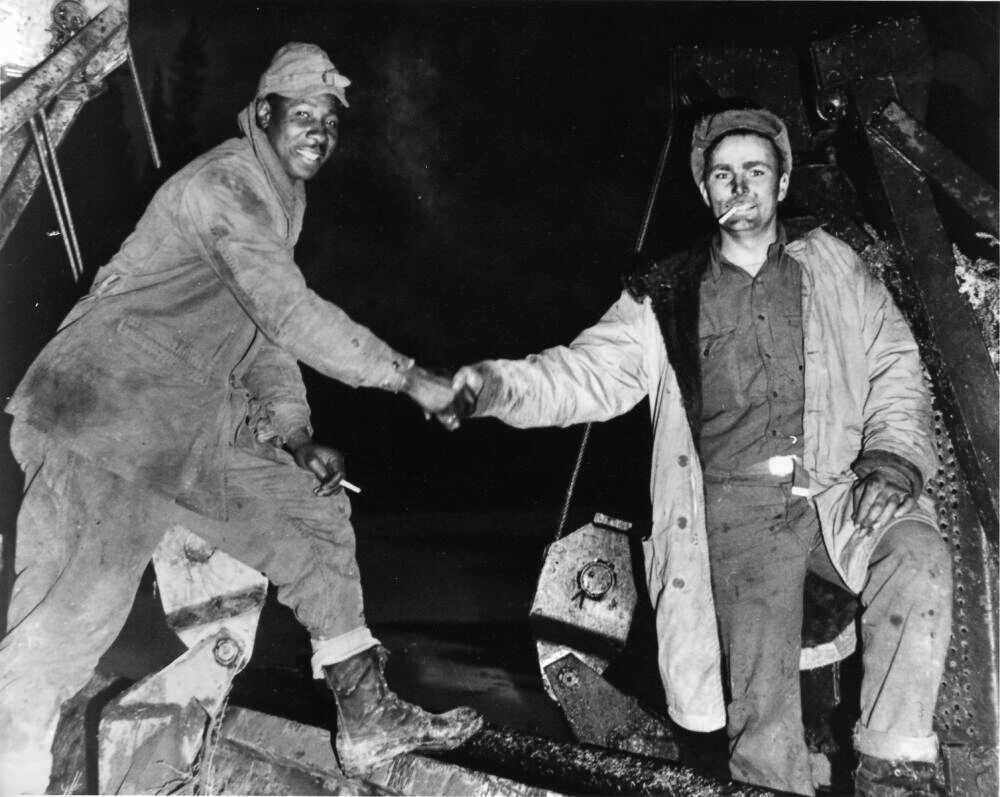
Work proceeded in opposite directions from designated points along the route of the highway. At one point, an African-American regiment worked in one direction toward a white regiment. The iconic picture above shows the representative from the 97th Engineers Regiment shaking hands with the representative of the 18th Engineers at the point where they met at Beaver Creek, Yukon Territory, Canada. The meeting, on October 25, 1942, completed the last section of the road. It had taken only eight months to build a 1500 mile road through the wilderness of Canada and Alaska.

For more information you can follow this link to a PBS article about building the Alaska Highway and this link to another PBS article about the men who built the highway.

Watch the video for a visual account of building the Alaska Highway. These color images vividly show the terrain the engineers faced, as well as their hard work and dedication to this vital war project.

If you are still interested and want even more information about the Alaska Highway, watch this longer, more detailed documentary.

Jeep – The Iconic Vehicle of WWII

Do you drive a Jeep? Does a friend or family member? Almost everyone has had some experience with a Jeep. How did this vehicle become so much a part of our culture?

On the left, in the jeep, is President Franklin Roosevelt. Standing on the right is General George Patton.

The American infatuation with the jeep started during World War II when the Army wanted a small, four-wheel-drive vehicle. They sent out a request for designs giving the companies mere days to respond. Only three companies responded: Willys-Overland, Ford and Bantam. A designer with Bantam sent in the first design which the military liked so much they asked Ford and Willys-Overland to replicate it and produce prototypes. The prototypes were put through the wringer with every test the Army could come up with. The little vehicle performed like a champ. All three companies were given contracts to build the jeeps, with the requirement that all the parts must be interchangeable. During the war over 600,000 were produced.

The beginnings of the jeep.

Jeeps were used in every theater of the war – from Europe to Africa, from Hawaii to Singapore, from Australia to Japan, and everywhere the Allies went around the world. The servicemen and women loved this little vehicle. It was used to simply transport soldiers, as a reconnaissance vehicle and as an ambulance. It towed artillery pieces and ammo trailers. Female drivers chauffeured officers in jeeps. On air bases the jeep carried pilots and crew members to their airplanes. Even the Navy used jeeps on their naval bases.

The jeep went practically anywhere. It traversed swamps, mountains, deserts, snow and jungles. You didn’t have to be much of a mechanic to work on it on the rare occasion it wouldn’t run and parts were easily available thanks to the early planning. The tough vehicle became indispensable.

The designers and manufacturers of the original military jeep never imagined that this little utility vehicle would become a major automotive brand. After the war, ex-servicemen bought up surplus military jeeps. Willys created a civilian version in 1945 and the four-wheel-drive craze began. Over the years the jeep evolved into the SUV’s we drive today.