Movies about WWII Returning Veterans

In my latest novel, Scarred Dreams, the hero’s significant combat injuries bring him back to a hospital in the U.S. As you can imagine his initial reaction to becoming a disabled veteran is anger, followed by a sense of uselessness. Today we would treat him for anxiety, depression, maybe even PTSD, as he deals with his new reality. For the hero’s character, I drew inspiration from many sources including movies about WWII returning veterans coping with the after effects of their combat experiences.

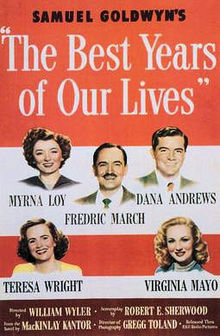
The most famous of these movies is “The Best Years of Our Lives” (1946) which tells the stories of three servicemen returning to their hometown after the war. One of the three, a sailor, has lost his hands and has learned to use hooks for replacements. Though the other two, a soldier and an airman, were not wounded, they struggle to adjust to civilian life after their combat experiences. Becoming friends, the men help each other get through the adjustment.

There are two other, lesser known films focused on veterans who were wounded in some way or had difficulty returning to civilian life.

Theatrical poster. Released by United Artists.

“The Men” (1950), starring Marlon Brando, takes place primarily in a paraplegic ward in a veteran’s hospital. One of many men who have lost the use of their legs, Brando’s character’s bitterness and anger prevent him from making the necessary changes to adapt to his new life. The physical therapists give him exercises to strengthen his upper body, yet he refuses to cooperate. He doesn’t want to go out into the world in a wheelchair and he refuses to see his pre-war girlfriend. Eventually, the other men in the ward bring him around. He allows his girlfriend to visit and even takes her out. Reality slams him hard and he must work his way back to acceptance of the permanence of his injuries. Only he can make the adjustments required to build a new life.
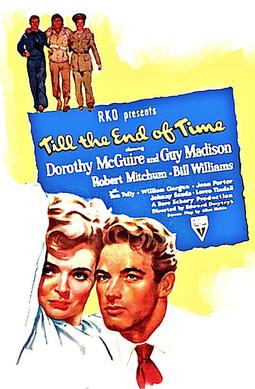
Theatrical Poster. Released by RKO Pictures

Another good film about returning servicemen is “Till the End of Time” (1946). The three main characters are portrayed by Robert Mitchum, Guy Madison and Bill Williams. Mitchum’s character received a head injury and as a result has a metal plate in his head and suffers headaches. Guy Madison was just out of school when he enlisted. He can’t return to being his parents teenage son. He has to find his way to a new life. Dorothy McGuire plays his love interest. Williams’ character, a former Marine, lost both his legs. Before the war he had been a boxer. Now he refuses to get out of bed and use his artificial legs. These three veterans try to help each other. As I watched this movie, I couldn’t help feeling for these men with their physical struggles and their struggles with memories of the horror of combat.

Even if you are not a history buff, if you have a person in your life who has returned from combat overseas, these movies will give you some insight into what they are going through. War is war, whether it is eighty years ago in World War II or thirty years ago in the Gulf War or more recently in Afghanistan. War takes a toll on the ones who fight and the ones who participate in other ways, such as treating the wounded.

Sign up for my newsletter by clicking HERE.

Follow my blog by filling in your email in the right-hand column and clicking on the FOLLOW button.

My Top Five WWII Home-Front Movies

Some of my favorite WW II films are set in the United States or on the “home-front.” These helped inspire me to write stories set on the “home front” as well as overseas. On the “home-front” almost everyone contributed to the war effort so there are many, many stories to be told. Here are my top five favorites in reverse order.

5. Saboteur (1942)

This Alfred Hitchcock thriller is a wartime, “home-front” movie as well as a romance. In the film Robert Cummings tries to clear his name by chasing down an arsonist only to become entangled with a spy ring trying to blow up Hoover Dam. Priscilla Lane and her uncle help him, and she becomes caught up in the action. Cummings suspects Norman Lloyd as the German spy. In New York the German sympathizers attempt to destroy a new battleship and are foiled by Cummings and Lane. They chase the spies through Radio City Music Hall. The climactic scene at the top of the Statue of Liberty is incredible, especially considering the technology of the time. Of course, Cummings and Lane get together in the end.

4. The Clock (1945)

This movie is definitely a wartime love story. Judy Garland accidently trips over Robert Walker’s foot in Pennsylvania Station. He’s on 48 hours leave before he has to ship out. He asks her out that evening, and they agree to meet under the Clock at the Astor Hotel. After dinner they end up spending the night delivering milk then have breakfast with the milkman and his wife. Garland and Walker become separated in a crowded subway and desperately try to find each other without knowing last names. Back at the train station they reunite and Walker asks Garland to marry him. They spend his last day of leave fighting red tape to get married before he leaves. Then they must say good-bye until he returns from the war. (Tear-jerker time)

3. The Human Comedy (1943)

Mickey Rooney stars as a teenager in a small town who delivers telegrams for Western Union. The poignant drama depicts the human side of war as Mickey delivers the news of a loved one lost in battle, while his own brother is serving overseas. A romance between his boss and a local girl stalls when he joins the military and leaves for service. Over time the whole town feels the effects of the war. This is my favorite Mickey Rooney movie.

2. Since You Went Away (1944)

Claudette Colbert’s husband leaves wife and daughters (Jennifer Jones and Shirley Temple) to fight the war. Life quickly changes – from taking in a boarder to losing their cook to war work to Jones working in a hospital full of wounded soldiers to Jones falling for a soldier to Colbert learning to weld. The family evolves and grows and learns to cope with all the changes brought on by the war. I love the depiction of strong women on the “home-front” not only keeping life going but also contributing to the war effort.

1. The Best Years of Our Lives (1946)

Absolutely my favorite WWII movie. Three men, a soldier (Frederic March) a sailor (Harold Russell) and an airman (Dana Andrews) return home together and try to adjust to civilian life. There’s awkwardness between March, his wife (Myrna Loy), daughter (Teresa Wright) and teenage son and trouble returning to his banking job. Russell must adapt to life without his hands and decide whether to marry his long-time girl friend. Andrews struggles to find work while his war-time bride (Virginia Mayo) wants to party all the time. The film won several Oscars including Best Picture.

Some other “home-front” movies I recommend are: Miracle in the Rain, Tender Comrade and A League of Their Own.