From Here To Eternity

I’ve just finished reading From Here To Eternity by James Jones, as I continue to read both current and older novels about World War II. From Here to Eternity is set in Hawaii in the year leading up to and including the Japanese attack on Pearl Harbor. It depicts the soldiers of the “old” Army, their training and life while stationed at Scholfield Barracks on Oahu.

In writing From Here To Eternity, Jones drew on his own experiences serving in the Army at Schofield Barracks in Hawaii. An eye-witness to the Japanese attack on December 7, 1941, Jones used that involvement to create the plot and characters in From Here To Eternity. The realism in the book could only have come from living through the events.

As his first published novel, From Here To Eternity became a best seller and won the National Book Award. That was quite a feat for a new novelist even in 1952.

Not only was the novel a success, Hollywood made it into a block-buster movie in 1953 starring Burt Lancaster, Montgomery Cliff, Deborah Kerr, Donna Reed, and Frank Sinatra. With this illustrious cast and Director Fred Zimmerman, the film version of From Here To Eternity won eight Academy Awards, including Best Picture, Best Director, Best Screenplay Adaptation, Best Supporting Actor (Frank Sinatra) and Best Supporting Actress (Donna Reed.) You definitely need to see this film, if you haven’t already.

By “Copyright 1953 Columbia Pictures Corp.” – Scan via Heritage Auctions. Cropped from original image., Public Domain, https://commons.wikimedia.org/w/index.php?curid=86221992

James Jones planned to write a World War II trilogy, From Here To Eternity being the first of three. Later he wrote The Thin Red Line published in 1962 and based on his experiences fighting in Guadalcanal. The Thin Red Line was another success, and it, too, was made into a movie in 1964 and again in 1998. Most of you will remember the 1998 version starring Sean Penn, Nick Nolte and Jim Caviezel, although I also recommend the 1964 version.

The third novel in the trilogy, Whistle, comes from Jones’s experiences recovering from his wounds in a veterans hospital in Memphis, Tennessee. Jones did not finish Whistle before his death of congestive heart failure in 1977. His friend and associate, Willie Morris, completed it from Jones’s volumes of notes and published it in 1978. I’ve read this one, too. Few novels or films show WWII wounded veterans recovering state-side. Whistle gave me insight that I later used in my novel Scarred Dreams.

I highly recommend From Here To Eternity. Note that writing styles were different in the early 1950’s. Also, Jones uses improper grammar and misspelling intentionally as a way to convey the characters level of education and background. If this bothers you, be aware and be prepared. I found the reading a little more difficult due to the style so it took longer to read, yet the novel, over all, is excellent. You will definitely want to read it. From Here To Eternity is truly an American classic.

Eleanor Roosevelt and a WWII Moment

Women’s History Month could not pass without honoring Eleanor Roosevelt, First Lady and so much more. There is little I can add to the volumes that have been written about her life, her contributions to the career of her husband, Franklin Roosevelt, and her later contributions to the United Nations. Instead I will tell you about some of what I admire about her.

Although her family was wealthy, she was a shy child from an unhappy home. Her mother died when she was young and her father was an alcoholic so Eleanor was raised by her grandmother. As she grew to adulthood she overcame her shyness and ventured out into society. When she married her handsome, distant cousin, Franklin, she would have been content to be a wife and mother, but her husband’s political ambitions threw her into the public arena. This public role would not have been her choice but she rose to the challenge. Even as First Lady she went beyond the expected role of managing social events and became her husband’s eyes, ears and legs. She traveled the country making speeches, listening to people in all walks of life and reporting back to the White House. It took a lot of inner strength to overcome her early life and become a force in Washington.

The quiet little girl became a savvy political figure who promoted women’s causes whenever she could. She encouraged her husband to appoint women to various positions in his administration. In a time when women reporters were not allowed in the White House news conferences, Eleanor began holding her own news conferences for women only. After Franklin’s death, President Truman appointed Eleanor as delegate to the newly formed United Nations. There she led the fight for resettlement of refugees and she is considered largely responsible for the Universal Declaration of Human Rights which is still protecting human rights around the globe.

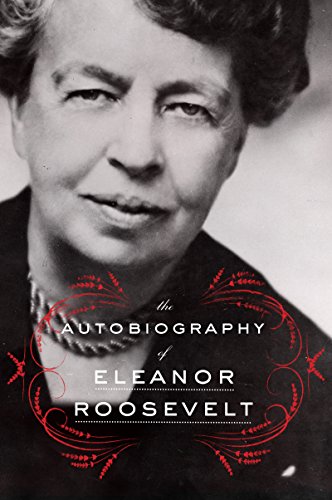
Another thing that garners my admiration is that Eleanor was a writer. Beginning during her tenure in the White House, she wrote a daily newspaper column “My Day” that was syndicated in newspapers across the country. This would have been the equivalent of writing a daily blog today. She also wrote regular columns for several magazines and had a weekly radio broadcast. After leaving Washington Eleanor wrote four autobiographies and several other books. These books are still available. I treasure my copy of the combined autobiographies.

The money she earned from this column and from her books she donated to charity. That brings me to another thing I admire about Eleanor Roosevelt. Her charity and compassion for the people. She gave her money and she gave of herself to better the lives of others.

Something that many people don’t know about Eleanor is that at the beginning of World War II when the Japanese attacked Pearl Harbor, Eleanor spoke to the American people about the attack before her husband’s famous speech to Congress. It was Sunday, December 7, 1941, and her weekly radio broadcast was scheduled to go on the air that evening. While Franklin consulted with the country’s leaders, Eleanor went on the air and talked to the people in her kind and compassionate style. She could relate to the feelings of fear families had because she too was a mother who had four sons of the age for military service.  Two of her sons were already in the military. She knew what was coming and she knew the people needed to hear a message of hope and courage so that is what she gave them.  Listen to her words in the attached You Tube recording.  How could you not admire a woman like that.