276th Armored Field Artillery Battalion – Part 2

When we last left our hero’s of the 276th Armored Field Artillery Battalion, it was February, 1945, and they had just crossed into Germany from Luxembourg.

I’m a map person. Several years ago I purchased a coffee-table book “US Army Atlas of the European Theater in World War II.” Researching this post I scoured the maps for locations mentioned in the 276th Battalion history and that exercise put some of the distances in perspective. In a straight line from Bastogne, Luxembourg, to Bitburg, Germany, it’s about 30 miles through hilly, heavily wooded terrain with crooked, narrow roads. The defenses of the Siegfried line ran along the German border between the two points. Bitter cold winter weather hindered progress as the Germans retreated behind their “west wall” line of defense. Can you imagine life for the men? Living outdoors, eating when they could, following orders, doing their jobs, fearing the next attack and struggling to survive. The 276th was a few miles southeast of Bastogne at the beginning of January. They did not reach Bitburg until Feb. 28, 1945. Eight long weeks.
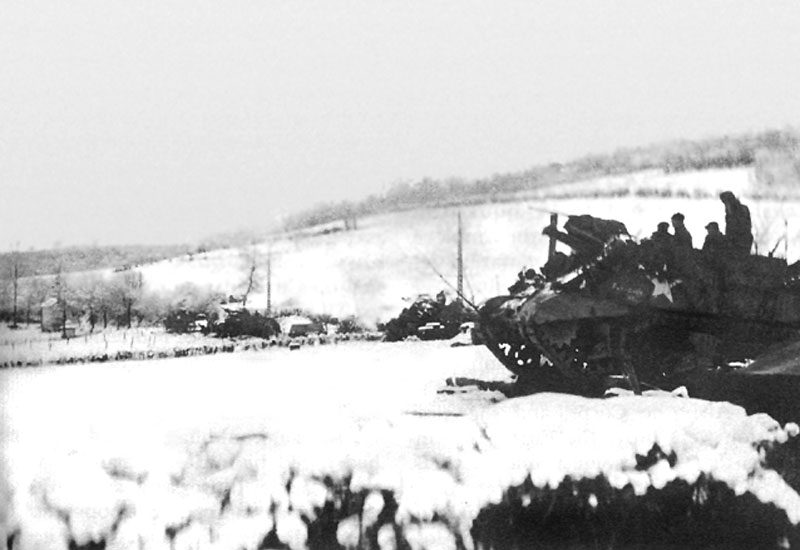
From the southern shoulder of the “bulge” in the line, due to the German counter-offensive later known as the Battle of the Bulge, the 276th moved toward the northeast in support of the 80th Infantry Division. On Feb. 7, 1945, the Battalion fired 1,702 rounds in preparation for the 80th attack across the Our River into Germany and against the Siegfried Line. The 276th fired a total of 2,610 rounds that day, more than 325 rounds per gun. After that firing continued at a rate of approximately 1,000 rounds per day as they continued to pound the German fortifications. On Feb. 19-20 the 276th again fired heavily in preparation for another attack by the 80th Division. This time the 276th AFA Battalion crossed the Sauer river into Germany near Cruchten.

During these attacks the 276th for the first time fired a mixture of rounds that consisted of 40% fuze delay, 50% fuze quick and 10% white phosphorus, a chemical that burned through anything and could not be extinguished with water. The combination proved effective against enemy troops and would be used again.

In early March they moved rapidly northward to Koblenz on the Rhine. My father-in-law told of sitting on high ground overlooking the Rhine river and seeing the Ludendorff Bridge at Remagen, north of Koblenz. Although not mentioned in the history, he remembered seeing the bridge and firing across the river to protect the crossing troops. Since it was the only bridge left intact across the Rhine, it had to be the bridge at Remagen. For years he had a print of the bridge hanging in his room.

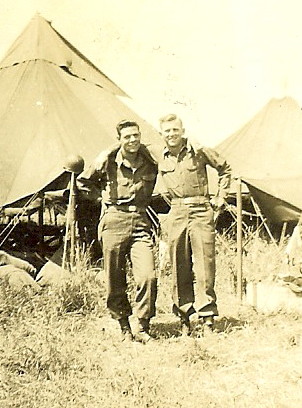
His buddy in the 276th told a funny story on him years later. While near the Rhine, a young man, drunk on liberated cognac, sat astride the gun barrel when German artillery began firing rockets on their position. He couldn’t get down so he rode out the barrage on the tube. Shells landed so close that the water cans hanging on the gun were shot off, but he didn’t get a scratch. According to my husband, his father didn’t want the story told and tried his best to stop his buddy from telling it in front of his sons. 
At Koblenz the north-east flowing Moselle joins the Rhine. On March 15 the 276th crossed the Moselle with elements of the 4th Armored Division. They continued toward the south-east against stubborn resistance from rear-guard troops and defiant towns. Although the men rarely knew what was going on overall in the war, they knew moving forward meant they were winning and that was always good news.

While the 4th Armored Division diverted south to take Worms, the 276th remained at Oppenheim to support a bridgehead operation by the 5th Division. They crossed the Rhine on a pontoon bridge above Oppenheim on March 24, then reverted back to supporting the 4th Armored Division on their swift advance east to encircle the city of Frankfort. Within days they advanced across northern Bavaria, heading northeast. On April 3 they ended a long road march near the city of Gotha with enemy aircraft and artillery firing on their advance. After an ultimatum Gotha surrendered the next day and the 276th moved south on the road to Ohrdruf.

On April 5th the battalion fired on the city of Ohrdruf against stubborn resistance by the Germans. When the enemy surrendered, the Americans learned why they defended it so stubbornly. Ohrdruf was a sub-camp of Buchenwald – the concentration camp and ‘death factory’ – and the first such camp discovered by the Americans. Although my father-in-law never spoke of it directly, Patton visited the camp and ordered that as many of his men as possible tour the camp as witnesses to the atrocities committed there. More than likely the men of the 276th saw the camp at Ohrdruf and, possibly Buchenwald, since they were in the area when it was discovered. The only time I ever heard my father-in-law say anything about the concentration camps was in the 1990’s when a TV program mentioned that there were people claiming the holocaust never happened. He adamantly insisted that it did happen, but he would say no more.

Reassigned to the 11th Armored Division, the 276th drove southeast from near Suhl  to near Kulmbach by April 12, battling not only Germans but also heavy rains. As part of Task Force Hearn another road march began near Grafenwohr, “site of the largest barracks and training area in central Germany,” and within a week they traveled 150 miles to Grafenau. Their objective was Linz, Austria on the Danube. The German army offered little resistance during this advance.

But, on April 30, the enemy made a stand at Wegscheld. After an all day assault, including heavy fire from the 276th, the 11th Armored Division occupied the demolished town. The battalion fired approximately 1,600 rounds that day, including a 90 round white phosphorous concentration. May 1st the 276 crossed into Austria with the 11th.

On May 2, the 276th received orders to return to supporting the 4th Armored Division near Lalling, Germany. They marched back to the northwest, then on May 3 moved to a ‘rest’ bivouac area near Saldenberg for three days. On the 5th they joined the 4th Armored Division moving east and north into Czechoslovakia toward the city of Strakonice. The Czech’s lined the roads welcoming their liberators.  They were still moving toward Prague when they received word that the German armed forces had surrendered. The war in Europe was over.
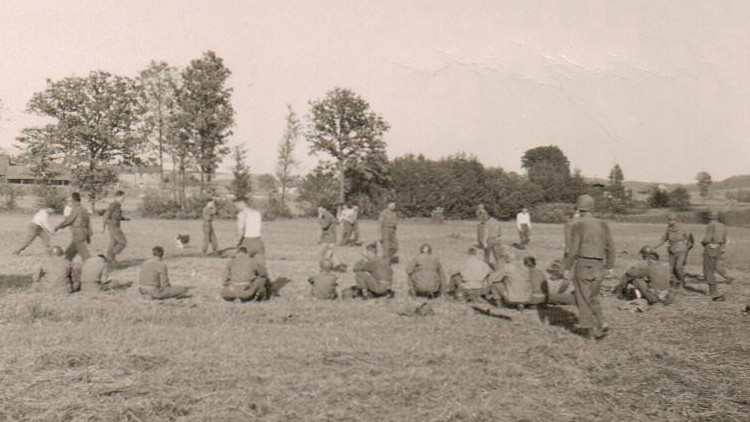
Surrendering German troops streamed through the battalion’s camp toward designated assembly areas. On May 10 the 276th motored to Bogen, Germany, where they became part of the military government and oversaw the flow of prisoners into fenced areas for processing to prisoner of war camps.

The joy and relief of victory in Europe was short-lived for the 276th. On May 13 they learned they would be deployed within 30 days to the Pacific Theater, traveling through the United States. On May 16 they participated in a ‘ceremony shoot’ for a group of Russian generals. On June 2 they received orders to move out. The heavy vehicle column traveled across Germany and France by train while the light motor column traveled by road meeting up at Camp Lucky Strike, near Le Havre, France. Here, due to the points system for discharge, members of the battalion with more than 85 points were transferred to the 341st FA Battalion of the 89th Infantry for transport home and discharge.

The remainder of the 276th embarked for the US from Le Havre, France, on July 2, 1945. It was one year to the day from their departure from New York.   By July 11 all had departed Camp Shanks, NY, for home on furloughs. Thankfully, by the time they were to reassemble for redeployment training, the Japanese had surrendered and the war was over.
Health Issues And Our Family History

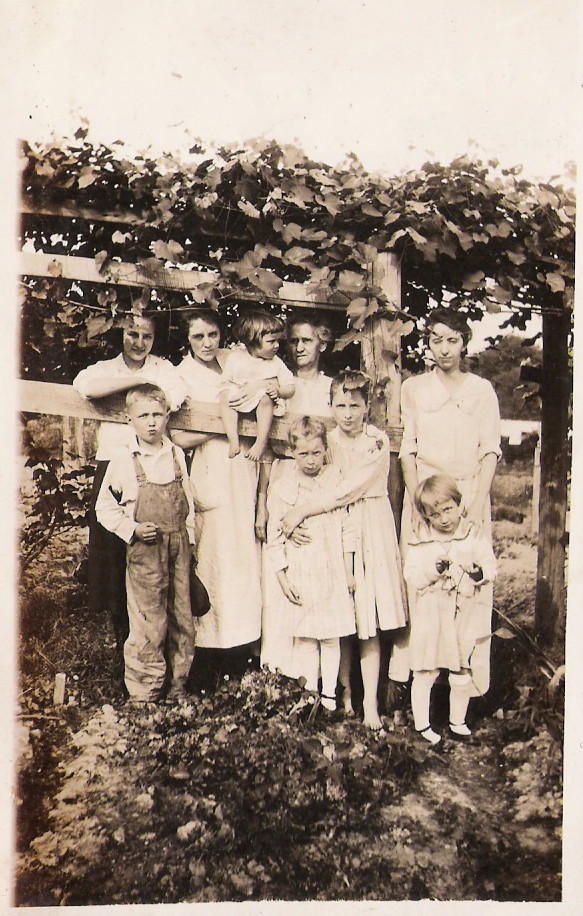
Illnesses and accidents affected our ancestors in many different ways. Often health issues changed the course of their lives and the lives of their families. Without the benefits of modern medicine, what today would be a simple illness became a life or death struggle, often ending in an untimely death.

After being under the weather during May (nothing serious), I thought about the health conditions in my own family history and how those medical problems impacted their lives. There were epidemics, accidents, women who died young after having too many children and those assorted family illnesses your doctor asks about when taking your family medical history.

We rarely hear about epidemics these days due to better sanitation, monitoring and medical treatments. In the past epidemics caused panic and many deaths. In 1873 Asiatic Cholera swept through the small community where my family lived. A father and son who were working on railroad bridges across one of the many creeks, contracted the disease. Both men succumbed, one day apart. First the father, then the son. This son had survived wounds suffered at Malvern Hill where he fought for the Confederacy. He returned from the war, married and fathered two children. His untimely death left his twenty-three-year-old widow to raise their son and daughter alone. That son was my grandfather, the one I never knew. Cholera took his father and his grandfather when he was only four years old and had a lasting effect on his family.

The Spanish flu epidemic of 1918 killed more people worldwide than died in World War I. Some call it a pandemic. Unlike today when the elderly and the very young are considered most at risk from the flu, in 1918 the flu struck healthy, young adults. My grandmother survived a bout of this virulent strain of influenza.  Her mother, my great-grandmother, took primary responsibility for my mother, a baby at the time, so her daughter could recover. My mother always said her grandmother raised her. In her later years my grandmother was susceptible to pneumonia due to the scaring of her lungs caused by the flu.

Accidents also impacted our family. My husband’s grandfather died in an automobile accident coming home to Tennessee from Detroit to visit his family for Thanksgiving. He went to Detroit to earn enough to pay off the mortgage on the family farm. He had paid the debt, purchased a new car and planned to return to farm with his grandsons. The oldest grandchild, my husband was twelve and his brother was eleven. They lost the opportunity to work on the farm with their grandfather. Due to the determination of my husband, his father and siblings much of the place his grandfather worked so hard to keep is still owned by family.

When my grandfather was eighteen and working for the railroad, he caught his arm between the couplings of two cars. His mother recorded both the date his arm was mashed and the day after when it was amputated in the family bible, reflecting the importance of the event. Unable to do physical labor with only one arm, he had to find an occupation suitable for a one-armed man in the 1880’s and 90’s. Medical knowledge at that time ensured that the injury did not threaten his life. Years later his eleven-year-old daughter fell from the porch and sustained internal injuries. These injuries might have been repaired with modern surgery, but in 1914 medicine had not progressed enough to save her. She died of her injuries leaving a grieving family.

Doctors of the past couldn’t always diagnose an illness. One of my great-grand fathers became unable to work on the farm due to an unknown ailment. So he sold the farm sometime after 1900 and moved to another town along the railroad where his wife and daughters ran a boarding house. Had it not been for the illness the family would have remained on the farm and one of the daughters would not have run off and married to a man who lived in the boarding house.

For at least two women in our family, having too many children appears to have contributed to their early demise. My great-aunt married in 1900, had seven children and died in 1911, a month after the birth of her last child. She was only thirty-one years old. In my husband’s family his great-grandmother married at age sixteen, had nine children and died in 1919 at age thirty-nine. Her death certificate gives tuberculosis as cause of death with influenza as a contributing factor, another victim of the influenza epidemic of 1918-19. In the case of my great-aunt, her husband moved his in-laws in with him to help him raise his children. He later married his first wife’s sister, my grandmother. In my husband’s family, his great-grandfather only lived four years after his wife’s death. The older children then took the younger ones, eight and eleven, to raise. We will never know if these women would have lived longer if birth control had been available back then.

Discussions of illness and death can get pretty depressing, yet it can be important to our own health to know about the ailments of our family members. My paternal grandmothers had colon cancer so I have colonoscopies more often than most people. We’ve identified several members of my mother’s family who had Alzheimer’s, including my mother, so the horror of that dreadful disease looms over us. A stroke caused my grandfather’s death in 1955 and 41 years later my father died from a stroke. My aunt said my father’s death was almost identical to the way their father had died years before. So I watch the blood pressure and cholesterol. My husband developed diabetes which affected the lives of several members of his family. So even if it feels uncomfortable, we should all have those family discussions about illness and causes of death. It could save our lives.

No doubt modern medicine would have changed outcomes and changed lives. Some of us might not be here if outcomes had been different. Yet such intimate knowledge gives a humanity to the old family tree and allows us to see them as people, struggling and suffering just as we do. They continue to live through the family stories passed down from one generation to the next. And perhaps we will learn something about ourselves.

Grandfather’s Books

My Grandfather

I recently unboxed some of my grandfather’s old books. Since he died years before I was born, these books provide a connection to a man I never knew. They represent a part of my family history and a reason for my lifelong love of books.

Until his death in 1920, my grandfather accumulated books. Inside each cover he either stamped or wrote his name so that everyone would know it belonged in his library. Since the small community had no public library, he would loan out books to students or friends. But he kept track of them and ensured they were returned.

Picture barrister bookshelves with glass doors covering one whole wall, floor to 12-foot ceiling, in my grandmother’s living room. More books filled shelves and cabinets throughout the house. This awe-inspiring world of books impressed upon me the value of the written word.

After her husband’s death, my grandmother meticulously maintained the library. I can see her holding the big, hand-written journal that listed every book and its location on the shelves.

By the time I reached high school, my grandmother deemed me responsible enough to borrow a book, but she always made sure I returned it. As she aged it became harder for her to keep track of the books. Gradually some went missing or were misplaced on the shelves.

Cousins with books

My bachelor uncle lived with my grandmother. As the youngest child, born after his father’s death, he continued to live in the home place after his mother’s passing in 1977 and became the custodian of the library. My uncle was brilliant and yet not quite normal. He lacked his parents’ sense of order and probably had some mental disorder. Over the years we have speculated on his possible diagnosis but, of course, we will never know. His original condition was exacerbated by his stint in the Army during World War II. Drafted, he never made it through basic training. He was hospitalized by the army until war’s end, then given a disability. According to my parents, he was never the same. When I read “To Kill a Mockingbird,” I immediately associated my uncle with Boo Radley. All the kids in town were either afraid of him or made fun of him. To me he was just my uncle, a little different, but part of our family.

Always suspicious of people, my uncle let few people into the house after his mother’s death. He knew more about family and local history than anyone around. He would have loved computers and the internet, if they had been around back then. And he might have had many online friends, instead of the few people in town who would talk to him.  In his latter years, a local man gained his confidence and convinced my uncle to lower the ceilings in the old house to save on his heat bill. To do the work everything had to be moved. Things went missing in the confusion, including some of the books. By the time my uncle figured out that the man was taking advantage of him, the damage was done – to the house, to the antiques and to the books.

After my uncle’s death, my brother and sister-in-law went through the house, inventoried everything and arranged for a sale. (Bless them for their hard work.) As the youngest of nine and with no children, the estate had to be divided up over many nieces and nephews, great-nieces and great-nephews.

The boxes of books I purchased at the sale are the ones I finally unboxed and put on my bookshelves. I have sets of books by Jules Verne, Bret Harte, Victor Hugo (including Les Miserables), Edgar Rice Burroughs (Tarzan),  Winston Churchill (yes he apparently wrote fiction), Rudyard Kipling and other less-familiar authors published around 1900. There are books by James Fenimore Cooper, essays and poems by Ralph Waldo Emerson, a history of the Italian earthquake of 1908 and a history of the Cuban struggle for independence.

Many other authors filled my grandfather’s library.  His interests were diverse and provide some insight into who he was. I remember Edgar Allen Poe, Alexander Dumas, Robert Louis Stevenson, a huge dictionary and a 1903 Encyclopedia Britannica, to name just a few.  In a time with no television or computers, when radio and movies were strange novelties, the library provided entertainment as well as knowledge to my grandparents and their children. For me, his books open a window into the past.

With all the talk today about e-books, e-readers and the demise of books as we know them, I wonder what today’s readers will leave behind. Will they simply delete the electronic files after they read them? Will they even think about transferring the files to someone else? Even paperbacks can be passed on to others. Why not e-books?

Although my old books have been damaged by dust, heat, humidity and the deteriorating acid paper, they can still be read. They have provided a legacy to several generations by inspiring a love of learning and literature. I believe that children who grow up surrounded by books, who are read to and who see their parents and grandparents reading will become readers themselves. Technology is wonderful, but I think books will be around for a long time.

Obituary of Sallie Nesbitt Sizemore

Sometimes when we research our ancestors we find some interesting characters on our family tree – such as my Great-Aunt Sallie Nesbitt Sizemore. Aunt Sallie married my Great-great-grandfather’s brother, Rufus Hicks Sizemore, in 1856, when he was 24 and she was 22. Years ago my mother showed me the faded newspaper which carried Aunt Sallie’s obituary and asked me to make photo-copies. More recently I typed it up before it faded into oblivion. The obituary reads like a tribute to a woman who was both prominent in the community and loved by all who knew her. She’s one of my ancestors I wish I knew more about. I hope everyone enjoys reading her obituary from almost one hundred years ago.

Obituary of Sallie Nesbitt Sizemore published in the Dickson County Herald

April 19, 1912

In Memoriam

Mrs. Sallie Nesbitt Sizemore was born in Dickson County, Tennessee, and died at the home of her son Claude H. Sizemore, in Dickson, Tenn. April 1, 1912, aged 78 years.

Mrs. Sizemore was a great-niece of the sainted Samuel McAdoo, one of the pioneers in establishing the Cumberland Presbyterian Church in this country. She became a member of the Cumberland Church when just a child and was a faithful and loyal Christian all her life. She was married to Dr. R. H. Sizemore and was a faithful and devoted wife for him to his death.  He died at Erin, Tenn., July 14, 1879.

Three sons blessed the united life of Mrs. Sizemore, vis.: Eugene A., who died in infancy; Clarence R., now living in St. Louis, Mo., and Claude H., a resident of Dickson, Tenn. The deceased has also left one brother and one sister to mourn their loss.  Mrs. Sizemore had every attention in her last sickness that loving hands and tender hearts could render. It was not until the inevitable came upon her that she would allow special attention.

She was a woman of great willpower and never wanted anyone to attend to her so long as she could wait on herself.  She was cheerful and hopeful in all her sickness up to only a short time before the end came. Her faith in God was fixed to the end. Almost with her latest breath she whispered, “It is well.” She knew no fear of any thing, or any body. She fully believed her life was safe anywhere. Day or night, if she felt duty called, she did not hesitate, but, at once, would go out in the darkness of the night that she might be a help somewhere. Her husband was a surgeon in the army during the war between the States, and this good woman soon felt that loyalty to her husband demanded her presence with him in his delicate work, and she went to him and for two years, or longer, she was right by his side assisting him in his work.  Many of the old soldiers yet living say she was God’s angel among the wounded and dying.  At her funeral veterans of the gray were her pall-bearers. Many of them as they looked upon her cold form for the last time could not refrain from weeping. It was by their hands her body was consigned to its last resting place.

Her patriotism is no less spoken of than that of many of the illustrious dead who fell in line of battle. Many of her courageous and daring deeds are recalled by those who were with her and knew her army record. I only mention a few here. At one time she passed between the Union and Confederate lines while under fire with a looking-glass under her arm, playing the citizen of the neighborhood. At another time, on hearing of the hunger of an almost starving rebel, she determined to get some potatoes nearby, and though the army on both sides were in battle array she passed somehow the pickets, got the potatoes and returned and was reprimanded by her husband for taking such risks. Her simple reply was, “I got the potatoes.” Another time, at the point of a pistol she forced a horse thief to put back her horse in the stable, warning him that to carry out his orders would result in his death. She was taken to Atlanta while the city was being shelled, but made her escape in a meat car. In a difficulty between a Federal officer and her husband she threw herself between them to save her husband from the drawn sword in the officer’s hand. She defied the officer and called him a coward. She often went among the sick and dying administering medicine and giving such other help as she knew how to give in their troubles. She assisted her husband in dissecting, often standing in heaps of limbs all around her, she holding the tallow candle, the only light available, while her husband was amputating and otherwise attending the soldiers.

Mrs. Sizemore was indeed a remarkable woman and her long life of heroism and Christian labor is an inheritance for her grown sons that they will ever enjoy. The older people feel the loss of a comrade. The younger ones feel the loss of a loving and congenial mother, who was ever ready with a rich story to rehearse that would thrill and make them love her memory. She sleeps the sleep of the good and brave. Some sweet day we shall meet her again.

Her funeral was conducted from the M. E. Church, South, in Dickson,Tenn., before a large audience of sorrowing friends, April 3, 1912.

Gold Coin – 160 Years Old

With gold at record high prices, like many others, I started looking at my jewelry to see if there were any odds & ends I could sell. Broken chains, single earrings, and other such pieces. This got me to thinking about what I have, where they came from and what the items mean to me. Some pieces hold such sentimental value that I would never sell them.

One of my treasures is the gold coin necklace my mother gave me years ago. Along with the gift came the story, the family history tied to the coins. This piece of family lore makes the coin necklace a treasure beyond price.

My great-grandmother, Theodosia, was born in Mississippi in 1858. According to family stories she received my coin, a 2 1/2 dollar gold piece dated 1851, as a birthday gift. Dosia lived most of her life in Tennessee where she died at the age of 82. She gave two coins, mine and another dated 1850, to my grandmother who in turn passed them on to my mother. After having the coins set in bezels so they could be worn as necklaces, my mother gave them to my sister and me.

That explains how I came to own the coin, but it doesn’t tell the whole story. I can only speculate on the origin of the coins. Did they come from Dosia’s father or, perhaps, her grand-father? Was it a family custom to give the children gold coins on their birthdays? Did her mother put the coins away so that Dosia and her siblings would have them when they grew older?  Whatever the plans for the coins, the outbreak of the Civil War in 1861 changed everything.

Dosia’s father, R. B. Sizemore, enlisted in the 26th Mississippi Infantry, C.S.A. Her mother, Elvira, remained behind to tend the farm and their four children. Late in 1864 R. B. Sizemore died a result of some unknown disease, rather from battle wounds. From the history of the 26th, the date he enlisted and his death, we can surmise that he participated in the Battle of Ft. Donelson  (Feb. 1862) where he was taken prisoner and exchanged six months later at Vicksburg. During the following year the regiment defended Mississippi, Louisiana and Alabama against Grant and Sherman. Then in May, 1864, they journeyed east to Virginia where they fought in the Wilderness Campaign, the Seven-Days battles around Richmond and finally to Petersburg. There is no way for us to know when R.B. became ill. We only know he died in Mississippi in December, 1864.

Sometime during the war, either before or after R.B.’s death, Elvira hid the gold coins in a stump for safekeeping. She probably stashed more than the two coins, but we will never know what treasures she hid away so that they would not be stolen in those uncertain times.

My great-great-grandmother remained on the farm in Mississippi until 1867 when she took her children north to her mother-in-law’s home in Tennessee. Theodosia was nine years old.

After her mother remarried in 1870, to her father’s brother, Dosia went to live with another of her father’s brothers, R. H. Sizemore. This uncle was a doctor who had served as a surgeon in the Confederate Army with his wife, Sallie, by his side as his nurse.

During the time Dosia lived with her aunt and uncle, she must have met her future husband, John Uffleman. He was the oldest son of German immigrants who came to America in 1850 and settled in Beaver County, Pennsylvania. John’s family did not participate in the Civil War. In 1867 his entire family left Pennsylvania, came down the Ohio River, then up the Cumberland River. They bought enough cheap land in western middle Tennessee along Wells Creek to divide into separate farms for each son.

Dosia and John married in 1879. My grandmother, Elvira, born in 1893, was the fourth of five children to survive to adulthood. The family lived on the farm on Wells Creek until John became unable to work. Sometime around 1905 they sold the farm and moved to McKenzie, Tennessee, where they ran a boarding house near Bethel College. My grandmother told me that they left the farm when she was 12 so I’ve calculated the date based on that.  During their time in McKenzie, my grandmother attended Bethel College. After their oldest daughter, Lois, died in 1911, John, Dosia and their two younger daughters returned to Houston County, near their former home, to help raise the grandchildren.

Theodosia Sizemore Uffleman led a fascinating life spanning the years from before the Civil War until the beginning of World War II. That’s a big chunk of American history. The coin pendant gives me a tangible connection to the places she lived, to the events of her personal life and to the historical events of the time.  When I pass it on to one of my grandchildren, I also hope to pass along the story of Dosia’s coins.

Introduction

Welcome to my website! Join me as I journey through history doing research for my novels, visiting historic sites and digging into my family genealogy. To introduce myself, I will begin with where I grew up – because I am one of those southern women whose identity is strongly tied to place and ancestry.

I was raised in middle Tennessee between the Cumberland and Tennessee Rivers in the small town of Erin. The story goes that Erin was named by the Irish railroad workers in the mid-1800’s because the green valley nestled between steep hills reminded them of Ireland. But the area was occupied much earlier.

American Indians, including the Cherokee, the Creeks and the Choctaw, shared middle Tennessee as a hunting ground. Evidence of human occupation has been dated back to pre-historic times. The Wells Creek Basin is the site of an ancient meteorite crater. Indians traded flint from Wells Creek as arrow heads and spear heads throughout North America. On a trip to Yellowstone in the 1970’s I visited the Buffalo Bill Historic Center in Cody, Wyoming, where I was surprised to find a collection of arrowheads from Wells Creek, Tennessee, on display.

My grandfather Boone was an amateur geologist/archeologist. He collected rocks, including dolomite and shatter cone from the Wells Creek Basin and various Indian artifacts from the area. Although he died when my mother was four, my grandfather’s collections remained on display in my grandmother’s house, like a private museum. The stories fascinated me and his collection inspired the “rock hound” in me to start my own collection.

The first influx of settlers came to the area where I was raised after the Revolution when Continental soldiers received land grants as payment for their service. Some soldiers sold their land to settlers and speculators, but many brought their families west to what was then the frontier. The McMillan’s, my fraternal grandmother’s family, settled on their land grant in what became my hometown. The McMillan family cemetery is situated on a hillside in western end of the valley overlooking the middle school (old high school), the nursing home, and much of the community known as Arlington. These early settlers were primarily of Scotch or Scotch-Irish descent who brought with them an independent spirit and strong religious faith.

Several regiments were raised in the area during the Civil War. My maternal great-grandfather served in the 14th Tennessee and fought in the eastern theatre. My fraternal great-great-grandfather served in the 24th Tennessee Sharpshooters and Maney’s Battery along with his two brothers and one brother-in-law. His other brother-in-law served in the 50th Tennessee. My maternal great-great-grandfather served in the 26thMississippi Infantry.  All these soldiers reflect the strong support for the Confederacy within my family, yet none represent the “traditional” image of the south filled with wealthy plantation owners. They were all small farmers or local merchants.

After the war, people from the north came south in search of cheap land. Among these were my maternal great-great-grandparents, who emigrated from Germany in 1850 and settled in Beaver County, Pennsylvania. In 1867, they came down the Ohio and up the Cumberland to Wells Creek and purchased farmland. These are my German ancestors and the most recent of my ancestors to come to America.

In 1871 portions of Stewart, Montgomery, Humphreys and Dickson Counties were combined to create Houston County, named for Sam Houston, former Governor of the State of Tennessee. Sam Houston is one of the many historical figures from Tennessee. Unfortunately, I can claim no kinship to the Tennessean turned Texan.

In 1886, Goodspeed published a history of Tennessee which includes a History of Houston County.  The account provides fertile ground for the imagination. So many individual stories, so many lives to explore. These are the people who make up the fabric of our country. Real history, about real people, helps us understand who we are and where we came from. It’s why I love history. It inspires me to write, to transform bits and pieces of real lives into fictional characters and stories.

Over time I will share some of the history that inspires my historical romantic fiction and my women’s fiction stories.