During WWII, the two bombers that carried the load in European air war for the Americans were the B-17 Flying Fortress and the B-24 Liberator. In my latest work-in-progress I am trying to decide which airplane my hero/navigator would have flown. My first thought was to use the B-17 since it seemed more glamorous, but with more research about both planes, I found that the Liberator was quite a plane, too. After all, Jimmy Stewart flew the B-24. How’s that for glamor?
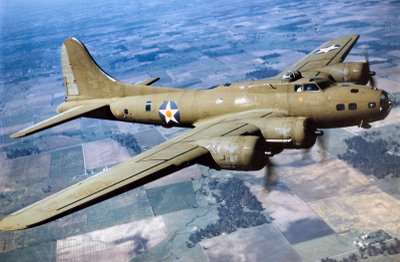
Boeing B-17 Flying FortressAlmost everyone has heard of the iconic B-17. When we think of bombers of that era, images come to mind of planes shot full of holes, with sections blown off and engines not functioning, yet landing safely on air fields in England. Those images are usually of B-17’s. Its crews loved the Flying Fortress because it took lots of damage and still brought them home.
Memphis Belle
Anyone remember the Memphis Belle? It was the first bomber that finished the required 25 missions in 1943. (Mission requirements were increased to 30 and then to 35 in 1944) Major William Wyler, the famous director and movie maker, as part of the First Motion Picture Unit of the US Army Air Forces, directed a film depicting the final flight of the Memphis Belle. The footage became the documentary “The Memphis Belle: A Story of a Flying Fortress.” As a morale booster for the Army and the folks back home, the crew, the plane and the movie toured the US selling war bonds and recruiting flyers for the Army Air Force. In 1990, Hollywood made a movie about that last flight, “The Memphis Belle.” Both films depict the lives of bomber crews in WWII and are well worth seeing.
Consolidated B-24 LiberatorBut what about the B-24 Liberator? In researching accounts of WWII bomber crew members, I discovered that Jimmy Stewart (Yes! the movie star) flew combat missions over Europe in B-24’s. Starr Smith wrote in “Jimmy Stewart Bomber Pilot”about Jimmy enlisting before the war even started. He earned his wings and became an instructor flying B-17’s. Apparently the military feared Stewart would be harmed if sent overseas, which frustrated Stewart. Finally in 1943 his wish for combat duty came true with his assignment to the 445th Bomber Group, part of the Eighth Air Force. He quickly learned to fly the B-24 and within months received orders for England. Captain Stewart commanded the 703rd Squadron of the 445th Bomber Group and regularly flew combat missions. Promoted to Major and transferred to the 453rd Bomber Group as Operations Officer, Stewart continued to fly combat missions, including flying on D-Day (June 6, 1944). In July 1944, Lt. Colonel Stewart’s transfer to Second Combat Wing Headquarters severely limited his combat flying. In his twenty-three months overseas, Stewart flew 20 combat missions over Europe, all in B-24 Liberators.
Jimmy StewartData for a head to head comparison of the B-17 and the B-24 can be found on several websites for anyone who likes statistics. One interesting difference I found was that the B-17 was slower than the B-24. The difference in speed meant that the two bombers could not fly in the same formations, although they were often sent on the same missions. But the B-17 could fly at higher altitudes. There is no doubt that the Flying Fortress crews and the Liberator crews each believed their plane the best and maintained an ongoing, good-natured rivalry.
Some believe that the B-17 got better press during the war and many thought it a better looking plane. It is definitely the one most people associate with WWII.
So, which plane will I use in my book? I haven’t decided. But I’m leaning toward the B-24 because it’s less known and because I have found some good books to use as reference material. Among them are: “A Reason To Live” by John Harold Robinson who flew as a gunner and engineer on a B-24; “Lucky Penny’s Tail” by Gregory J. Matenkoski recounting the story of Edmund Survilla, a tail gunner on a B-24; and “Jimmy Stewart Bomber Pilot” by Starr Smith.
For additional research, I plan to travel to Savannah, Georgia, to visit the Mighty Eighth Air Force Museum sometime in the near future. This museum should give me additional details and insight into the WWII air war. Wouldn’t I love to take a ride on one of those old planes? I’m watching for an opportunity.
The concept of coastal artillery has been around for a long time. With the invention of the cannon centuries ago, countries along the sea realized they could defend their shores from invasion by positioning guns at key locations. Important harbors and port cities became the primary location for defensive forts armed with artillery pieces.
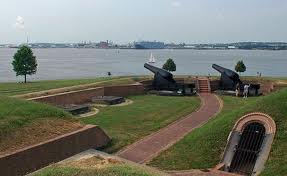
Think about our early history. During the War of 1812 Fort McHenry defended Baltimore and we sing about it in our national anthem. At the tip of Manhattan in Battery Park the guns of Castle Clinton protected New York City during the same war. Even Fort Sumter’s guns were intended to defend Charleston from invaders, not fire on the Federal troops to start the Civil War.
Guns at Ft. McHenry
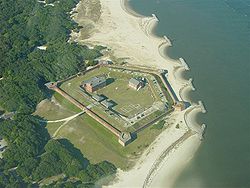
During the Civil War, locations like Fort Clinch on Amelia Island, Florida, and Fort Morgan in Mobile Bay, Alabama, controlled important shipping lanes. Confederates and Federals fought to occupy these key positions.
Fort Clinch, Amelia Island, Florida
Hitler’s Atlantic Wall was a classic and extensive example of coastal artillery used to defend a coastline. Fortifications built along occupied Europe’s Atlantic Coast created a defensive wall against the Allied invasion that both sides knew was inevitable.
German Gun Emplacement on French Coast
During WWII the Coastal Artillery was also a vital part of this America’s defense. After the attack on Pearl Harbor, the US expected the Japanese to attack the west coast. And German U-Boats were expected to attack US ports on the Atlantic and Gulf coasts. The Army updated the already existing forts and gun emplacements and added anti-aircraft guns.
Battery Davis 16 in gun at San Francisco
My father’s service in the coastal artillery from 1942 to 1943 spurred me to learn more about this now-defunct branch of the military. Stationed at the entrance to San Francisco bay, he manned huge guns aimed at the surrounding ocean to protect the city and the bay.
The Presidio of San Francisco, a military post dating back to the Spanish and Mexican days, became the headquarters for defense of the west coast. Its location on the San Francisco side of the Golden Gate bridge oversaw the narrow entrance to the bay. An extensive network of fortifications, gun emplacements, anti-aircraft guns and observation posts located on the opposite side, in what is now part of Golden Gate National Recreation Area, also protected the critical passage.
Disappearing Rifle at Battery Chamberlin, Presidio, San Francisco
The American military expected the Japanese to attempt to get into San Francisco Bay and wreak havoc so they developed defenses to prevent intrusion. The Navy laid minefields and stretched a huge anti-submarine net across the inner harbor. Navy tug boats would open and close it for authorized vessels. In 1939 a German submarine penetrated Scapa Flow, the main British naval base, and sank a battleship, so it was no far-fetched idea.
During WWII San Francisco was the busiest port on the west coast. My father recalled looking out over the harbor and seeing thousands of ships, both military and civilian. He expressed pride in protecting this vital port. He told of manning the big guns, the blackouts along the coast and walking patrol on the beaches. The threat of saboteurs sneaking ashore was very real in those days.
As the war progressed US forces destroyed much of the Japanese and German navies, thus reducing the threat to our coast line. Recapturing islands such as Midway and Wake made airborne attacks less likely. By 1944 the military realized that neither the Japanese nor the Germans could mount an invasion or a serious attack on the US. With manpower needed elsewhere in Europe and the Pacific, coastal artillery units were stripped and soldiers were reassigned to the field artillery or the infantry. That usually meant overseas duty for the men. It also spelled the end of the Coastal Artillery.
My father was on the list to be transferred overseas when his request to join a newly formed medical rehabilitation unit was approved. While his brother fought in the Pacific under MacArthur recapturing the Philippines and other islands, my father remained stateside and helped wounded veterans regain their health and strength. (The story of this unique rehab unit will be the subject of another post.)
Advances in the technology of warfare, through airplanes and missiles, caused the demise of the coastal artillery. After WWII with the advent of the Cold War, the Strategic Air Command (SAC) and inter-continental ballistic missiles (ICBM’s) took over the nation’s defense. And coastal artillery faded into history. A few of the locations remain as local or national parks and historic sites. Visit some of these unique sites for a stroll into the past.
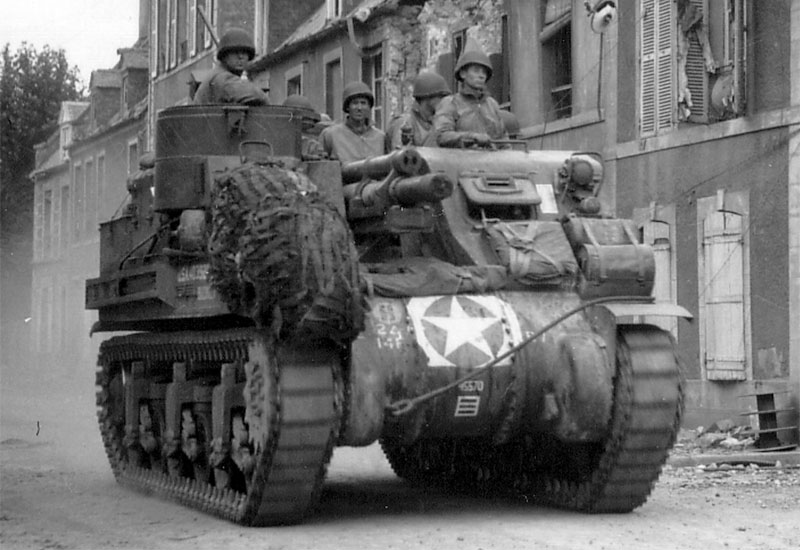
To the average person, this vehicle looks like a tank, but it’s not. It’s an artillery piece. One key difference is the main gun, a 105 mm Howitzer. Compare this to a 75 mm gun on a Sherman tank. Also on the M7 the crew is riding on top of the vehicle in the open unlike a tank crew tucked away safely inside the tank. So the men on the M7 had no armor plating protecting them in combat. But the track gave this gun the mobility to advance alongside tanks and infantry into the thick of battle.
My father-in-law served on an M7 in the 276th Armored Field Artillery Battalion. When his son asked him what he did in WWII, the veteran told him he was on a tank, rather than trying to explain to him about the track-mounted artillery piece. So as a boy my husband proudly proclaimed to his friends that his father served on a tank with Patton. As he grew older my husband learned more about the war and he continued to ask his father questions. Although reluctant to talk about his WWII experiences, the ex-GI explained that the vehicle he manned was actually an M7 105 mm Self Propelled Gun, also called an M7 Priest. (The British dubbed it “Priest” due to the .50 caliber machine gun mounted in a drum-like ring on the front that resembled a priest’s pulpit.)
The former soldier rarely relayed stories about the war. When he did, he told of experiences during the Battle of the Bulge, Remagen Bridge and the invasion of Germany as part of Patton’s Third Army. GI’s on the front didn’t know the big picture. He said that as long as they were moving, they figured things were going good.
Reading the history of the 276th AFA BN put their role in the war in perspective. I learned that these artillery pieces were assigned to whatever front or division needed their support. So, like other artillery units, the 276th was not included in the combat records of any particular division, which makes research for specific details much more difficult. Fortunately we have a copy of the official account printed immediately after the war and given to each soldier in the unit.
M7 Priest in Michigan
Last summer while visiting relatives in Michigan, my brother-in-law took us to a VFW outside Flint where an M7 Priest is on display. For the first time my husband saw, in person, a gun like his father’s. Having served in an armored unit himself, my husband has been around many tanks, but seeing and touching this vehicle thrilled him. He even climbed up on top in the rain to gain perspective on his Dad’s experience riding atop the powerful gun. That day we both made a connection to his Dad and his experiences during the war, experiences that changed a 19-year-old forever.
Dad’s Gun
If you are interested in the history of action aboard the M7 during the second world war, read “Longneck, A History of the 274th AFA BN” by Jack K. Morrison or “Payoff Artillery – WWII” by Frank H. Armstrong. Both these veterans give fascinating accounts of their service in these unique units.






 Barbara Whitaker