Obituary of Sallie Nesbitt Sizemore

Sometimes when we research our ancestors we find some interesting characters on our family tree – such as my Great-Aunt Sallie Nesbitt Sizemore. Aunt Sallie married my Great-great-grandfather’s brother, Rufus Hicks Sizemore, in 1856, when he was 24 and she was 22. Years ago my mother showed me the faded newspaper which carried Aunt Sallie’s obituary and asked me to make photo-copies. More recently I typed it up before it faded into oblivion. The obituary reads like a tribute to a woman who was both prominent in the community and loved by all who knew her. She’s one of my ancestors I wish I knew more about. I hope everyone enjoys reading her obituary from almost one hundred years ago.

Obituary of Sallie Nesbitt Sizemore published in the Dickson County Herald

April 19, 1912

In Memoriam

Mrs. Sallie Nesbitt Sizemore was born in Dickson County, Tennessee, and died at the home of her son Claude H. Sizemore, in Dickson, Tenn. April 1, 1912, aged 78 years.

Mrs. Sizemore was a great-niece of the sainted Samuel McAdoo, one of the pioneers in establishing the Cumberland Presbyterian Church in this country. She became a member of the Cumberland Church when just a child and was a faithful and loyal Christian all her life. She was married to Dr. R. H. Sizemore and was a faithful and devoted wife for him to his death.  He died at Erin, Tenn., July 14, 1879.

Three sons blessed the united life of Mrs. Sizemore, vis.: Eugene A., who died in infancy; Clarence R., now living in St. Louis, Mo., and Claude H., a resident of Dickson, Tenn. The deceased has also left one brother and one sister to mourn their loss.  Mrs. Sizemore had every attention in her last sickness that loving hands and tender hearts could render. It was not until the inevitable came upon her that she would allow special attention.

She was a woman of great willpower and never wanted anyone to attend to her so long as she could wait on herself.  She was cheerful and hopeful in all her sickness up to only a short time before the end came. Her faith in God was fixed to the end. Almost with her latest breath she whispered, “It is well.” She knew no fear of any thing, or any body. She fully believed her life was safe anywhere. Day or night, if she felt duty called, she did not hesitate, but, at once, would go out in the darkness of the night that she might be a help somewhere. Her husband was a surgeon in the army during the war between the States, and this good woman soon felt that loyalty to her husband demanded her presence with him in his delicate work, and she went to him and for two years, or longer, she was right by his side assisting him in his work.  Many of the old soldiers yet living say she was God’s angel among the wounded and dying.  At her funeral veterans of the gray were her pall-bearers. Many of them as they looked upon her cold form for the last time could not refrain from weeping. It was by their hands her body was consigned to its last resting place.

Her patriotism is no less spoken of than that of many of the illustrious dead who fell in line of battle. Many of her courageous and daring deeds are recalled by those who were with her and knew her army record. I only mention a few here. At one time she passed between the Union and Confederate lines while under fire with a looking-glass under her arm, playing the citizen of the neighborhood. At another time, on hearing of the hunger of an almost starving rebel, she determined to get some potatoes nearby, and though the army on both sides were in battle array she passed somehow the pickets, got the potatoes and returned and was reprimanded by her husband for taking such risks. Her simple reply was, “I got the potatoes.” Another time, at the point of a pistol she forced a horse thief to put back her horse in the stable, warning him that to carry out his orders would result in his death. She was taken to Atlanta while the city was being shelled, but made her escape in a meat car. In a difficulty between a Federal officer and her husband she threw herself between them to save her husband from the drawn sword in the officer’s hand. She defied the officer and called him a coward. She often went among the sick and dying administering medicine and giving such other help as she knew how to give in their troubles. She assisted her husband in dissecting, often standing in heaps of limbs all around her, she holding the tallow candle, the only light available, while her husband was amputating and otherwise attending the soldiers.

Mrs. Sizemore was indeed a remarkable woman and her long life of heroism and Christian labor is an inheritance for her grown sons that they will ever enjoy. The older people feel the loss of a comrade. The younger ones feel the loss of a loving and congenial mother, who was ever ready with a rich story to rehearse that would thrill and make them love her memory. She sleeps the sleep of the good and brave. Some sweet day we shall meet her again.

Her funeral was conducted from the M. E. Church, South, in Dickson,Tenn., before a large audience of sorrowing friends, April 3, 1912.

Gold Coin – 160 Years Old

With gold at record high prices, like many others, I started looking at my jewelry to see if there were any odds & ends I could sell. Broken chains, single earrings, and other such pieces. This got me to thinking about what I have, where they came from and what the items mean to me. Some pieces hold such sentimental value that I would never sell them.

One of my treasures is the gold coin necklace my mother gave me years ago. Along with the gift came the story, the family history tied to the coins. This piece of family lore makes the coin necklace a treasure beyond price.

My great-grandmother, Theodosia, was born in Mississippi in 1858. According to family stories she received my coin, a 2 1/2 dollar gold piece dated 1851, as a birthday gift. Dosia lived most of her life in Tennessee where she died at the age of 82. She gave two coins, mine and another dated 1850, to my grandmother who in turn passed them on to my mother. After having the coins set in bezels so they could be worn as necklaces, my mother gave them to my sister and me.

That explains how I came to own the coin, but it doesn’t tell the whole story. I can only speculate on the origin of the coins. Did they come from Dosia’s father or, perhaps, her grand-father? Was it a family custom to give the children gold coins on their birthdays? Did her mother put the coins away so that Dosia and her siblings would have them when they grew older?  Whatever the plans for the coins, the outbreak of the Civil War in 1861 changed everything.

Dosia’s father, R. B. Sizemore, enlisted in the 26th Mississippi Infantry, C.S.A. Her mother, Elvira, remained behind to tend the farm and their four children. Late in 1864 R. B. Sizemore died a result of some unknown disease, rather from battle wounds. From the history of the 26th, the date he enlisted and his death, we can surmise that he participated in the Battle of Ft. Donelson  (Feb. 1862) where he was taken prisoner and exchanged six months later at Vicksburg. During the following year the regiment defended Mississippi, Louisiana and Alabama against Grant and Sherman. Then in May, 1864, they journeyed east to Virginia where they fought in the Wilderness Campaign, the Seven-Days battles around Richmond and finally to Petersburg. There is no way for us to know when R.B. became ill. We only know he died in Mississippi in December, 1864.

Sometime during the war, either before or after R.B.’s death, Elvira hid the gold coins in a stump for safekeeping. She probably stashed more than the two coins, but we will never know what treasures she hid away so that they would not be stolen in those uncertain times.

My great-great-grandmother remained on the farm in Mississippi until 1867 when she took her children north to her mother-in-law’s home in Tennessee. Theodosia was nine years old.

After her mother remarried in 1870, to her father’s brother, Dosia went to live with another of her father’s brothers, R. H. Sizemore. This uncle was a doctor who had served as a surgeon in the Confederate Army with his wife, Sallie, by his side as his nurse.

During the time Dosia lived with her aunt and uncle, she must have met her future husband, John Uffleman. He was the oldest son of German immigrants who came to America in 1850 and settled in Beaver County, Pennsylvania. John’s family did not participate in the Civil War. In 1867 his entire family left Pennsylvania, came down the Ohio River, then up the Cumberland River. They bought enough cheap land in western middle Tennessee along Wells Creek to divide into separate farms for each son.

Dosia and John married in 1879. My grandmother, Elvira, born in 1893, was the fourth of five children to survive to adulthood. The family lived on the farm on Wells Creek until John became unable to work. Sometime around 1905 they sold the farm and moved to McKenzie, Tennessee, where they ran a boarding house near Bethel College. My grandmother told me that they left the farm when she was 12 so I’ve calculated the date based on that.  During their time in McKenzie, my grandmother attended Bethel College. After their oldest daughter, Lois, died in 1911, John, Dosia and their two younger daughters returned to Houston County, near their former home, to help raise the grandchildren.

Theodosia Sizemore Uffleman led a fascinating life spanning the years from before the Civil War until the beginning of World War II. That’s a big chunk of American history. The coin pendant gives me a tangible connection to the places she lived, to the events of her personal life and to the historical events of the time.  When I pass it on to one of my grandchildren, I also hope to pass along the story of Dosia’s coins.

Coastal Artillery’s Demise During WWII

The concept of coastal artillery has been around for a long time. With the invention of the cannon centuries ago, countries along the sea realized they could defend their shores from invasion by positioning guns at key locations. Important harbors and port cities became the primary location for defensive forts armed with artillery pieces.

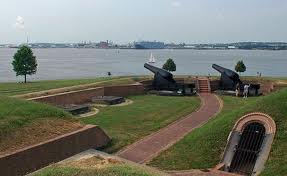
Think about our early history. During the War of 1812 Fort McHenry defended Baltimore and we sing about it in our national anthem. At the tip of Manhattan in Battery Park the guns of Castle Clinton protected New York City during the same war. Even Fort Sumter’s guns were intended to defend Charleston from invaders, not fire on the Federal troops to start the Civil War.

Guns at Ft. McHenry

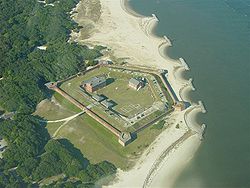
During the Civil War, locations like Fort Clinch on Amelia Island, Florida, and Fort Morgan in Mobile Bay, Alabama, controlled important shipping lanes. Confederates and Federals fought to occupy these key positions.

Fort Clinch, Amelia Island, Florida

Hitler’s Atlantic Wall was a classic and extensive example of coastal artillery used to defend a coastline. Fortifications built along occupied Europe’s Atlantic Coast created a defensive wall against the Allied invasion that both sides knew was inevitable.

German Gun Emplacement on French Coast

During WWII the Coastal Artillery was also a vital part of this America’s defense. After the attack on Pearl Harbor, the US expected the Japanese to attack the west coast. And German U-Boats were expected to attack US ports on the Atlantic and Gulf coasts. The Army updated the already existing forts and gun emplacements and added anti-aircraft guns.

Battery Davis 16 in gun at San Francisco

My father’s service in the coastal artillery from 1942 to 1943 spurred me to learn more about this now-defunct branch of the military.  Stationed at the entrance to San Francisco bay, he manned huge guns aimed at the surrounding ocean to protect the city and the bay.

The Presidio of San Francisco, a military post dating back to the Spanish and Mexican days, became the headquarters for defense of the west coast. Its location on the San Francisco side of the Golden Gate bridge oversaw the narrow entrance to the bay. An extensive network of fortifications, gun emplacements, anti-aircraft guns and observation posts located on the opposite side, in what is now part of Golden Gate National Recreation Area, also protected the critical passage.

6in_Rifled_Gun_No_9
Disappearing Rifle at Battery Chamberlin, Presidio, San Francisco

The American military expected the Japanese to attempt to get into San Francisco Bay and wreak havoc so they developed defenses to prevent intrusion. The Navy laid minefields and stretched a huge anti-submarine net across the inner harbor. Navy tug boats would open and close it for authorized vessels. In 1939 a German submarine penetrated Scapa Flow, the main British naval base, and sank a battleship, so it was no far-fetched idea.

During WWII San Francisco was the busiest port on the west coast. My father recalled looking out over the harbor and seeing thousands of ships, both military and civilian. He expressed pride in protecting this vital port. He told of manning the big guns, the blackouts along the coast and walking patrol on the beaches. The threat of saboteurs sneaking ashore was very real in those days.

As the war progressed US forces destroyed much of the Japanese and German navies, thus reducing the threat to our coast line. Recapturing islands such as Midway and Wake made airborne attacks less likely. By 1944 the military realized that neither the Japanese nor the Germans could mount an invasion or a serious attack on the US. With manpower needed elsewhere in Europe and the Pacific, coastal artillery units were stripped and soldiers were reassigned to the field artillery or the infantry. That usually meant overseas duty for the men. It also spelled the end of the Coastal Artillery.

My father was on the list to be transferred overseas when his request to join a newly formed medical rehabilitation unit was approved. While his brother fought in the Pacific under MacArthur recapturing the Philippines and other islands, my father remained stateside and helped wounded veterans regain their health and strength. (The story of this unique rehab unit will be the subject of another post.)

Advances in the technology of warfare, through airplanes and missiles, caused the demise of the coastal artillery. After WWII with the advent of the Cold War, the Strategic Air Command (SAC) and inter-continental ballistic missiles (ICBM’s) took over the nation’s defense. And coastal artillery faded into history. A few of the locations remain as local or national parks and historic sites. Visit some of these unique sites for a stroll into the past.

A Civil War Sniper – Jack Hinson

Jack Hinson's One-Man War by Tom McKenney: Book Cover

Not everyone who fought against the Union did so because they believed in the Confederate cause. For some the motivation was revenge. This was the case for Jack Hinson. Living near Dover, Tennessee, Hinson tried to stay neutral. During the battle at Fort Donelson he made it known he would not take sides. His only concern was for his family. During the battle he traversed the lines as a neutral and after the battle General Ulysses S. Grant visited the Hinson farm near Dover as a guest.

So why did Jack Hinson become a sniper who killed numerous Union officers? In his book, “Jack Hinson’s One Man War – A Civil War Sniper”  Tom C. McKenney tells the compelling story.

Although one of Jack’s grown sons joined the Confederate army, Jack opposed secession and intended to remain neutral. At the beginning of the war Jack Hinson owned a large farm, called Bubbling Springs, where his wife, eight of his ten children and his slaves lived and worked. Yes, Jack Hinson owned slaves who worked in his home and on the farm. McKenney says they were treated as extended family and some of their descendents still live in the area. Nevertheless, Jack Hinson did not support the Confederate cause until Union troops attacked his family.

One day when his two teenaged sons were out hunting, a Union patrol stopped them and accused them of being bushwhackers. Without benefit of trial, they took the boys to Dover and executed them. As if this injustice were not enough, the officer in charge ordered the boys beheaded and their heads delivered to the Hinson farm where they were placed on the gate posts.

If you think these types of horrific events did not happen during the Civil War, then you’ve only heard the cleansed version of history. I grew up in this area of Tennessee, just 30 miles from Dover. Many families passed down stories of atrocities that the official versions want to forget. Why did these atrocities happen? Once Tennessee became occupied territory, the better Union officers and troops moved on to the more active battle fronts. That left the less capable officers and less disciplined soldiers as occupational forces. Combine that with disgruntled Confederate sympathizers who carried on a guerilla-type warfare and you can better understand what happened to the Hinson boys.

Jack Hinson was a God-fearing man who believed in vengeance. He quietly commissioned a special sniper rifle and began using it on the Union patrols. He targeted only the officers because he believed that they were responsible rather than the soldiers who merely carried out orders. When a friend warned him that the Union troops were going to arrest him, he bundled up his wife and younger children and sent them to safety with relatives in West Tennessee. In a winter snowstorm Jack Hinson entrusted his family’s safety to his slaves who got them through the snow and across the Tennessee River. Hinson stayed behind to continue his sniping. When the Union troops arrived at the farm to arrest Hinson, they were met by defiant slaves. The Union soldiers burned the farm.

Hinson lived in a cave on a bluff high above the Tennessee River. At that time the rivers were the superhighways that transported troops and supplies to the Union army. From his vantage point overlooking the river, he shot Union officers and river pilots on the riverboats that passed below him. Hinson managed to disrupt traffic on the river and terrorize the crews and passengers on the riverboats.

Jack moved from time to time and carefully protected the local citizens who helped him. When he ventured across the river to visit his family, he learned that two of his younger children, who were sick with measles at the time of their escape, had died. To Hinson, the Union had caused their deaths. He continued his one-man campaign against the Union. Later his son in the Confederate Army died in battle and his other grown son died in a guerrilla raid.

Jack Hinson never officially joined the Confederate Army, but he did aid them. Before the Battle of Johnsonville, Jack acted as scout and guide for General Nathan B. Forrest, and he was with the Confederate troops during the battle.

Although hunted as an outlaw, Jack Hinson was never captured. After the war he settled what was left of his family (only five of his ten children survived) on White Oak Creek. The scarcely populated area provided a safe haven where Jack lived his remaining years.

For a thorough and well researched account of the life of Jack Hinson, read “Jack Hinson’s One Man War – A Civil War Sniper” by Tom C. McKenney. He skillfully weaves Jack Hinson’s life into the events of the day. The former Marine uses his military background to help the reader understand the weapons, tactics and terrain. His extensive research included scouring military records and personal accounts, visiting the sites and conducting extensive interviews. McKenney’s fascinating, descriptive accounts make the reader feel he is actually there. I especially appreciated his description of the land “Between the Rivers” since I grew up in this area bounded by the Tennessee River on the west and the Cumberland River to the East and North. McKenney’s explanation of the lead up to the war and his detailed accounts of the battles at Fort Henry and Fort Donelson are excellent and confirm the stories I heard growing up. I highly recommend this book for anyone interested in Civil War history.

It’s Not A Tank – M7 Priest

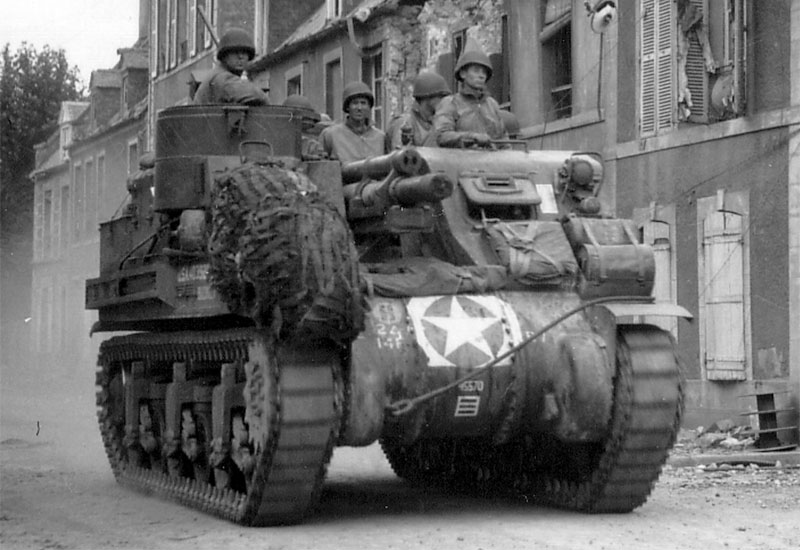
To the average person, this vehicle looks like a tank, but it’s not. It’s an artillery piece. One key difference is the main gun, a 105 mm Howitzer. Compare this to a 75 mm gun on a Sherman tank. Also on the M7 the crew is riding on top of the vehicle in the open unlike a tank crew tucked away safely inside the tank. So the men on the M7 had no armor plating protecting them in combat. But the track gave this gun the mobility to advance alongside tanks and infantry into the thick of battle.

My father-in-law served on an M7 in the 276th Armored Field Artillery Battalion. When his son asked him what he did in WWII, the veteran told him he was on a tank, rather than trying to explain to him about the track-mounted artillery piece.  So as a boy my husband proudly proclaimed to his friends that his father served on a tank with Patton. As he grew older my husband learned more about the war and he continued to ask his father questions. Although reluctant to talk about his WWII experiences, the ex-GI explained that the vehicle he manned was actually an M7 105 mm Self Propelled Gun, also called an M7 Priest. (The British dubbed it “Priest” due to the .50 caliber machine gun mounted in a drum-like ring on the front that resembled a priest’s pulpit.)

The former soldier rarely relayed stories about the war. When he did, he told of experiences during the Battle of the Bulge, Remagen Bridge and the invasion of Germany as part of Patton’s Third Army. GI’s on the front didn’t know the big picture. He said that as long as they were moving, they figured things were going good.

Reading the history of the 276th AFA BN put their role in the war in perspective. I learned that these artillery pieces were assigned to whatever front or division needed their support. So, like other artillery units, the 276th was not included in the combat records of any particular division, which makes research for specific details much more difficult. Fortunately we have a copy of the official account printed immediately after the war and given to each soldier in the unit.

M7 Priest in Michigan

Last summer while visiting relatives in Michigan, my brother-in-law took us to a VFW outside Flint where an M7 Priest is on display. For the first time my husband saw, in person, a gun like his father’s. Having served in an armored unit himself, my husband has been around many tanks, but seeing and touching this vehicle thrilled him. He even climbed up on top in the rain to gain perspective on his Dad’s experience riding atop the powerful gun. That day we both made a connection to his Dad and his experiences during the war, experiences that changed a 19-year-old forever.

Dad’s Gun

If you are interested in the history of action aboard the M7 during the second world war, read “Longneck, A History of the 274th AFA BN” by Jack K. Morrison or “Payoff Artillery – WWII” by Frank H. Armstrong. Both these veterans give fascinating accounts of their service in these unique units.

Research Using USGenNet Sites

Whether researching your family history or a specific area for a novel setting, the USGenNet group of webpages is a great resource.  Quoting from their site at http://www.usgennet.org/ “USGenNet is the first and only nonprofit historical-genealogical web hosting service on the Internet.” Many states, county and local genealogical and/or historical groups have websites using this hosting service. When you go to one of these websites, such as the one for Dickson County, Tennessee, you will find a wealth of information about the area. There are family histories, obituaries, maps, cemetary information, newspapers, pictures, etc. Links to other sites of interest, like state archives, are often provided.

Keep in mind that these are websites maintained by individuals so the exact information posted and how often the information is updated depends on the individuals maintaining the site. Some allow contributors to submit items to be posted on the site. Most rely on volunteers to keep the sites going.

I have spent hours exploring the TNGenWeb site – since Tennessee is my home state. The County Pages offers easy access to every county that has an individual site and offers additional information about each county.  It  includes a clickable map of the counties which is very helpful if you need to research a region but you aren’t sure which counties to search. And if you are looking at a county, like my home county (Houston), which was formed from sections of several different counties, you can dig deeper by going to those original counties. Another map evolves over time with the creation of the counties starting before statehood when Tennessee was a part of North Carolina. It even includes the State of Franklin, the first attempt at adding a new state to the original thirteen states. The State of Franklin is another whole topic for a later day – but a very interesting episode in the history of our country. My adopted home state of Florida‘s site includes lots of information that I have only just begun to explore.

Although I started using these pages for genealogy research, I found some truly fascinating stories. For a historical novelist, the details provide not only story ideas but authentic background, events, dates, and locations.

Point Park in Chattanooga

From high atop Lookout Mountain the Tennessee River looks like a ribbon winding its way through the valley below. Today the city of Chattanooga sprawls along the river and up the surrounding mountainsides. But in 1863 Chattanooga was a small town nestled along the riverbank. Its importance lay in the railroads that intersected in the mountain valley leading to Nashville, Knoxville, and Atlanta. The iron and coke works supplying the Confederacy added to its value.

After the Battle of Chicamauga in September 1863, the defeated Union Army retreated to Chattanooga. Surrounded by the Confederates for more than a month, the Union soldiers were almost out of supplies when reinforcements arrived. Still the southern forces held the high ground on Lookout Mountain with a commanding view of the valley, river and town.

Point Park Cannon

Standing on the rocks in Point Park and looking down at the shear drop off the mountain, it is hard to imagine the Union soldiers attacking – but they did. On Nov. 24, 1863, they came up the rocks and cliffs in an attempt to take the summit. Confederate cannon had been mounted to fire at the river and town below. When they tried to adjust their fire toward the attacking soldiers, the cannon balls would roll out of the barrel before they could be fired. Without benefit of cannon, the southern troops defended the mountain with rifles and hand-to-hand fighting.  It is said that Confederate soldiers who ran out of ammunition hurled rocks at the attacking Yankees. Imagine the terror of combat in such a place where a soldier could fall to his death if he stumbled and lost his footing.

Cliffs on Lookout Mountain

Because a heavy mist hung over the mountain making it difficult for either side to see more than a few feet, the battle was referred to as the Battle above the Clouds. By the end of the day the Union was victorious and the Confederates retreated to Missionary Ridge where the next day they were defeated again.

During the Battle of Missionary Ridge a young soldier picked up the fallen colors and led the charge up the ridge. Arthur MacArthur was awarded the Medal of Honor for his action that day. In later years he became a Lieutenant General and the father of Douglas MacArthur who achieved the five-star rank of  General of the Army in World War II. These two men are the only father and son recipients of the Medal of Honor.

My husband and I recently visited Point Park atop Lookout Mountain accompanied by our son, daughter-in-law and grandson. The park preserves the site of the civil war battlefield. The famous Incline Railway took us up the mountain and we walked the three blocks to the park. Beautiful old houses sit atop the mountain. Those on the edge have gorgeous views and back yards that go straight down. It is definitley worth a visit. Chattanooga has many interesting and historic sites for anyone seeking a getaway.

Introduction

Welcome to my website! Join me as I journey through history doing research for my novels, visiting historic sites and digging into my family genealogy. To introduce myself, I will begin with where I grew up – because I am one of those southern women whose identity is strongly tied to place and ancestry.

I was raised in middle Tennessee between the Cumberland and Tennessee Rivers in the small town of Erin. The story goes that Erin was named by the Irish railroad workers in the mid-1800’s because the green valley nestled between steep hills reminded them of Ireland. But the area was occupied much earlier.

American Indians, including the Cherokee, the Creeks and the Choctaw, shared middle Tennessee as a hunting ground. Evidence of human occupation has been dated back to pre-historic times. The Wells Creek Basin is the site of an ancient meteorite crater. Indians traded flint from Wells Creek as arrow heads and spear heads throughout North America. On a trip to Yellowstone in the 1970’s I visited the Buffalo Bill Historic Center in Cody, Wyoming, where I was surprised to find a collection of arrowheads from Wells Creek, Tennessee, on display.

My grandfather Boone was an amateur geologist/archeologist. He collected rocks, including dolomite and shatter cone from the Wells Creek Basin and various Indian artifacts from the area. Although he died when my mother was four, my grandfather’s collections remained on display in my grandmother’s house, like a private museum. The stories fascinated me and his collection inspired the “rock hound” in me to start my own collection.

The first influx of settlers came to the area where I was raised after the Revolution when Continental soldiers received land grants as payment for their service. Some soldiers sold their land to settlers and speculators, but many brought their families west to what was then the frontier. The McMillan’s, my fraternal grandmother’s family, settled on their land grant in what became my hometown. The McMillan family cemetery is situated on a hillside in western end of the valley overlooking the middle school (old high school), the nursing home, and much of the community known as Arlington. These early settlers were primarily of Scotch or Scotch-Irish descent who brought with them an independent spirit and strong religious faith.

Several regiments were raised in the area during the Civil War. My maternal great-grandfather served in the 14th Tennessee and fought in the eastern theatre. My fraternal great-great-grandfather served in the 24th Tennessee Sharpshooters and Maney’s Battery along with his two brothers and one brother-in-law. His other brother-in-law served in the 50th Tennessee. My maternal great-great-grandfather served in the 26thMississippi Infantry.  All these soldiers reflect the strong support for the Confederacy within my family, yet none represent the “traditional” image of the south filled with wealthy plantation owners. They were all small farmers or local merchants.

After the war, people from the north came south in search of cheap land. Among these were my maternal great-great-grandparents, who emigrated from Germany in 1850 and settled in Beaver County, Pennsylvania. In 1867, they came down the Ohio and up the Cumberland to Wells Creek and purchased farmland. These are my German ancestors and the most recent of my ancestors to come to America.

In 1871 portions of Stewart, Montgomery, Humphreys and Dickson Counties were combined to create Houston County, named for Sam Houston, former Governor of the State of Tennessee. Sam Houston is one of the many historical figures from Tennessee. Unfortunately, I can claim no kinship to the Tennessean turned Texan.

In 1886, Goodspeed published a history of Tennessee which includes a History of Houston County.  The account provides fertile ground for the imagination. So many individual stories, so many lives to explore. These are the people who make up the fabric of our country. Real history, about real people, helps us understand who we are and where we came from. It’s why I love history. It inspires me to write, to transform bits and pieces of real lives into fictional characters and stories.

Over time I will share some of the history that inspires my historical romantic fiction and my women’s fiction stories.