Behind the Barbed Wire – American Airmen POW’s

When many of us think of American airmen held as prisoners by the Germans during World War II, we see images from the movie “The Great Escape” or the TV comedy series “Hogan’s Heroes.” Unfortunately, the truth about their imprisonment was no adventure and certainly no comedy. The real stories, as told by the men who lived through the experience, are fascinating. Their survival nothing short of miraculous.

American bomber crews and fighter pilots flew thousands of missions over German occupied Europe from 1942 to 1945. Many were shot down and most of the survivors became prisoners of war.

Just imagine – Airmen in a bomber raid flew at 20,000 feet or higher, endured sub-zero conditions in un-pressurized planes, survived terrifying fighter attacks and the helplessness of flying through flack to get to their targets. Youth, optimism and sheer determination kept them going. When their plane sustained damage, the decision to bail out came as a shock to many. Everyone knew it was possible, something they’d been briefed on before every flight, yet these brave, young men didn’t believe it would ever happen to them.

Some of them jumped into a sky filled with airplanes, bullets flying, debris from exploding planes, and artillery shells(flack)  exploding around them. Others chose between a crash landing or a parachute ride. When they floated to the ground in hostile territory, they landed in fields, in trees, in water, or in the very towns they had been bombing. Sometimes angry civilians greeted them, ready to kill them on the spot if the German military did not intervene.

The crews became separated once they bailed out and many did not see fellow crew members or know what happened to them until the war was over. If a downed airman landed in an occupied country, such as France, Holland, Belgium, Poland, or even Italy, local partisans or resistance fighters sometimes hid them and helped them evade capture. But with or without help, the Germans captured most of the downed airmen.

Until a prisoner was reported to the International Red Cross, he remained vulnerable to the whims of his captors. Once in the hands of the German military, downed airmen were transported to a Stalag Duft or interrogation center. Intelligence officers attempted to glean information from prisoners by keeping them in solitary cells and questioning them for hours at a time.

In German-held territory the different branches of the military ran POW camps. So, the Luftwaffe (German Air Force), the German Navy, and the Wehrmacht (German Army), operated separate camps. They generally complied with the requirements of the Geneva Convention for treatment of prisoners of war. The food was the main complaint. If it hadn’t been for the Red Cross packages shipped in through Switzerland, many prisoners would have starved.

Probably the most famous German POW camp was Stalag Luft III. At this camp near what is now Sagan, Poland, British and American airmen staged the most daring escape attempt of the war. Known as “The Great Escape,” the popular 1963 movie and many books recount the story. Today there are several websites dedicated to Stalag Luft III and the Great Escape. Some websites have posted interviews with former POW’s or personal accounts written by former POW’s. These websites are a tribute to the prisoners, those who survived and those who didn’t.

An often forgotten portion of the story of Stalag Luft III is the evacuation of the camp in January 1945 to prevent the Russians from taking it. As a blizzard approached, orders came to assemble and be ready to march. The men took what they could carry and wore whatever clothes they had. Over ten thousand prisoners and their German guards trudged in the freezing cold along snow-covered roads through the night and for days to come with no idea where they were going. Sub-zero temperatures, inadequate winter clothing and boots, and lack of food took their toll. Along the way the prisoners were allowed to rest in various shelters – churches, barns, a jail building and a tile factory. Finally reaching a marshalling yard, the Germans packed the prisoners into boxcars and transported them to overcrowded POW camps in Nuremberg and Moosburg, Germany. Many prisoners did not survive the horrific journey.

The Germans moved prisoners from Stalag Luft III and other POW camps to consolidate them in the face of Allied advances and in hopes of using them as bargaining chips in surrender negotiations. But negotiations never took place and Allied forces continued their advance. In late April, 1945, the camps were finally liberated by American troops.

Read more about the POW camps and the experiences of the prisoners on these websites:

http://www.b24.net/pow/stalag3.htm

http://www.merkki.com/

http://www.pbs.org/wnet/berga/beyond/system.html

http://www.303rdbga.com/pow-camps.html#dulagluft

http://www.loc.gov/vets/stories/pow-germany.html

Old Deeds and Genealogy

Was my great-grandmother a real estate mogul? Not likely. But she did buy and sell real estate at a time when women were supposed to stay home, keep house and raise children. We’ve found her name on several deeds, from 1892 to 1914, some in prime locations in the downtown district of the thriving community. She passed on her real estate savvy to her son, my grandfather, who invested in several land parcels. Disposing of his real estate sent me on a search where I found more than deeds.

Great-grandmother Boone & Aunt Lura

Old deeds can provide another tool for genealogical research. Although they are not likely to be available on the internet, if you are willing to search through courthouse records, they can provide a valuable resource in learning about your ancestors. Which is what I have done, not for the sole purpose of genealogy, but for the purpose of settling an old estate.

It might seem incredible to some but my grandfather’s estate, at least the real estate portion of it, has never been settled. Not so bad you say, except he died in 1921. Yes, that’s ninety-one years ago. He left a widow and nine children, including my four-year-old mother. All the children are gone now, so it is up to the grandchildren to settle his estate. With so many heirs, the property must be sold and the proceeds divided up. After the lawyers take their share, no one will get much, but my hope is to get it settled before the hundred-year mark.

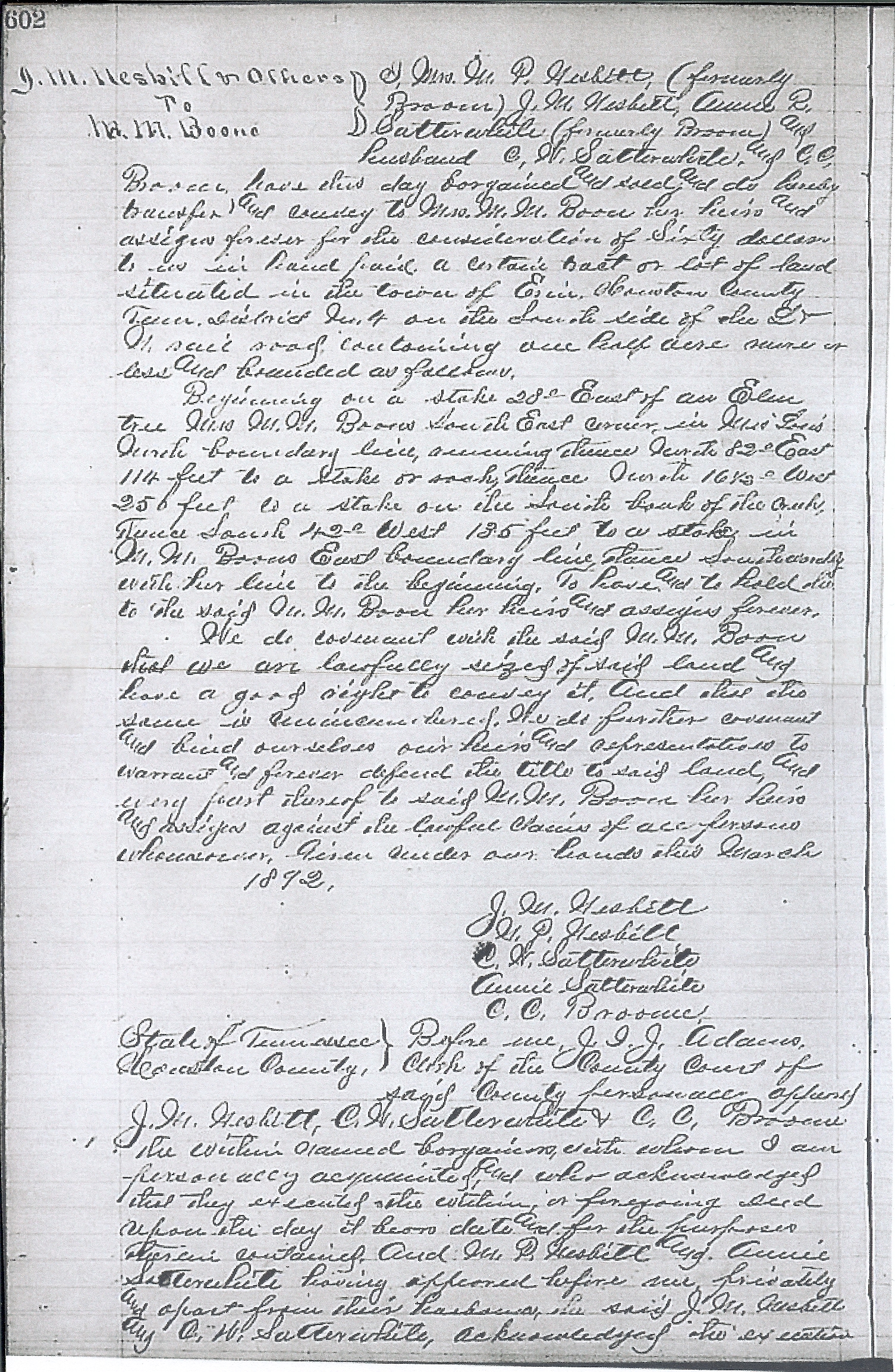
Before selling real estate you must have the deed. The task of locating these documents has proved to be difficult. Although my family paid the real estate taxes all these many years, when the lawyers searched for the deeds they couldn’t find them all. Or rather, they couldn’t match the deeds they found with the property. So my dear brother and his wife went to the courthouse and scanned every deed they could find that might be related to our family. Scanning them was an enormous task. Reading them and making sense of them proved to be something entirely different.

Have you ever read a hand written deed from before 1900? If not, it is an experience you should try at least once – if you have the patience. Needless to say, I volunteered for the job.  I had deciphered some old deeds from the 1800’s passed down in my husband’s family so I didn’t go into it entirely blind. I’ve also spent time on Ancestry.com reading census records and other handwritten documents. So I used those experiences as a guide. I knew the people involved, at least I knew their names from our genealogical records. Finally, I knew the location of the property. I grew up in the small town and my mother made a point of showing us the property when we were younger.

The deeds I looked at were dated as early as 1871 and as late as the 1950’s. The ones prior to the 1920’s were hand-written. The old descriptions might refer to an “oak tree” or a “tree stump” that is long gone and usually list adjoining property owners who years ago sold their land. The people involved are no longer living. Roads have been moved or widened or re-named or no longer exist. So it has been quite a challenge.

The silver-lining to all this work has been the insight I gained about my Great-grandmother Boone. My mother and grandmother rarely spoke of the woman although she lived near them and was obviously a part of their lives. I got the impression from my grandmother that Great-grandmother Boone was the stereo-typical mother-in-law, always critical. Perhaps that came from her own difficult life.

At age 23 she was left a widow with two small children. Both her husband and father-in-law died during a cholera epidemic in 1873. I don’t know how she survived in the ensuing years. I do know that over time she became a business woman. She managed to send her son to Edgewood Academy,  a prominent boarding school in the area. And she invested in real estate.

By 1900, census records tell us she owned her home, free of mortgage, and she took in boarders. Both the 1910 and 1920 censuses show that she ran a hotel, which she rented, and she had employees. According to family lore, she and her daughter ran the hotel for the railroad. It sat facing the railroad tracks across the street from the train station. She purchased a lot on Market Street (the main drag) in 1914 which became the location of the Central Hotel when the building was moved in 1921.

In the early 20th century, Erin was a thriving railroad town where twenty or more trains came through each day because it was the shortest route from Nashville to Memphis. The high ridge west of town meant each west-bound locomotive needed the help of a hill engine to get it to the top of the hill. The train would stop in Erin so that the additional engine could be hooked up. A turn-around track enabled the hill engine to reverse directions both in town and atop the ridge.  Over time the railroad decided that a longer route was more economical than utilizing the hill engine so traffic declined. But during the railroad’s heyday, my great-grandmother’s hotel would have been a thriving business.

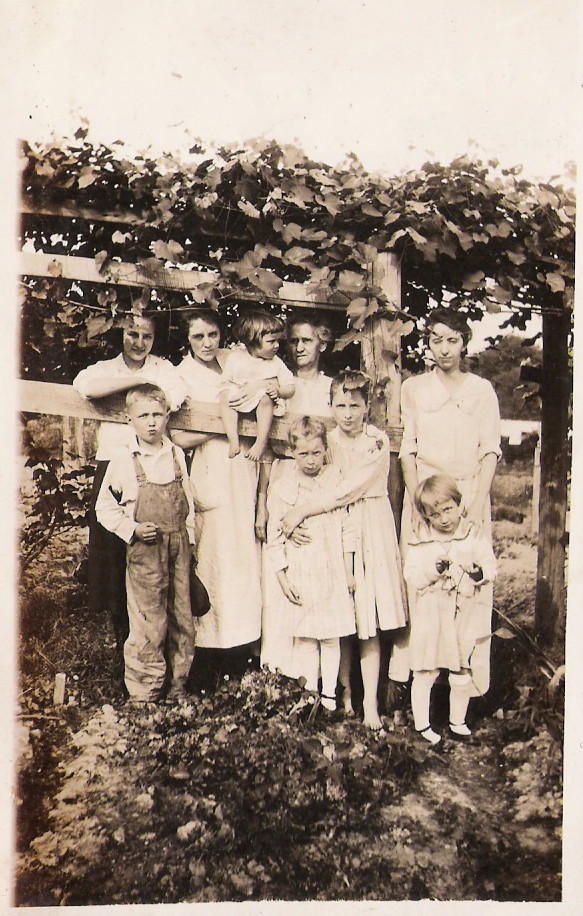
When her daughter-in-law died in 1911 leaving six small children, my great-grandmother refused to raise her son’s children. She was 61 and running her own business. My other, and younger, great-grandmother and great-grandfather moved in with my grandfather and took over the day-to-day responsibilities of running the household and caring for the children. Comments in later years from one of my aunts conveyed my grandfather’s disappointment in his mother. Family resentment carried down through the generations.

As a career woman and grandmother myself, I have some understanding of my great-grandmother’s viewpoint. She had raised her children to adulthood alone. She had moved on to become a business woman active in her church and community. At her age taking on the responsibility of caring for a baby, a toddler, pre-schoolers and school children must have seemed an insurmountable task and a drastic change to her lifestyle. So I can sympathize with her decision. She didn’t abandon the family. She was nearby to provide support and guidance. As the children grew older she let them work at the hotel, she set a high standard for her grandchildren’s behavior, and, I’m sure, she contributed financially to their support.

Yes, my great-grandmother Boone was a strong, independent woman well ahead of her time. And I’m pleased to have learned more about her and her many real estate transactions.

276th Armored Field Artillery Battalion – Part 3

The Love Story

The story of the 276th Armored Field Artillery Battalion would not be complete without telling the story of two Tennessee boys and a wartime love story.

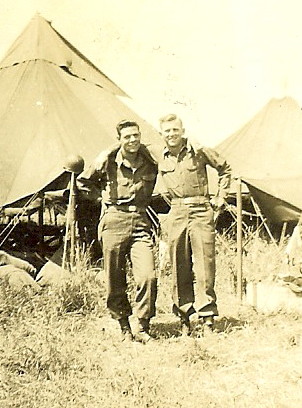
My father-in-law, Paul, had asthma as a small child so he was still in high school when he was drafted into the Army at age 19. His parents tried to get their only child out of the Army but their efforts only caused problems during his early months in the service. While training in Kansas, Paul made friends with another Tennessee boy, Luther, who grew up in a small town a few miles south of Camp Campbell, Ky.

When the 276th received orders for retraining on the M-7 to become a mobile artillery unit, Luther must have been delighted to be stationed so close to home. With a car at his disposal Luther would take his friend to his home town on weekends where they spent time with the local girls. They probably met other girls in Clarksville, the town closest to their camp. Months passed and both boys knew they would soon receive orders for overseas. One weekend when Luther had a date with a girl who lived near Clarksville, he asked her to find a date for his friend, Paul.

While in school, Earlene went with a boy who lived near her family’s farm. He joined the Army after the war broke out and became a gunner on a B-17 bomber. His plane went down during training and he was killed sometime in 1943.

Earlene’s father rented out their farm and went to Detroit to work in the defense industry.  While waiting for him to send for them, Earlene, her mother and sister lived with her grandmother near Clarksville. Earlene’s grandmother had remarried years before and her youngest daughter was only a little older than Earlene. This “aunt” agreed to find a date for Luther’s friend, and that’s how Earlene and Paul met.

It must have been love at first sight because Paul came back to see Earlene several times in the next two weeks.  Confined to camp awaiting orders to ship out, Paul and Luther sneaked out of camp so Paul could go see his girl. That night Paul asked Earlene to marry him. She hesitated at first. She knew what could happen. But he told her that he knew she wouldn’t be there when he came back. Somehow he convinced her. Luther drove them to Hopkinsville, Ky., where they were married.  It was June 20th, 1944, and they had known each other for twelve days.

The couple agreed to keep their marriage a secret from their parents, at least for a while. The 276th shipped out three days later, on June 23rd, for the war in Europe.

Months later, but before going to Detroit, Earlene told her mother about her marriage. Upset, her mother wrote to her father. Both parents were not happy about the marriage, but they accepted it. Paul wrote to his parents and his unexpected marriage must have shocked them.

Earlene tells of meeting her in-laws for the first time. She took a bus to West Tennessee where Paul’s parents lived. The bus driver misplaced her suitcase so when she arrived in Selmer, Tennessee, she had nothing but the clothes she wore. This made an already anxious situation worse. Paul’s parents recognized her in the bus station. They drove the only vehicle they owned, a logging truck. The three of them rode in the cab for the long drive to their house. Earlene said it was so far back in the sticks that she began to wonder what she had gotten herself into.

Paul’s grandmother waited at the house. When the old woman met Earlene she exclaimed “I knew Paul wouldn’t marry trash.” From that Earlene knew what her in-law’s had expected.

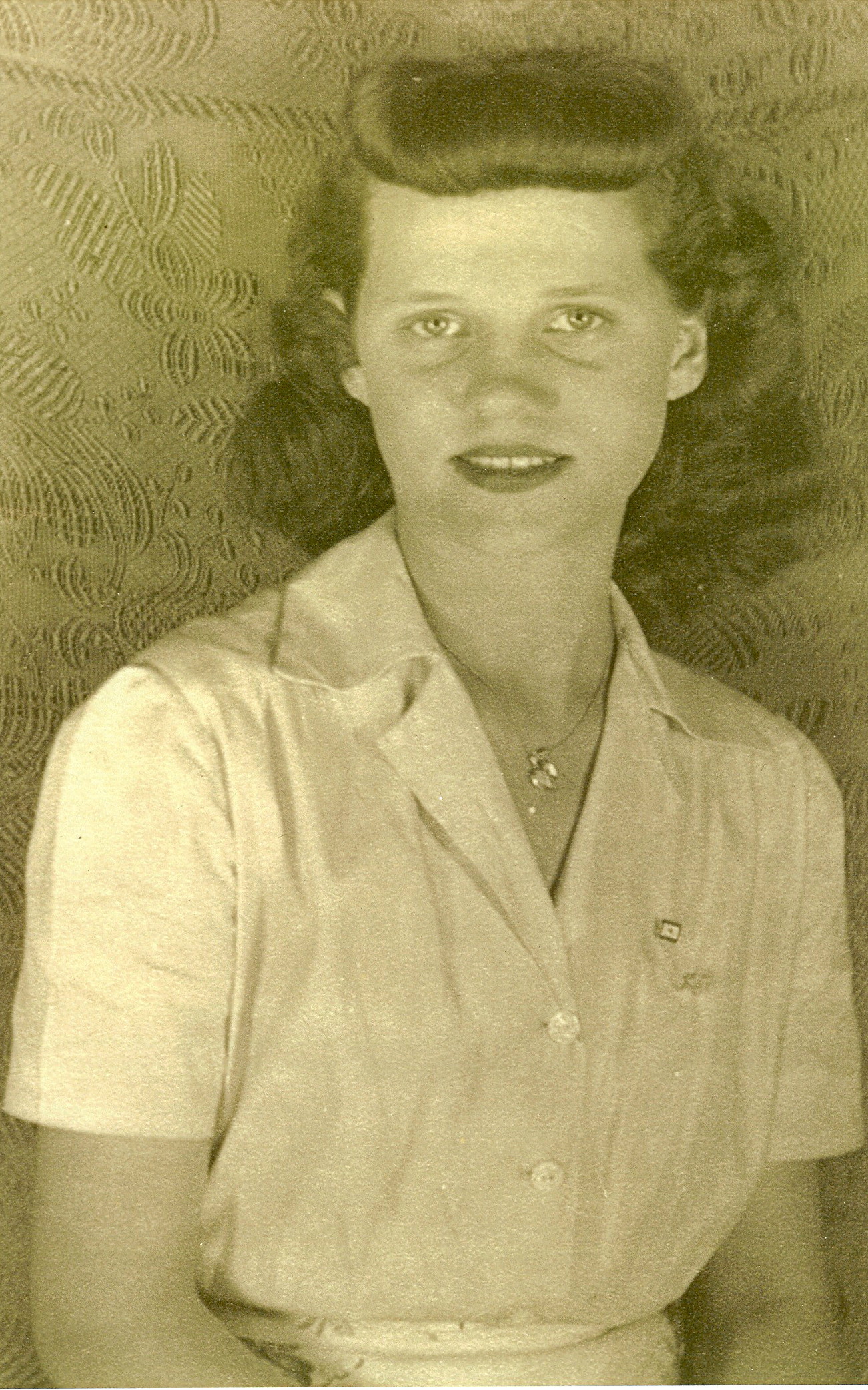
The young couple stayed in touch through letters. Earlene sent Paul a picture that she had made especially for him.

Both Paul and Luther survived the war in Europe. Before leaving Germany they were told they would be shipped to the United States, then would be reassigned for shipment to the Pacific Theater. When the men reached the states, in July 1945, they received a 30 day furlough to visit their families. Paul found his bride on her father’s farm and met her family for the first time.

Paul did not intend to go back to combat. He’d been through too much, seen too much. He vowed he would get lost in the swamp where no one could find him. Unfortunately his father was ill so Paul had to help his mother. He couldn’t hide. Instead, he gained permission to extend his leave. Before he had to report back, the Japanese surrendered.

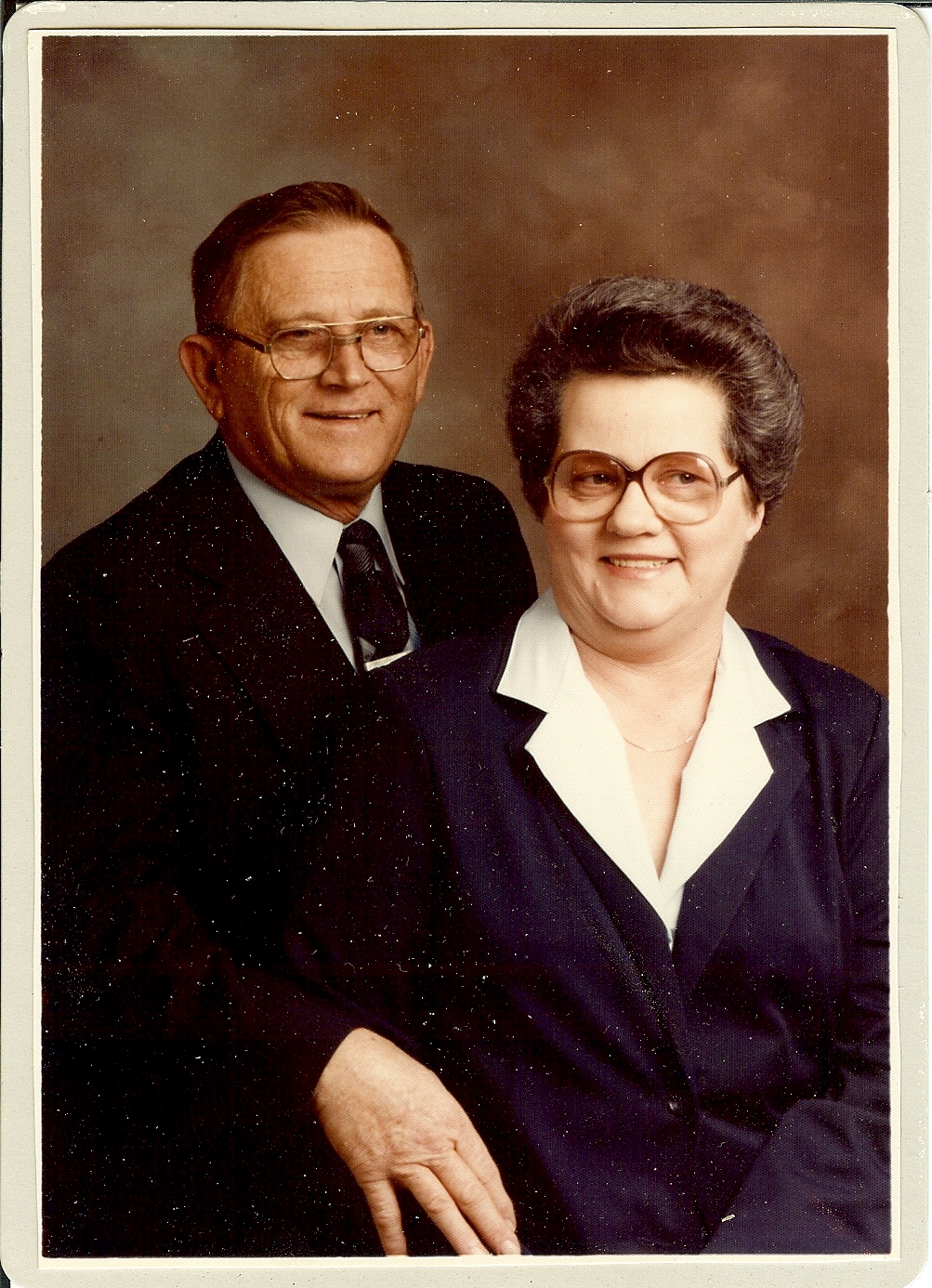
Paul reported to Ft. Bragg, N. C. and was discharged in November, 1945. Paul and Earlene’s marriage lasted until his death in 1999. They raised five children. Paul’s friend Luther lived nearby. When Luther visited his stories revealed much of what Paul’s children knew of their father’s service because he rarely talked about it.

There were many of these love stories during World War II. Young men and women traveled all over the country and overseas. Workers left their homes for defense plants. The couples met in many ways and places – on the military bases, in USO canteens, through friends, while in transit, etc. Soldiers even developed serious relationships with girls they met overseas where they were stationed or fighting. War brought an urgency to their courtships. Many were short and some of the relationships did not survive after the war. What’s amazing is how many of these marriages not only survived but flourished. They are wonderful stories and I never tire hearing them.

276th Armored Field Artillery Battalion – Part 2

When we last left our hero’s of the 276th Armored Field Artillery Battalion, it was February, 1945, and they had just crossed into Germany from Luxembourg.

I’m a map person. Several years ago I purchased a coffee-table book “US Army Atlas of the European Theater in World War II.” Researching this post I scoured the maps for locations mentioned in the 276th Battalion history and that exercise put some of the distances in perspective. In a straight line from Bastogne, Luxembourg, to Bitburg, Germany, it’s about 30 miles through hilly, heavily wooded terrain with crooked, narrow roads. The defenses of the Siegfried line ran along the German border between the two points. Bitter cold winter weather hindered progress as the Germans retreated behind their “west wall” line of defense. Can you imagine life for the men? Living outdoors, eating when they could, following orders, doing their jobs, fearing the next attack and struggling to survive. The 276th was a few miles southeast of Bastogne at the beginning of January. They did not reach Bitburg until Feb. 28, 1945. Eight long weeks.

From the southern shoulder of the “bulge” in the line, due to the German counter-offensive later known as the Battle of the Bulge, the 276th moved toward the northeast in support of the 80th Infantry Division. On Feb. 7, 1945, the Battalion fired 1,702 rounds in preparation for the 80th attack across the Our River into Germany and against the Siegfried Line. The 276th fired a total of 2,610 rounds that day, more than 325 rounds per gun. After that firing continued at a rate of approximately 1,000 rounds per day as they continued to pound the German fortifications. On Feb. 19-20 the 276th again fired heavily in preparation for another attack by the 80th Division. This time the 276th AFA Battalion crossed the Sauer river into Germany near Cruchten.

During these attacks the 276th for the first time fired a mixture of rounds that consisted of 40% fuze delay, 50% fuze quick and 10% white phosphorus, a chemical that burned through anything and could not be extinguished with water. The combination proved effective against enemy troops and would be used again.

In early March they moved rapidly northward to Koblenz on the Rhine. My father-in-law told of sitting on high ground overlooking the Rhine river and seeing the Ludendorff Bridge at Remagen, north of Koblenz. Although not mentioned in the history, he remembered seeing the bridge and firing across the river to protect the crossing troops. Since it was the only bridge left intact across the Rhine, it had to be the bridge at Remagen. For years he had a print of the bridge hanging in his room.

His buddy in the 276th told a funny story on him years later. While near the Rhine, a young man, drunk on liberated cognac, sat astride the gun barrel when German artillery began firing rockets on their position. He couldn’t get down so he rode out the barrage on the tube. Shells landed so close that the water cans hanging on the gun were shot off, but he didn’t get a scratch. According to my husband, his father didn’t want the story told and tried his best to stop his buddy from telling it in front of his sons. 

At Koblenz the north-east flowing Moselle joins the Rhine. On March 15 the 276th crossed the Moselle with elements of the 4th Armored Division. They continued toward the south-east against stubborn resistance from rear-guard troops and defiant towns. Although the men rarely knew what was going on overall in the war, they knew moving forward meant they were winning and that was always good news.

While the 4th Armored Division diverted south to take Worms, the 276th remained at Oppenheim to support a bridgehead operation by the 5th Division. They crossed the Rhine on a pontoon bridge above Oppenheim on March 24, then reverted back to supporting the 4th Armored Division on their swift advance east to encircle the city of Frankfort. Within days they advanced across northern Bavaria, heading northeast. On April 3 they ended a long road march near the city of Gotha with enemy aircraft and artillery firing on their advance. After an ultimatum Gotha surrendered the next day and the 276th moved south on the road to Ohrdruf.

On April 5th the battalion fired on the city of Ohrdruf against stubborn resistance by the Germans. When the enemy surrendered, the Americans learned why they defended it so stubbornly. Ohrdruf was a sub-camp of Buchenwald – the concentration camp and ‘death factory’ – and the first such camp discovered by the Americans. Although my father-in-law never spoke of it directly, Patton visited the camp and ordered that as many of his men as possible tour the camp as witnesses to the atrocities committed there. More than likely the men of the 276th saw the camp at Ohrdruf and, possibly Buchenwald, since they were in the area when it was discovered. The only time I ever heard my father-in-law say anything about the concentration camps was in the 1990’s when a TV program mentioned that there were people claiming the holocaust never happened. He adamantly insisted that it did happen, but he would say no more.

Reassigned to the 11th Armored Division, the 276th drove southeast from near Suhl  to near Kulmbach by April 12, battling not only Germans but also heavy rains. As part of Task Force Hearn another road march began near Grafenwohr, “site of the largest barracks and training area in central Germany,” and within a week they traveled 150 miles to Grafenau. Their objective was Linz, Austria on the Danube. The German army offered little resistance during this advance.

But, on April 30, the enemy made a stand at Wegscheld. After an all day assault, including heavy fire from the 276th, the 11th Armored Division occupied the demolished town. The battalion fired approximately 1,600 rounds that day, including a 90 round white phosphorous concentration. May 1st the 276 crossed into Austria with the 11th.

On May 2, the 276th received orders to return to supporting the 4th Armored Division near Lalling, Germany. They marched back to the northwest, then on May 3 moved to a ‘rest’ bivouac area near Saldenberg for three days. On the 5th they joined the 4th Armored Division moving east and north into Czechoslovakia toward the city of Strakonice. The Czech’s lined the roads welcoming their liberators.  They were still moving toward Prague when they received word that the German armed forces had surrendered. The war in Europe was over.

Surrendering German troops streamed through the battalion’s camp toward designated assembly areas. On May 10 the 276th motored to Bogen, Germany, where they became part of the military government and oversaw the flow of prisoners into fenced areas for processing to prisoner of war camps.

The joy and relief of victory in Europe was short-lived for the 276th. On May 13 they learned they would be deployed within 30 days to the Pacific Theater, traveling through the United States. On May 16 they participated in a ‘ceremony shoot’ for a group of Russian generals. On June 2 they received orders to move out. The heavy vehicle column traveled across Germany and France by train while the light motor column traveled by road meeting up at Camp Lucky Strike, near Le Havre, France. Here, due to the points system for discharge, members of the battalion with more than 85 points were transferred to the 341st FA Battalion of the 89th Infantry for transport home and discharge.

The remainder of the 276th embarked for the US from Le Havre, France, on July 2, 1945. It was one year to the day from their departure from New York.   By July 11 all had departed Camp Shanks, NY, for home on furloughs. Thankfully, by the time they were to reassemble for redeployment training, the Japanese had surrendered and the war was over.

The 276th Armored Field Artillery Battalion – Part 1

Due to the interest generated by my post about the M7 Priest, I decided to write about  my father-in-law’s unit and their experiences during the war.

The Battalion

The 276th Armored Field Artillery Battalion was in the European Theatre of Operation combat zone for 241 days, from September 1944 until the Germans surrendered in May 1945. They fought in the Battle of Northern France, the Battle of the Rhineland, the Battle of the Bulge, and the Battle for Central Europe. From the first round fired at Andelot, France, (near Nancy) they moved across Europe to near Strakonice, Czechoslovakia, at the war’s end. The battalion’s eighteen guns fired approximately 90,000 rounds in combat and provided support to whoever needed their guns. Thus they supported numerous groups including the French Second Armored Division, the Third Army, the 80th Infantry Division, the 6th Armored Division, the 12th Armored Division, the 9th Armored Division, the 4th Armored Division, the 90th Infantry Division, the 5th Infantry Division, the 26th Infantry Division, and the 11th Armored Division.


The 276th started out in Kansas where they trained as a field artillery battalion. While on maneuvers in Tennessee orders came to reorganize the battalion into an armored field artillery battalion. In January, 1944, they reported to Camp Campbell, Ky., for retraining on M7 track-mounted 105 howitzers.

On June 23 they left for Camp Shanks, New York, where they boarded the SS John Ericsson, set sail on July 1, 1944, and crossed the Atlantic to England. After arriving at Liverpool, they proceeded by train to Lianmartin, Monmouthshire, South Wales, for a thirty-day readying period.

The Campaign in Lorraine

On August 20th the battalion moved to Weymouth, on the south coast, and loaded on LST’s to cross the channel. After landing on Utah Beach in Normandy, the 276th began the motor march across France. By September 10 they reached Joinville, in eastern France near Nancy, where they were assigned to the French Second Armored Division. Here they fired their first combat rounds in the war.

Over the next few days the 276th crossed the Moselle and Meurthe rivers still in support of the French. During September and into October the account of engagements and movements reads like a tour guide of villages in Lorraine. Members of the battalion were killed, wounded and a few were captured. During a short rest the men stayed in French villages where the citizens welcomed them as liberators. From late October through mid-November,  the 276th supported the 6th Armored Division defending Landroff from a strong enemy counter-attack.  Steady rain in November caused muddy roads, traffic jams, hampered operations and generally made life miserable for the men. On December 5 they fired into Germany for the first time.

In early December orders came transferring 10% of the enlisted men, or 48 men, to the infantry.  Assigned to support the 80th Infantry Division, the 276th continued to fight along the German border. But on December 20th orders changed.

Battle of the Bulge

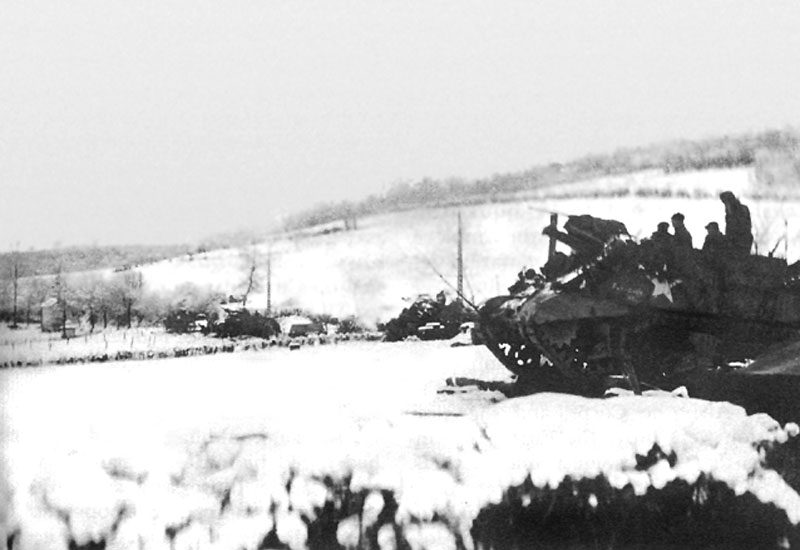
As part of Patton’s Third Army, the 276th journeyed from near Bettviller in easternmost France to the City of Luxembourg in four days, enduring snow, extreme cold, and icy, mountainous roads. This was the famous march in the dead of winter that Third Army made to relieve the US troops surrounded at Bastogne. In Luxembourg the 276th moved further north to engage the enemy along the southern shoulder of the bulge where they spent Christmas of 1944. During this time the weather was extremely cold. They were not allowed to build fires and they had no hot food. My father-in-law said that one night he fell asleep under the gun and when awakened by gunfire he was numb and stiff. Had he not awakened, he would have frozen to death, as many did that winter.

In the movie “Patton” there is a scene where General George S. Patton ordered a chaplain to write a prayer for good weather so that they could attack. This actually happened. The successful results of this prayer impressed Patton so much that he had a copy of it sent to all the men in Third Army. My father-in-law sent it to his mother who gave it to my husband. The prayer is printed on both front and back of a small, thin piece of paper about the size of a baseball card.

In January the 276th still supported the 80th Infantry Division as they fought northward helping the 319th Inf. Regiment repel a strong counter-thrust near Nocher. The battle remained near Heiderscheid until Jan. 18.  when the battalion supported attacks on Dahl and Kaulenbach, Luxembourg. By the end of January the Allies had crushed German offensive and had pushed back the battle lines to roughly where they had been in early December.

In February the battalion hammered the Siegfried Line along the Luxembourg-German border. They established liaison with the 4th Armored Division protecting the flanks of the 80th. Targets for the thousands of rounds fired included German defensive positions with nebelwerfers (rockets called screaming meme’s), mortars, tanks, pill boxes, snipers, infantry, vehicles and gun batteries. They crossed the Sauer river near Cruchten into Germany on February 20. Five days later the 276th received orders transferring them to support of the 4th Armored Division and continued to move further into German territory.

In Part 2 I will continue to recount the experiences of the 276th in the last months of the war in Europe.

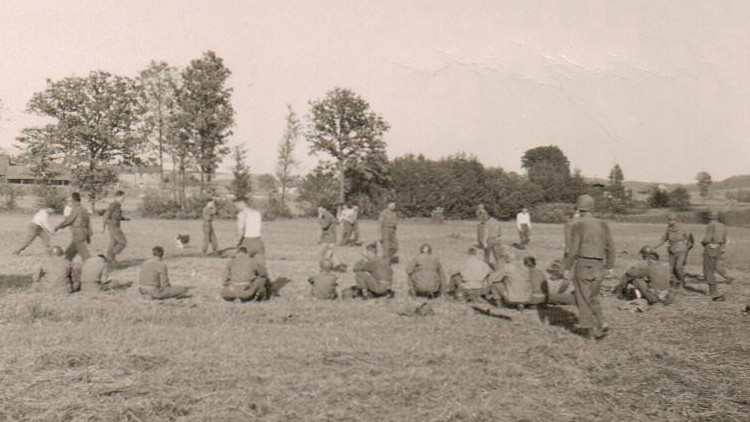
Thanks to Teresa Williams for allowing me to use her father’s photos. Her father is Morris I. Grayson, Battery “B”, 276th Armored Field Artillery Battalion. Details were taken from the history of the 276th Armored Field Artillery Battalion compiled by Sgt. Bruce B. Palmer.

Health Issues And Our Family History

Illnesses and accidents affected our ancestors in many different ways. Often health issues changed the course of their lives and the lives of their families. Without the benefits of modern medicine, what today would be a simple illness became a life or death struggle, often ending in an untimely death.

After being under the weather during May (nothing serious), I thought about the health conditions in my own family history and how those medical problems impacted their lives. There were epidemics, accidents, women who died young after having too many children and those assorted family illnesses your doctor asks about when taking your family medical history.

We rarely hear about epidemics these days due to better sanitation, monitoring and medical treatments. In the past epidemics caused panic and many deaths. In 1873 Asiatic Cholera swept through the small community where my family lived. A father and son who were working on railroad bridges across one of the many creeks, contracted the disease. Both men succumbed, one day apart. First the father, then the son. This son had survived wounds suffered at Malvern Hill where he fought for the Confederacy. He returned from the war, married and fathered two children. His untimely death left his twenty-three-year-old widow to raise their son and daughter alone. That son was my grandfather, the one I never knew. Cholera took his father and his grandfather when he was only four years old and had a lasting effect on his family.

The Spanish flu epidemic of 1918 killed more people worldwide than died in World War I. Some call it a pandemic. Unlike today when the elderly and the very young are considered most at risk from the flu, in 1918 the flu struck healthy, young adults. My grandmother survived a bout of this virulent strain of influenza.  Her mother, my great-grandmother, took primary responsibility for my mother, a baby at the time, so her daughter could recover. My mother always said her grandmother raised her. In her later years my grandmother was susceptible to pneumonia due to the scaring of her lungs caused by the flu.

Accidents also impacted our family. My husband’s grandfather died in an automobile accident coming home to Tennessee from Detroit to visit his family for Thanksgiving. He went to Detroit to earn enough to pay off the mortgage on the family farm. He had paid the debt, purchased a new car and planned to return to farm with his grandsons. The oldest grandchild, my husband was twelve and his brother was eleven. They lost the opportunity to work on the farm with their grandfather. Due to the determination of my husband, his father and siblings much of the place his grandfather worked so hard to keep is still owned by family.

When my grandfather was eighteen and working for the railroad, he caught his arm between the couplings of two cars. His mother recorded both the date his arm was mashed and the day after when it was amputated in the family bible, reflecting the importance of the event. Unable to do physical labor with only one arm, he had to find an occupation suitable for a one-armed man in the 1880’s and 90’s. Medical knowledge at that time ensured that the injury did not threaten his life. Years later his eleven-year-old daughter fell from the porch and sustained internal injuries. These injuries might have been repaired with modern surgery, but in 1914 medicine had not progressed enough to save her. She died of her injuries leaving a grieving family.

Doctors of the past couldn’t always diagnose an illness. One of my great-grand fathers became unable to work on the farm due to an unknown ailment. So he sold the farm sometime after 1900 and moved to another town along the railroad where his wife and daughters ran a boarding house. Had it not been for the illness the family would have remained on the farm and one of the daughters would not have run off and married to a man who lived in the boarding house.

For at least two women in our family, having too many children appears to have contributed to their early demise. My great-aunt married in 1900, had seven children and died in 1911, a month after the birth of her last child. She was only thirty-one years old. In my husband’s family his great-grandmother married at age sixteen, had nine children and died in 1919 at age thirty-nine. Her death certificate gives tuberculosis as cause of death with influenza as a contributing factor, another victim of the influenza epidemic of 1918-19. In the case of my great-aunt, her husband moved his in-laws in with him to help him raise his children. He later married his first wife’s sister, my grandmother. In my husband’s family, his great-grandfather only lived four years after his wife’s death. The older children then took the younger ones, eight and eleven, to raise. We will never know if these women would have lived longer if birth control had been available back then.

Discussions of illness and death can get pretty depressing, yet it can be important to our own health to know about the ailments of our family members. My paternal grandmothers had colon cancer so I have colonoscopies more often than most people. We’ve identified several members of my mother’s family who had Alzheimer’s, including my mother, so the horror of that dreadful disease looms over us. A stroke caused my grandfather’s death in 1955 and 41 years later my father died from a stroke. My aunt said my father’s death was almost identical to the way their father had died years before. So I watch the blood pressure and cholesterol. My husband developed diabetes which affected the lives of several members of his family. So even if it feels uncomfortable, we should all have those family discussions about illness and causes of death. It could save our lives.

No doubt modern medicine would have changed outcomes and changed lives. Some of us might not be here if outcomes had been different. Yet such intimate knowledge gives a humanity to the old family tree and allows us to see them as people, struggling and suffering just as we do. They continue to live through the family stories passed down from one generation to the next. And perhaps we will learn something about ourselves.

The First Women in the Military

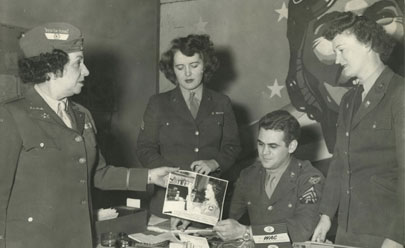
Today most of us know women who have served in the military and many who served overseas in combat. But how many of us know about the first women in the military? And how many know what our mothers and grandmothers did during WWII? Did they serve in the military? Red Cross? Defense industry? During World War II women’s lives changed. The vital role they played, both as civilians and in the military, impacted the outcome of the war and changed how American women viewed themselves.

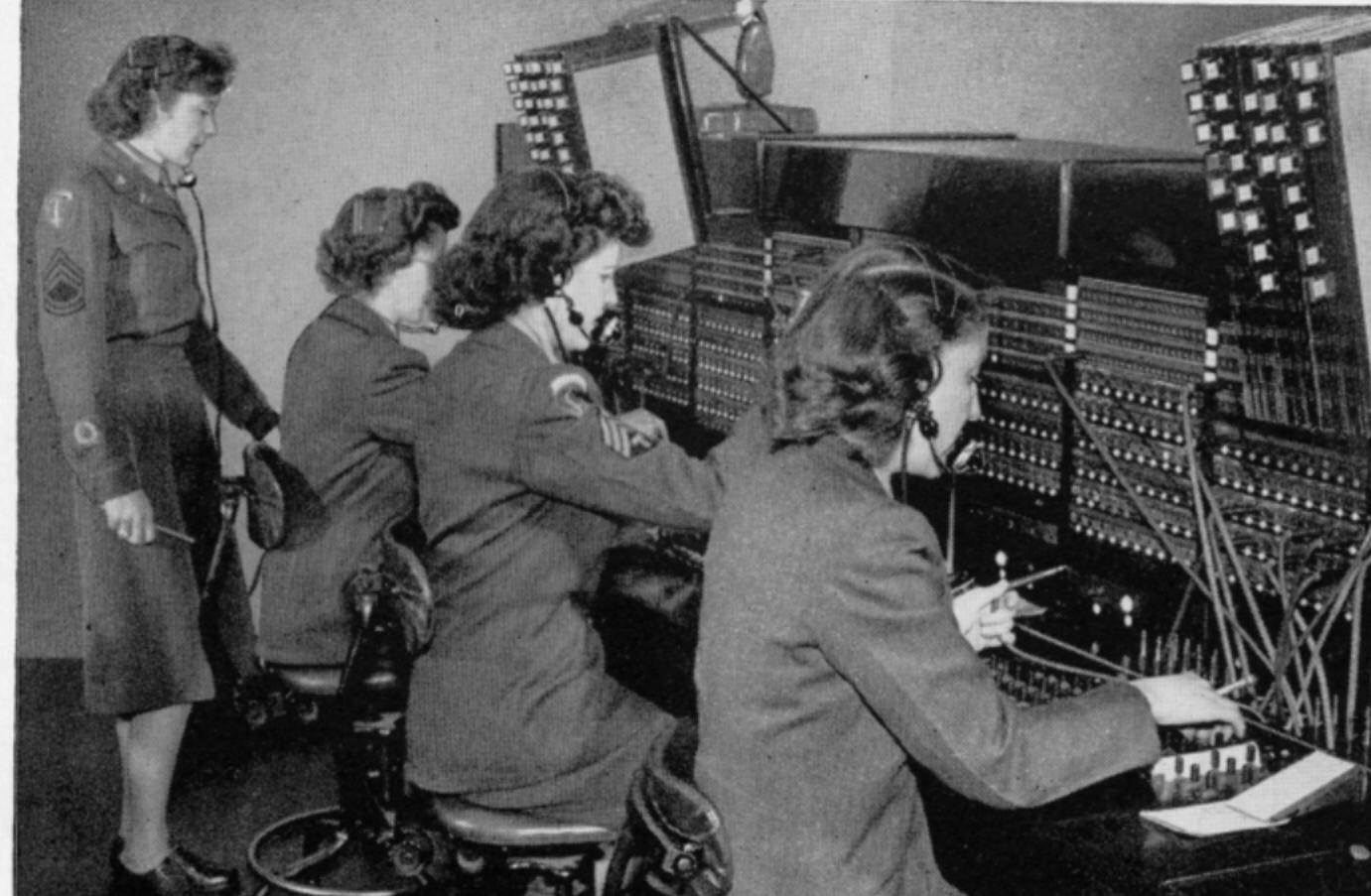
Women filled the void left by men who either joined or were drafted into the military after Pearl Harbor. Factories converted to wartime production needed workers so, out of necessity, they hired women. Jobs formerly reserved for men opened up for women. Females worked in factories, hospitals, offices, and farms. And some of them joined the military. Of course, it took an act of Congress to allow women into the armed services, but with strong enemies across the Atlantic and Pacific the U. S. needed to utilize all its resources.

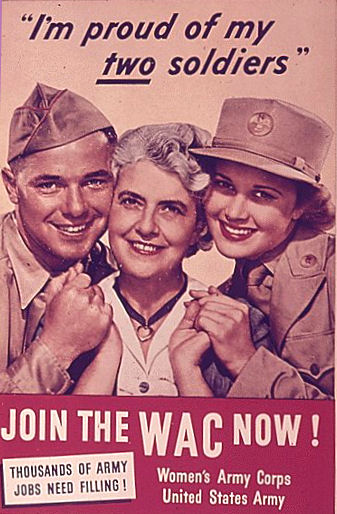
Before 1942 women who supported the military worked as civilians, except for Army Nurses. With Congressional authorization the Navy established the WAVES (Women Accepted for Voluntary Emergency Services) and the Coast Guard SPARS (Semper Paratus – Always Ready) as part of the Department of the Navy. The Army chose to create two “auxiliary” units, the Womens Auxiliary Army Corps (WAAC) and the Womens Airforce Service Pilots (WASP).  These women’s auxiliaries had separate command structures, they were paid less than men, and they had no military benefits like life insurance or veterans medical benefits.  With WAAC’s being sent overseas, the Army recognized the problems and in 1943 the Women’s Army Corps was authorized as an official part of the Regular Army. But the WASP never gained the same status and it was disbanded in December, 1944. Authorization for women in the WAC, WAVES, and SPARS only lasted for the “duration plus six months.” At that time these women’s’ military organizations ceased to exist.

After much political discussion the WAC was reinstated in 1947. Many today may not realize that women remained segregated from the regular Army until 1978. Yes, it was post Vietnam when the separate Women’s Army Corps was abolished and women were integrated into the regular Army.

In the 1940’s many across America opposed women serving in the military. Back then most believed that a woman’s place was in the home. Culturally it was difficult for both men and women to accept. Many female enlistees were accused of being immoral or gay. Some men refused to let their wives, girl friends, daughters or sisters join up. But other families supported and encouraged their young women to do their patriotic duty.

First Lady Eleanor Roosevelt threw her support behind the women who volunteered to serve. The media used advertising to promote images of  women in uniform and Hollywood made movies depicting beautiful starlets serving in the various branches of the armed forces. Thousands of women answered the call.

What was it like for those first female soldiers? Seeing women in uniform was a new experience for everyone. Young ladies donned newly designed, skirted uniforms, little green sear-sucker fatigue dresses for their rigorous physical training and twill jumpsuits or coveralls for heavier work. Girls left home for the first time and found themselves  living in open barracks with no privacy, not even in the shower. They learned to march in step, keeping the seams of their heavy cotton stockings straight. Long hikes carrying heavy packs toughened the most feminine. Failing inspections drew the dreaded gigs and led to extra hours of KP (Kitchen Police) duty. In basic training male instructors taught them military regulations and procedures until enough women were trained and available to take over. Many specialized training courses took place on college campuses where the military  commandeered both space and teachers. Others trained alongside the men. Unlike modern female soldiers, the WAC’s of WWII were considered non-combatants so they were not trained to shoot or handle weapons.

In researching my latest work-in-progress I read some memoirs that give  fascinating, first- hand accounts of WAC’s wartime experiences. “Call of Duty, A Montana Girl in World War II” by Grace Porter Miller, “Mollie’s War” by Mollie Weinstein Schaffer, and “One Woman’s War, Letters Home from the Women’s Army Corp 1944-1946” by Anne Bosanko Green give three diverse accounts of Army life during the war.

And to answer my other question, my mother did clerical work as a civilian at several military bases as she followed my father from one post to another. My dad and two of his three brothers served in the Army, while the third worked in a defense plant. My mother’s sisters also worked in defense plants. So no WAC’s or WAVES in my immediate family. But my sister’s mother-in-law served in the WAC’s. The woman was quite a character and I wish I had had the opportunity to talk to her about her military service and her experiences during World War II before she died.  The “Greatest Generation,” both men and women, are quickly dying off and they take with them the stories of their service to their country so many years ago.

Today’s female soldiers, as well as all American women who work outside the home, benefit from what these brave women did during World War II. They stepped up and proved that they were capable of doing almost any job. I believe that the women’s movement had its origins in the mothers who, after the war, told their daughters they could do any thing they wanted to do. The women of the Greatest Generation believed it because of what they did in helping to win the war.

Irish Celebration – Erin, Tennessee

Every year at St. Patrick’s Day my hometown of Erin, Tennessee, holds an Irish Celebration.  The celebration honors the Irish roots of the community and, during the Celebration, everyone in town is Irish.

In March 2011, we attended the annual parade. Thousands lined the main street to watch. Both before and afterward celebrants enjoyed the food, music, carnival and crafts.

Irish Day Parade 2011
St. Patrick Leads the Parade

Weather in March doesn’t always cooperate, but in 2011 bright sunshine blessed the celebration. Main Street was closed at 9:30, and by 10 the local wee ones dressed as leprecans began the long treck through the center of town. Traditionally, the children’s parade leads the way. Youngsters dressed in every shade of green walked and rode assorted vehicles past the crowds of onlookers.

St. Patrick himself, portrayed by a local pastor, led the main event. Continental soldiers carried the colors flanked by Tennessee frontiersmen. The parade lasted more than two hours and included everything imaginable. The local high school band plus a naval band and two separate bagpipe units provided music. Local beauties, from infants to teens, rode in convertibles, in pickups and on floats. Firetrucks and military vehicles added color. Members of a Middle Tennessee Miata club showcased their vehicles. Clowns entertained, while vendors hawked their wares.

Bagpipes add to Irish Celebration

Every Shriner unit in Tennessee must have joined the celebration. Motorcycles, mini-cars, buses filled with clowns, and other assorted vehicles circled and roared through town providing lots of fun for all.

Clown in Parade

A highlight of the parade for me was a flat-bed truck carrying civil war vintage cannon and re-enactors. Confederate infantrymen marched behind the truck and periodically fired their rifles. Many parade goers were startled by the loud volleys. Quite impressive.

The parade would not have been complete without the numerous floats portraying the annual theme. Proud owners rode beautiful horses and drove antique tractors. Almost every unit tossed candy and beads to the crowd sending kids scurrying to retrieve the goodies. My hometown really put on a fabulous parade enjoyed by all.

Wearin' o' the Green

Both before and after the parade people crowded into the downtown area where numberous stalls sold all types of food, crafts, and souveniers. Artists and craftsmen displayed their works. Bands provided music and the carnival rides served up thrills and screams of delight.

This annual event provides families and old friends the opportunity to get together during high school class reunions and family reunions. This year’s parade is scheduled for Saturday, March 17, 2012. Come early and enjoy the day.

Grandfather’s Books

My Grandfather

I recently unboxed some of my grandfather’s old books. Since he died years before I was born, these books provide a connection to a man I never knew. They represent a part of my family history and a reason for my lifelong love of books.

Until his death in 1920, my grandfather accumulated books. Inside each cover he either stamped or wrote his name so that everyone would know it belonged in his library. Since the small community had no public library, he would loan out books to students or friends. But he kept track of them and ensured they were returned.

Picture barrister bookshelves with glass doors covering one whole wall, floor to 12-foot ceiling, in my grandmother’s living room. More books filled shelves and cabinets throughout the house. This awe-inspiring world of books impressed upon me the value of the written word.

After her husband’s death, my grandmother meticulously maintained the library. I can see her holding the big, hand-written journal that listed every book and its location on the shelves.

By the time I reached high school, my grandmother deemed me responsible enough to borrow a book, but she always made sure I returned it. As she aged it became harder for her to keep track of the books. Gradually some went missing or were misplaced on the shelves.

Cousins with books

My bachelor uncle lived with my grandmother. As the youngest child, born after his father’s death, he continued to live in the home place after his mother’s passing in 1977 and became the custodian of the library. My uncle was brilliant and yet not quite normal. He lacked his parents’ sense of order and probably had some mental disorder. Over the years we have speculated on his possible diagnosis but, of course, we will never know. His original condition was exacerbated by his stint in the Army during World War II. Drafted, he never made it through basic training. He was hospitalized by the army until war’s end, then given a disability. According to my parents, he was never the same. When I read “To Kill a Mockingbird,” I immediately associated my uncle with Boo Radley. All the kids in town were either afraid of him or made fun of him. To me he was just my uncle, a little different, but part of our family.

Always suspicious of people, my uncle let few people into the house after his mother’s death. He knew more about family and local history than anyone around. He would have loved computers and the internet, if they had been around back then. And he might have had many online friends, instead of the few people in town who would talk to him.  In his latter years, a local man gained his confidence and convinced my uncle to lower the ceilings in the old house to save on his heat bill. To do the work everything had to be moved. Things went missing in the confusion, including some of the books. By the time my uncle figured out that the man was taking advantage of him, the damage was done – to the house, to the antiques and to the books.

After my uncle’s death, my brother and sister-in-law went through the house, inventoried everything and arranged for a sale. (Bless them for their hard work.) As the youngest of nine and with no children, the estate had to be divided up over many nieces and nephews, great-nieces and great-nephews.

The boxes of books I purchased at the sale are the ones I finally unboxed and put on my bookshelves. I have sets of books by Jules Verne, Bret Harte, Victor Hugo (including Les Miserables), Edgar Rice Burroughs (Tarzan),  Winston Churchill (yes he apparently wrote fiction), Rudyard Kipling and other less-familiar authors published around 1900. There are books by James Fenimore Cooper, essays and poems by Ralph Waldo Emerson, a history of the Italian earthquake of 1908 and a history of the Cuban struggle for independence.

Many other authors filled my grandfather’s library.  His interests were diverse and provide some insight into who he was. I remember Edgar Allen Poe, Alexander Dumas, Robert Louis Stevenson, a huge dictionary and a 1903 Encyclopedia Britannica, to name just a few.  In a time with no television or computers, when radio and movies were strange novelties, the library provided entertainment as well as knowledge to my grandparents and their children. For me, his books open a window into the past.

With all the talk today about e-books, e-readers and the demise of books as we know them, I wonder what today’s readers will leave behind. Will they simply delete the electronic files after they read them? Will they even think about transferring the files to someone else? Even paperbacks can be passed on to others. Why not e-books?

Although my old books have been damaged by dust, heat, humidity and the deteriorating acid paper, they can still be read. They have provided a legacy to several generations by inspiring a love of learning and literature. I believe that children who grow up surrounded by books, who are read to and who see their parents and grandparents reading will become readers themselves. Technology is wonderful, but I think books will be around for a long time.

B-17 or B-24?

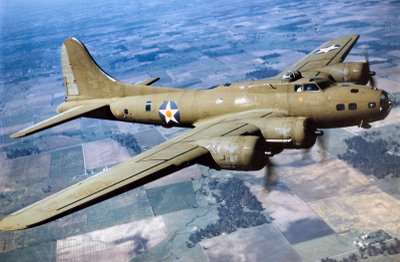
During WWII, the two bombers that carried the load in European air war for the Americans were the B-17 Flying Fortress and the B-24 Liberator. In my latest work-in-progress I am trying to decide which airplane my hero/navigator would have flown.  My first thought was to use the B-17 since it seemed more glamorous, but with more research about both planes, I found that the Liberator was quite a plane, too. After all, Jimmy Stewart flew the B-24. How’s that for glamor?

Boeing B-17 Flying Fortress
Almost everyone has heard of the iconic B-17. When we think of bombers of that era, images come to mind of planes shot full  of holes, with sections blown off and engines not functioning, yet landing safely on air fields in England. Those images are usually of B-17’s. Its crews loved the Flying Fortress because it took lots of damage and still brought them home.

Memphis Belle

Anyone remember the Memphis Belle? It was the first bomber that finished the required 25 missions in 1943. (Mission requirements were increased to 30 and then to 35 in 1944)  Major William Wyler, the famous director and movie maker, as part of the First Motion Picture Unit of the US Army Air Forces, directed a film depicting the final flight of the Memphis Belle. The footage became the documentary “The Memphis Belle: A Story of a Flying Fortress.”  As a morale booster for the Army and the folks back home, the crew, the plane and the movie toured the US selling war bonds and recruiting flyers for the Army Air Force. In 1990, Hollywood made a movie about that last flight, “The Memphis Belle.” Both films depict the lives of bomber crews in WWII and are well worth seeing.

Consolidated B-24 Liberator
But what about the B-24 Liberator? In researching accounts of WWII  bomber crew members, I discovered that Jimmy Stewart (Yes! the movie star) flew combat missions over Europe in B-24’s. Starr Smith wrote in “Jimmy Stewart Bomber Pilot”about Jimmy enlisting before the war even started. He earned his wings and became an instructor flying B-17’s. Apparently the military feared Stewart would be  harmed if sent overseas, which frustrated Stewart. Finally in 1943 his wish for combat duty came true with his assignment to the 445th Bomber Group, part of the Eighth Air Force.  He quickly learned to fly the B-24 and within months received orders for England. Captain Stewart commanded the 703rd Squadron of the 445th Bomber Group and regularly flew combat missions. Promoted to Major and transferred to the 453rd Bomber Group as Operations Officer, Stewart continued to fly combat missions, including flying on D-Day (June 6, 1944). In July 1944, Lt. Colonel Stewart’s transfer to Second Combat Wing Headquarters severely limited his combat flying.  In his twenty-three months overseas, Stewart flew 20 combat missions over Europe, all in B-24 Liberators.

Jimmy Stewart
Data for a head to head comparison of the B-17 and the B-24 can be found on several websites for anyone who likes statistics.  One interesting difference I found was that the B-17 was slower than the B-24.  The difference in speed meant that the two bombers could not fly in the same formations, although they were often sent on the same missions.  But the B-17 could fly at higher altitudes. There is no doubt that the Flying Fortress crews and the Liberator crews each believed their plane the best and maintained an ongoing, good-natured rivalry.

Some believe that the B-17 got better press during the war and many thought it a better looking plane. It is definitely the one most people associate with WWII.

So, which plane will I use in my book? I haven’t decided. But I’m leaning toward the B-24 because it’s less known and because I have found some good books to use as reference material. Among them are:  “A Reason To Live” by John Harold Robinson who flew as a gunner and engineer on a B-24; “Lucky Penny’s Tail” by Gregory J. Matenkoski recounting the story of Edmund Survilla, a tail gunner on a B-24; and “Jimmy Stewart Bomber Pilot” by Starr Smith.

For additional research, I plan to travel to Savannah, Georgia, to visit the Mighty Eighth Air Force Museum sometime in the near future. This museum should give me additional details and insight into the WWII air war.  Wouldn’t I love to take a ride on one of those old planes? I’m watching for an opportunity.